
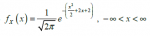
a hard integral: f_X(x) = (1/sqrt[2pi]) * e^(-(x^2/2 + 2x +2))

maryam

New member
Joined
Dec 26, 2016
Messages
1
Hi everyone...
for solving a probability problem first I need to solve this integral.

. . . . .\(\displaystyle \large{ f_X(x)\, =\, \dfrac{1}{\sqrt{\strut 2\pi \,}}\, e^{-\left(\frac{x^2}{2} + 2x + 2\right)},\, -\infty\, <\, x\, <\, \infty }\)

I searched as much as I can for a even sketchy solution but I did not find anything

I found this solution:

. . . . .\(\displaystyle \large{ \displaystyle \int_{-\infty}^{\infty}\, xe^{-a (x - b)^2}\, dx\, =\, b\, \sqrt{\dfrac{\pi}{a}\,} }\)

but I do not know how to convert that to this way or even if this is the right way to solve or not
 

Attachments
  • 6542.PNG
    6542.PNG
    4.1 KB · Views: 9
  • 8111.PNG
    8111.PNG
    4.8 KB · Views: 9
Last edited by a moderator:
for solving a probability problem first I need to solve this integral.

. . . . .\(\displaystyle \large{ f_X(x)\, =\, \dfrac{1}{\sqrt{\strut 2\pi \,}}\, e^{-\left(\frac{x^2}{2} + 2x + 2\right)},\, -\infty\, <\, x\, <\, \infty }\)

I searched as much as I can for a even sketchy solution but I did not find anything

I found this solution:

. . . . .\(\displaystyle \large{ \displaystyle \int_{-\infty}^{\infty}\, xe^{-a (x - b)^2}\, dx\, =\, b\, \sqrt{\dfrac{\pi}{a}\,} }\)

but I do not know how to convert that to this way or even if this is the right way to solve or not
Okay, I'm confused... You need to solve an integral... which does not involve an integrand. You've found nothing even close to leading to a solution, but you've also found the answer. You don't know how to do something or other with... something ("that") with relation to... something else ("this"). And you think the answer you found (in the back of the book...?) is wrong, though you have no idea what might be right.

Please reply with clarification. Thank you! ;)
 
Hi everyone...
for solving a probability problem first I need to solve this integral.

. . . . .\(\displaystyle \large{ f_X(x)\, =\, \dfrac{1}{\sqrt{\strut 2\pi \,}}\, e^{-\left(\frac{x^2}{2} + 2x + 2\right)},\, -\infty\, <\, x\, <\, \infty }\)
I take it you mean that \(\displaystyle f_X(x)\) is the integrand. That is, that the integral itself is
\(\displaystyle \dfrac{1}{\sqrt{\strut 2\pi \,}}\, \large{\int_{-\infty}^\infty}e^{-\left(\frac{x^2}{2} + 2x + 2\right)}dx\)

I searched as much as I can for a even sketchy solution but I did not find anything

I found this solution:

. . . . .\(\displaystyle \large{ \displaystyle \int_{-\infty}^{\infty}\, xe^{-a (x - b)^2}\, dx\, =\, b\, \sqrt{\dfrac{\pi}{a}\,} }\)[/tex]
The problem is that the "x" outside the exponential makes this a much simpler integral- it allows you to substitute for the quadratic. Without that, this cannot be integrated in terms of "elementary functions". You need to treat this in terms of the Gaussian integral, \(\displaystyle \int e^{-x^2} dx\). That, again, cannot be integrated in terms of "elementary functions" but can be written in terms of the "error function", erf(x), defined simply as \(\displaystyle erf(x)= \int_{-\infty}^x\int e^{-t^2} dt\)

but I do not know how to convert that to this way or even if this is the right way to solve or not

However, the definite integral \(\displaystyle \int_{-\infty}^{\infty} e^{-x^2} dx\) can be done, by changing to polar coordinates and gives a value of 1.

To do your integral, \(\displaystyle \dfrac{1}{\sqrt{\strut 2\pi \,}}\, \large{\int_{-\infty}^\infty}e^{-\left(\frac{x^2}{2} + 2x + 2\right)}dx\) complete the square in the exponent. \(\displaystyle \frac{x^2}{2}+ 2x+ 1= \frac{1}{2}(x^2+ 4x)+ 1= \frac{1}{2}(x^2+ 4x+ 4- 4)+ 1= \frac{1}{2}(x+ 2)^2- 1\).

Letting u= x+ 2, the integral becomes
\(\displaystyle \dfrac{1}{\sqrt{\strut 2\pi \,}}\,e^{-1}\int_{-\infty}^{\infty}e^{-u^2}du= \frac{e^{-1}{\sqrt{2\pi}}\)
 
Last edited:
Hi everyone...
for solving a probability problem first I need to solve this integral.

. . . . .\(\displaystyle \large{ f_X(x)\, =\, \dfrac{1}{\sqrt{\strut 2\pi \,}}\, e^{-\left(\frac{x^2}{2} + 2x + 2\right)},\, -\infty\, <\, x\, <\, \infty }\)

I searched as much as I can for a even sketchy solution but I did not find anything

I found this solution:

. . . . .\(\displaystyle \large{ \displaystyle \int_{-\infty}^{\infty}\, xe^{-a (x - b)^2}\, dx\, =\, b\, \sqrt{\dfrac{\pi}{a}\,} }\)

but I do not know how to convert that to this way or even if this is the right way to solve or not
Why are you searching for solutions? Did you ever think that thinking and trying might yield better results then searching? I studied calculus and there were no videos on the internet. Actually there was no internet when I *studied* calculus.
 
Top