
Hi everyone, i am new here at the forum, i have to register because i have two problems that i can't do, ussually i use symbolab to solve the equations but lately, they are focusing more in a "textual" way to put the problems and that it is really complicated for me, i hope that you can lend me a hand with this, i would like to know how to declare it on software like symbolab or wolfram mathematica to get the right answer.
this is one of the problems:
This type of questions consists of a statement, problem or context from which four options numbered from 1 to 4 are proposed, you must select the combination of two options that adequately answers the question and mark it on the answer sheet, according to with the following information:
• Mark A if 1 and 2 are correct.
• Mark B if 1 and 3 are correct.
• Mark C if 2 and 4 are correct.
• Mark D if 3 and 4 are correct.
A. One of the methods of solving ordinary differential equations of the first order is the integration factor, which involves a factor , that by multiplying the O.D.E. the transformation allowed by direct integration or transformation into an O.D.E. Exact That is, if it is true that
  is exact.
A procedure for supplying a medicament in the blood, that is, permanently by an injection technique. This method can be modeled by the differential equation , where C(t)= Drug concentration at each instant t, plus P, J and k are constants that represent the characteristics of the process and patient-specific conditions.
Given the above information, it can be stated that:
When solving the model that meets the initial condition C(0)=1, we obtain:
The general solution, which is: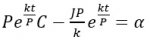
The particular solution, which is: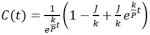
The general solution, which is:
The particular solution, which is: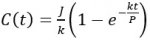
I Will post the another problema later, because i can not attach more images. I really appreciate the help, i am really bad with maths,
Following the given advice, i put the other excersice in plain text:
b. A differential expression of the form M (x, y) dx + N (x, y) of is known as the exact differential equation in a region R of the xy plane, if it corresponds corresponds to the differential function of function f (x, y) Defined in R. A first order differential equation of the form: M (x, y) dx + N (x, y) dy = 0 It is said to be an exact equation if the expression on the left side is an exact exact one. The criterion for an exact verification is: Let M (x, y) and N (x, y) be continuous and have first continuous partial derivatives in a rectangular region R defined by a <x <b, c <and <d. So, a necessary and sufficient condition for M (x, y) dx + N (x, y) dy to be an exact verification is:
/M / ∂y = ∂N / ∂x
According to the previous information to the problem the differential equation (5x + 4y) dx + (4x-8y ^ 3) dy = 0 by this method we obtain that the values for ∂M / ∂y, ∂N / ∂x and the solution The general differential equation are respectively:
∂M / ∂y = ∂N / ∂x = 5 + 24y ^ 2
f (x, y) = (5/2) x ^ 2 + 5xy + 24y ^ 2
f (x, y) = (5/2) x ^ 2 + 4xy-2y ^ 4
∂M / ∂y = ∂N / ∂x = 4
Thank you in advance,
John.
this is one of the problems:
This type of questions consists of a statement, problem or context from which four options numbered from 1 to 4 are proposed, you must select the combination of two options that adequately answers the question and mark it on the answer sheet, according to with the following information:
• Mark A if 1 and 2 are correct.
• Mark B if 1 and 3 are correct.
• Mark C if 2 and 4 are correct.
• Mark D if 3 and 4 are correct.
A. One of the methods of solving ordinary differential equations of the first order is the integration factor, which involves a factor
, that by multiplying the O.D.E. the transformation allowed by direct integration or transformation into an O.D.E. Exact That is, if it is true that is exact.A procedure for supplying a medicament in the blood, that is, permanently by an injection technique. This method can be modeled by the differential equation
, where C(t)= Drug concentration at each instant t, plus P, J and k are constants that represent the characteristics of the process and patient-specific conditions.Given the above information, it can be stated that:
When solving the model that meets the initial condition C(0)=1, we obtain:
The general solution, which is:
The particular solution, which is:
The general solution, which is:
The particular solution, which is:
I Will post the another problema later, because i can not attach more images. I really appreciate the help, i am really bad with maths,
Following the given advice, i put the other excersice in plain text:
b. A differential expression of the form M (x, y) dx + N (x, y) of is known as the exact differential equation in a region R of the xy plane, if it corresponds corresponds to the differential function of function f (x, y) Defined in R. A first order differential equation of the form: M (x, y) dx + N (x, y) dy = 0 It is said to be an exact equation if the expression on the left side is an exact exact one. The criterion for an exact verification is: Let M (x, y) and N (x, y) be continuous and have first continuous partial derivatives in a rectangular region R defined by a <x <b, c <and <d. So, a necessary and sufficient condition for M (x, y) dx + N (x, y) dy to be an exact verification is:
/M / ∂y = ∂N / ∂x
According to the previous information to the problem the differential equation (5x + 4y) dx + (4x-8y ^ 3) dy = 0 by this method we obtain that the values for ∂M / ∂y, ∂N / ∂x and the solution The general differential equation are respectively:
∂M / ∂y = ∂N / ∂x = 5 + 24y ^ 2
f (x, y) = (5/2) x ^ 2 + 5xy + 24y ^ 2
f (x, y) = (5/2) x ^ 2 + 4xy-2y ^ 4
∂M / ∂y = ∂N / ∂x = 4
Thank you in advance,
John.
Attachments



Last edited:
