
You are using an out of date browser. It may not display this or other websites correctly.
You should upgrade or use an alternative browser.
You should upgrade or use an alternative browser.
Hot to calculate these type of probability
- Thread starter raymond
- Start date
HallsofIvy
Elite Member
- Joined
- Jan 27, 2012
- Messages
- 7,760
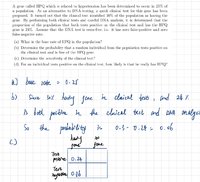
You have (a) and (b) correct. For (c) what is the definition of "sensitivity" of a test?
Indeed, it is the proportion of patients with disease who test positiveYou have (a) and (b) correct. For (c) what is the definition of "sensitivity" of a test?

Dr.Peterson
Elite Member
- Joined
- Nov 12, 2017
- Messages
- 16,974
Where did you get the 0.16 you put in the table? That would imply that 40% of the population have the gene.
sorry, maybe my handwriting is not clear. Indeed, it is 0.76Where did you get the 0.16 you put in the table? That would imply that 40% of the population have the gene.
Dr.Peterson
Elite Member
- Joined
- Nov 12, 2017
- Messages
- 16,974
But that would imply that 100% of the population have the gene! It should be 25%.
I wonder if you are using the table differently than it is intended.
I wonder if you are using the table differently than it is intended.
I just conduct it by the given data. Maybe the table is wrong. Actually, I have no idea in this questionBut that would imply that 100% of the population have the gene! It should be 25%.
I wonder if you are using the table differently than it is intended.
Dr.Peterson
Elite Member
- Joined
- Nov 12, 2017
- Messages
- 16,974
Can you show me an example of that type of table, filled in fully, from an example you have been given? I need to know what you have been taught about it, which could be different from what I would mean by it.
What I expect of the table is that each entry shows the percent of the entire population that meet the criterion. The top left entry is the percent who have the gene and test positive. The lower left entry should be the percent who have the gene and test negative, not the percent who do not both have the gene and test negative.
The sum of all entries should be 100%; any one column should not total 100%.
Is that different from what you have been taught about such a table?
What I expect of the table is that each entry shows the percent of the entire population that meet the criterion. The top left entry is the percent who have the gene and test positive. The lower left entry should be the percent who have the gene and test negative, not the percent who do not both have the gene and test negative.
The sum of all entries should be 100%; any one column should not total 100%.
Is that different from what you have been taught about such a table?
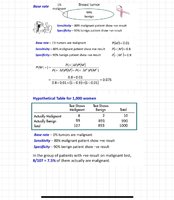
In my course, it has mentioned an example like the below image. And your explaining is correctCan you show me an example of that type of table, filled in fully, from an example you have been given? I need to know what you have been taught about it, which could be different from what I would mean by it.
What I expect of the table is that each entry shows the percent of the entire population that meet the criterion. The top left entry is the percent who have the gene and test positive. The lower left entry should be the percent who have the gene and test negative, not the percent who do not both have the gene and test negative.
The sum of all entries should be 100%; any one column should not total 100%.
Is that different from what you have been taught about such a table?
Dr.Peterson
Elite Member
- Joined
- Nov 12, 2017
- Messages
- 16,974
Thanks.
Do you see that (although this example uses actual counts rather than percentages) the total of each column is the number that fit the heading of the column, and the total of all the numbers is the total number of people?
So do you see that it is wrong in your problem for the first column to be 0.24 + 0.76, which adds up to 1.00 (100%)?
What should the sum of that column really be? Finish your table, and answer the question, so we can discuss it further.
Do you see that (although this example uses actual counts rather than percentages) the total of each column is the number that fit the heading of the column, and the total of all the numbers is the total number of people?
So do you see that it is wrong in your problem for the first column to be 0.24 + 0.76, which adds up to 1.00 (100%)?
What should the sum of that column really be? Finish your table, and answer the question, so we can discuss it further.
Is it the sum of column should be the percentage of the people who have HPQ gene?Thanks.
Do you see that (although this example uses actual counts rather than percentages) the total of each column is the number that fit the heading of the column, and the total of all the numbers is the total number of people?
So do you see that it is wrong in your problem for the first column to be 0.24 + 0.76, which adds up to 1.00 (100%)?
What should the sum of that column really be? Finish your table, and answer the question, so we can discuss it further.
Dr.Peterson
Elite Member
- Joined
- Nov 12, 2017
- Messages
- 16,974
Yes. And that number is ... ?
0.25?Yes. And that number is ... ?
Dr.Peterson
Elite Member
- Joined
- Nov 12, 2017
- Messages
- 16,974
Yes. Can you continue?
So it should be 0.24 and 0.01 respectivelyYes. Can you continue?
Dr.Peterson
Elite Member
- Joined
- Nov 12, 2017
- Messages
- 16,974
So, what is the rest of the table, and what answers do you get for parts (c) and (d)? Please do as much as you can rather than wait for a response after each tiny step, to avoid wasting time. We can make faster progress if you are bold.
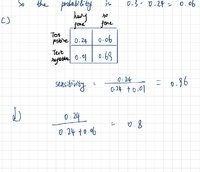
Should it be in this way?So, what is the rest of the table, and what answers do you get for parts (c) and (d)? Please do as much as you can rather than wait for a response after each tiny step, to avoid wasting time. We can make faster progress if you are bold.
Dr.Peterson
Elite Member
- Joined
- Nov 12, 2017
- Messages
- 16,974
Beautiful!
So the test detects 96% of people with the gene; but only 80% of those who test positive actually have the gene.
So the test detects 96% of people with the gene; but only 80% of those who test positive actually have the gene.
Yes!Thx for your guidance.thx?Beautiful!
So the test detects 96% of people with the gene; but only 80% of those who test positive actually have the gene.