
You are using an out of date browser. It may not display this or other websites correctly.
You should upgrade or use an alternative browser.
You should upgrade or use an alternative browser.
Probability problem
- Thread starter Darya
- Start date

pka
Elite Member
- Joined
- Jan 29, 2005
- Messages
- 11,978
Think: Triangle inequality.We randomly choose 2 numbers a,b from an interval a,b Є (0;2). What's the probability that a triangle with sides a,b,1 exists? I don't understand how we can calculate probability since in that interval we have infinite numbers. Any ideas?
Look Here What does that have to do with this problem?

Dr.Peterson
Elite Member
- Joined
- Nov 12, 2017
- Messages
- 16,974
if you've only learned about discrete probability, this would be difficult. One way to think about this is graphical: make a square in which x is between 0 and 2, and y is between 0 and 2. What points in this square represent pairs of numbers for which the triangle can be made? The probability is the ratio of the area of that region to the area of the whole square, because any point in the square is equally likely to be chosen.
Thank you for answering and sorry for the late reply. X must lie in the interval (0;2), right? So is it 2/3?Easier problem: we randomly choose x from (0; 3). What's the probability that a triangle with sides 1, 1, x exists?
Dr.Peterson
Elite Member
- Joined
- Nov 12, 2017
- Messages
- 16,974
Please show the square you drew, or whatever other work you did. You have not shown any reason for your answer of 2/3.
As I said, this is very difficult if you have never seen anything like it. It will help if you tell us what you have learned, and why you are working on this problem, which surely would not have been assigned to a class you are taking. We need to know what we can assume you know, in our answers.
As I said, this is very difficult if you have never seen anything like it. It will help if you tell us what you have learned, and why you are working on this problem, which surely would not have been assigned to a class you are taking. We need to know what we can assume you know, in our answers.

lev888
Elite Member
- Joined
- Jan 16, 2018
- Messages
- 2,991
Correct, but please see post #6.Thank you for answering and sorry for the late reply. X must lie in the interval (0;2), right? So is it 2/3?
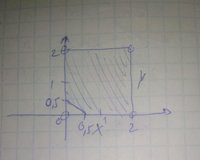
I'm only in high school and we really were never given such problems. Those are from entering exams of a university abroad and I see what we learn is far not as advanced. This is though the only problem I have difficulty with for now.Please show the square you drew, or whatever other work you did. You have not shown any reason for your answer of 2/3.
As I said, this is very difficult if you have never seen anything like it. It will help if you tell us what you have learned, and why you are working on this problem, which surely would not have been assigned to a class you are taking. We need to know what we can assume you know, in our answers.
I'm not sure where that dividing line should be.
Attachments
Dr.Peterson
Elite Member
- Joined
- Nov 12, 2017
- Messages
- 16,974
I'm only in high school and we really were never given such problems. Those are from entering exams of a university abroad and I see what we learn is far not as advanced. This is though the only problem I have difficulty with for now.
I'm not sure where that dividing line should be.
Thanks for confirming my guesses about your background.
You have the right idea, but the triangle inequality works for each of the sides of the triangle. If the sides are a, b, and 1, then
a + b > 1
a + 1 > b
b + 1 > a
Graph all three of these (the one you drew is not quite right), and you'll be on the right track.
Got it! The area of the square is 4, the area of the is 4-3*0,5=2,5. So it's 5/8. Thanks a lot for your patience and help!Thanks for confirming my guesses about your background.
You have the right idea, but the triangle inequality works for each of the sides of the triangle. If the sides are a, b, and 1, then
a + b > 1
a + 1 > b
b + 1 > a
Graph all three of these (the one you drew is not quite right), and you'll be on the right track.
Dr.Peterson
Elite Member
- Joined
- Nov 12, 2017
- Messages
- 16,974
Sounds like you probably have the right picture.
Now, if you'd like to learn more about this kind of problem, search for Geometric Probability (but not the geometric probability distribution).
Here is one good source, with many examples: https://brilliant.org/wiki/1-dimensional-geometric-probability/
Here is a shorter introduction: https://www.cut-the-knot.org/Probability/GeometricProbabilities.shtml
Now, if you'd like to learn more about this kind of problem, search for Geometric Probability (but not the geometric probability distribution).
Here is one good source, with many examples: https://brilliant.org/wiki/1-dimensional-geometric-probability/
Here is a shorter introduction: https://www.cut-the-knot.org/Probability/GeometricProbabilities.shtml
I couldn't be thankful enough!Sounds like you probably have the right picture.
Now, if you'd like to learn more about this kind of problem, search for Geometric Probability (but not the geometric probability distribution).
Here is one good source, with many examples: https://brilliant.org/wiki/1-dimensional-geometric-probability/
Here is a shorter introduction: https://www.cut-the-knot.org/Probability/GeometricProbabilities.shtml