
shortest path problem

eboolean

New member
Joined
May 23, 2020
Messages
7
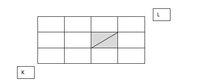
In the figure below, all the lines surrounding the squares show the streets and streets of a city that intersect each other.

The shaded area shows an artificial lake and the diagonal above it shows the bridge open to traffic on the lake.

Accordingly, how many different ways can you go from K to L in the shortest path?
k-lyolu.jpg
 
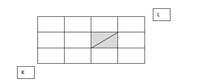
In the figure below, all the lines surrounding the squares show the streets and streets of a city that intersect each other.

The shaded area shows an artificial lake and the diagonal above it shows the bridge open to traffic on the lake.

Accordingly, how many different ways can you go from K to L in the shortest path?
View attachment 20003

Please show us what you have tried and exactly where you are stuck.

Please follow the rules of posting in this forum, as enunciated at:

https://www.freemathhelp.com/forum/threads/read-before-posting.109846/#post-486520

Please share your work/thoughts about this assignment.

1593172877693.png
 
In the figure below, all the lines surrounding the squares show the streets and streets of a city that intersect each other.

The shaded area shows an artificial lake and the diagonal above it shows the bridge open to traffic on the lake.

Accordingly, how many different ways can you go from K to L in the shortest path?
View attachment 20003
A good start will be to show us what you think a "shortest path" will look like. (The wording is odd, as there is clearly not one "the" shortest path.)
 
Would the set of shortest paths all use the bridge, all avoid the bridge, or could they be a mix (of some using the bridge and some not using the bridge)?
 
Since using the bridge takes one step rather than two I would say that any path using the bridge will require 6 steps while any other path will require at least seven steps. So the shortest path will be from K to the bridge, across the bridge, then to L To go from K to the bridge you have to use one of those vertical paths- there are three vertical paths so three possible ways. To go from the bridge to L you must take one of the two vertical paths so there are two such ways. There are a total of 3(2)= 6 such ways.
 
Yes, I was hoping that eboolean would be able to figure at least part of that out without being spoonfed ...
 
  • Like
Reactions: pka
There are simple counting problem.

No Bridge. You need t0 go to the right 4 times and up 3.
Bridge: You need to go to the right 3 times, up 2 and across the bridge.
 
There are simple counting problem. No Bridge. You need t0 go to the right 4 times and up 3.
Bridge: You need to go to the right 3 times, up 2 and across the bridge.
Without using the bridge the number of ways to arrange the string \(EEEENNN\) is the number of paths from K to L in the grid.
Of those paths, how many pass through the south-west corner of the artificial lake?
Well how many ways are there to arrange the string \(EEN\)? After using any one of those paths could then cross the lake bridge.
After crossing the bridge there are only two ways to proceed: \(EN\text{ or }NE\).
 
Top