
distribution of (n + 1) different balls

eboolean

New member
Joined
May 23, 2020
Messages
7
Q: How many ways can (n + 1) different balls be distributed to n boxes provided that "no box remains empty"?
A:

my 1st solution: (can you check me out)
At first we arrange n+1 balls in n box in a way such that each box gets only one ball.so the no of ways to do that is (n+1)P(n)=(n+1)!/(n+1-n)!=(n+1)!

And we are left with 1 extra ball which can go to any one of n boxes.Hence it can be arranged in n ways.

So total no of ways (n+1)!×n.


my 2nd solution (can you check me out)
1593177808732.png
 
Q: How many ways can (n + 1) different balls be distributed to n boxes provided that "no box remains empty"?
A:
my 1st solution: (can you check me out)
At first we arrange n+1 balls in n box in a way such that each box gets only one ball.so the no of ways to do that is (n+1)P(n)=(n+1)!/(n+1-n)!=(n+1)!
And we are left with 1 extra ball which can go to any one of n boxes.Hence it can be arranged in n ways.
So total no of ways (n+1)!×n.
my 2nd solution (can you check me out)
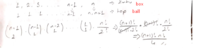
You need to say if the boxes are distinguishable or not.
If the boxes are distinguishable then the answer is \(n!S^{n+1}_n\) where \(S^{n+1}_n\) is a Stirling Number.
 
You arrange the 1st n balls in n! ways, then you place the last ball in one of n places. Answer is n!*n.
 
You arrange the 1st n balls in n! ways, then you place the last ball in one of n places. Answer is n!*n.
No, that will undercount, as it includes only cases in which the last ball shares space with another.
Q: How many ways can (n + 1) different balls be distributed to n boxes provided that "no box remains empty"?
A:

my 1st solution: (can you check me out)
At first we arrange n+1 balls in n box in a way such that each box gets only one ball.so the no of ways to do that is (n+1)P(n)=(n+1)!/(n+1-n)!=(n+1)!

And we are left with 1 extra ball which can go to any one of n boxes.Hence it can be arranged in n ways.

So total no of ways (n+1)!×n.
No, this will overcount. You are assigning a different box to each of n balls, and then assigning a shared box to the remaining one; but you would have made the same assignment if you had swapped the roles of the two balls in the shared box, assigning the last one as one of the n.

So how can you correct for this?

I can't follow your second solution.
 
No, that will undercount, as it includes only cases in which the last ball shares space with another.
No, this will overcount. You are assigning a different box to each of n balls, and then assigning a shared box to the remaining one; but you would have made the same assignment if you had swapped the roles of the two balls in the shared box, assigning the last one as one of the n.
So how can you correct for this? I can't follow your second solution.
What about the difference in Stirling numbers of the first or second kinds?
The poster never told us if the boxes were distinguishable or not.
 
I think it's a reasonable guess that the boxes are meant to be distinguishable (and the OP's attempt seems to imply that), but all we can do is guess until we're told. And if we were given the entire statement of the problem, then the question has to be pushed back to the teacher ...
 
Q: How many ways can (n + 1) different balls be distributed to n boxes provided that "no box remains empty"?
eboolean has not been seen on the forum since yesterday morning early. So now we assume that both the balls & boxes are distinct.
Suppose that the positive integers \(M~\&~N\) are such that \(M\ge N\) If set \(\|A\|=M\) i.e. has M elements and \(\|B\|=N\).
Then \(\displaystyle\sum\limits_{k = 0}^N {{{( - 1)}^k}\dbinom{N}{k}{{(N - k)}^M}} \) is the number of surjections (onto functions) from a set of \(M\) elements to a set of \(N\) elements.
That answers the question if \(m=n+1\).
 
Top