
Which hypothesis formula?

Dragan8ng

New member
Joined
Sep 14, 2020
Messages
17
So i have a table: Farmable land - 0-4, 4-8, 8-12, 12-16 Number of farms: 20, 30, 40 ,10
task: at 99% confidence level, examine if the percentage of farms with 8 and more farmable lands is less than 50%
I tried using the proportions formula but im missing values
 
So i have a table: Farmable land - 0-4, 4-8, 8-12, 12-16 Number of farms: 20, 30, 40 ,10
task: at 99% confidence level, examine if the percentage of farms with 8 and more farmable lands is less than 50%
I tried using the proportions formula but im missing values
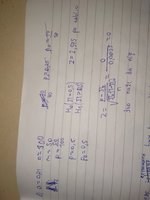
Please tell us how you "tried using the proportions formula".
 
Cant find phat and m and since phat=m/n, doesnt seem to work
Values im finding is n=50 a=0.01 and p0=0.5
 
So i have a table: Farmable land - 0-4, 4-8, 8-12, 12-16 Number of farms: 20, 30, 40 ,10
task: at 99% confidence level, examine if the percentage of farms with 8 and more farmable lands is less than 50%
I tried using the proportions formula but im missing values
Without knowing more about this data there is nothing we can say. Presumably this is not the complete question, if this is so please post the entire question.
 
Cant find phat and m and since phat=m/n, doesnt seem to work
Values im finding is n=50 a=0.01 and p0=0.5
Your n is wrong, and you haven't stated what you got for p-hat. Also, you mentioned a formula, but haven't stated it. We need to see your actual work in order to see what doesn't work.
 
Your n is wrong, and you haven't stated what you got for p-hat. Also, you mentioned a formula, but haven't stated it. We need to see your actual work in order to see what doesn't work.
So n is 100 then?meaning m is 50 so p-hat is 0.5?
 
What do you mean by "all the p values"?

Please just show your formulas and your work, so we can see where your questions are coming from.
 
I'm not sure of the meaning of your terms; you show [MATH]p[/MATH], [MATH]p_0[/MATH], [MATH]\pi[/MATH], and [MATH]\pi_0[/MATH], which are a little different from what I am used to. Can you define them?

But you stopped at the point I thought might be your difficulty; z = 0 is unusual! But continue the work as you normally would, and see what happens! (What do the four words under that mean?)

To my mind, the result is just what I would expect. If you want to decide whether the true proportion is less than 50%, and the sample shows exactly 50%, then it doesn't seem to support the conclusion that it is less than that, does it? I might not even bother doing the analysis.
 
I'm not sure of the meaning of your terms; you show [MATH]p[/MATH], [MATH]p_0[/MATH], [MATH]\pi[/MATH], and [MATH]\pi_0[/MATH], which are a little different from what I am used to. Can you define them?

But you stopped at the point I thought might be your difficulty; z = 0 is unusual! But continue the work as you normally would, and see what happens! (What do the four words under that mean?)

To my mind, the result is just what I would expect. If you want to decide whether the true proportion is less than 50%, and the sample shows exactly 50%, then it doesn't seem to support the conclusion that it is less than that, does it? I might not even bother doing the analysis.
The words are the conclusion that it is not less than 50% and terms are: p - appropriate value in the sample, π -proportion of elements that have appropriate property, it doesn't say what π0 is, but it is the same thing as p0
 
It sounds like you have the right conclusion, though we usually state it more carefully -- we can't be certain that the true proportion is not less than 50%, but the data do not justify that conclusion at 99% confidence level, or something like that.

You didn't state exactly how you came to that conclusion; there are several different techniques that are used ("p-value", critical region, ...), so I can't say which you are expected to use.
 
It sounds like you have the right conclusion, though we usually state it more carefully -- we can't be certain that the true proportion is not less than 50%, but the data do not justify that conclusion at 99% confidence level, or something like that.

You didn't state exactly how you came to that conclusion; there are several different techniques that are used ("p-value", critical region, ...), so I can't say which you are expected to use.
Its critical region which is W= (Z1-a,+∞)
 
Top