Radar probability of pulse collision

cicocicobum

New member
Joined
Sep 10, 2020
Messages
4
Dear All,
In the frame of an electronic project for Uni I have encountered a problem that I cannot solve.
I need to calculate the probability of collision of radar pulses in relation to the number of radars.
In my mind I structured the problem analogously to a problem of pick probability with replacement (or without?). I put in parenthesis the analogy.
I consider:
- r the TOTAL number of pulse slots (population of numbers available).
- u the number of emitted pulses (numbers extracted at each pick)
- n the number of radars (picks)
The event is: x pulse(s) collide (pick a number/numbers that have been already extracted by previous picks)
How should I express p(e)?
I have tried with Bernoulli formula for n indepentend Bernoulli trials where:
p_fav=u/r = collision
p_unfav=(1-pfav) = no collision
but I am not convinced because:
- p and 1-p change with n (so they are possibly not independent trials)
- the resulting probability has a bell shape (!) because p_unfav tends to zero after a certain number of pulses and the whole probability becomes 0 while I would expect that with increasing radars (higher n) involved the probability becomes higher.

I checked and [ p(at least one collision)] effectively becomes 1 after a certain number of radars so p_unfav has to be 0.

How should I analyze the problem?

Thanks in advance for your time.
 
Dear All,
In the frame of an electronic project for Uni I have encountered a problem that I cannot solve.
I need to calculate the probability of collision of radar pulses in relation to the number of radars.
In my mind I structured the problem analogously to a problem of pick probability with replacement (or without?). I put in parenthesis the analogy.
I consider:
- r the TOTAL number of pulse slots (population of numbers available).
- u the number of emitted pulses (numbers extracted at each pick)
- n the number of radars (picks)
The event is: x pulse(s) collide (pick a number/numbers that have been already extracted by previous picks)
How should I express p(e)?
I have tried with Bernoulli formula for n indepentend Bernoulli trials where:
p_fav=u/r = collision
p_unfav=(1-pfav) = no collision
but I am not convinced because:
- p and 1-p change with n (so they are possibly not independent trials)
- the resulting probability has a bell shape (!) because p_unfav tends to zero after a certain number of pulses and the whole probability becomes 0 while I would expect that with increasing radars (higher n) involved the probability becomes higher.

I checked and [ p(at least one collision)] effectively becomes 1 after a certain number of radars so p_unfav has to be 0.

How should I analyze the problem?

Thanks in advance for your time.
Please share your work with "Bernoulli" here. Please show us what you have tried
 
Last edited by a moderator:
Dear All,
In the frame of an electronic project for Uni I have encountered a problem that I cannot solve.
I need to calculate the probability of collision of radar pulses in relation to the number of radars.
In my mind I structured the problem analogously to a problem of pick probability with replacement (or without?). I put in parenthesis the analogy.
I consider:
- r the TOTAL number of pulse slots (population of numbers available).
- u the number of emitted pulses (numbers extracted at each pick)
- n the number of radars (picks)
The event is: x pulse(s) collide (pick a number/numbers that have been already extracted by previous picks)
How should I express p(e)?
I have tried with Bernoulli formula for n indepentend Bernoulli trials where:
p_fav=u/r = collision
p_unfav=(1-pfav) = no collision
but I am not convinced because:
- p and 1-p change with n (so they are possibly not independent trials)
- the resulting probability has a bell shape (!) because p_unfav tends to zero after a certain number of pulses and the whole probability becomes 0 while I would expect that with increasing radars (higher n) involved the probability becomes higher.

I checked and [ p(at least one collision)] effectively becomes 1 after a certain number of radars so p_unfav has to be 0.
I think it would be a good idea to fully state the problem itself without reference to what may well be a false analogy. What is the situation, and what is the event whose probability you want to find?
 
You must have done something wrong because a "whole" probability (assuming the sum of the probabilities is what you mean by that) is always 1.

In any case, here is one model to think about. Assume that the probability of interference between two pulses emitted from two separate sources is x, where 0 < x < 1. Then, for a given source, the expected ratio of impaired pulses over emitted pulses will be:

0 if there is no competing source operating

x if there is exactly one competing source operating

x + x(1 - x) = 2x - x^2 if there are exactly two competing sources operating

2x - x^2 + x(1 - (2x - x^2)) = 3x - 3x^2 + x^3 if there are exactly three competing sources operating.

This gives us some math work to do. What is the general expression if there are n sources competing with a given source? Can we show under what circumstances the value of that expression will be in (y, 1), where y is the maximum acceptable level of impairment?

This may be too simplistic. I remember virtually no physics, a course I detested.
 
Thanks to you all for the replies. I will try to clarify better and show what I have done so far.
1) the code (Matlab):
------------------
%initializations
pulse_duration_us=1;
radars=1:1:8000;
p_noreplace=zeros(1000,8000);
fact=zeros(1000,8000);
punfav=zeros(1000,8000);
pfav=ones(1000,8000);
sampled_time_sec=1.25;
r=sampled_time_sec/(pulse_duration_us*10^-6); %number of available pulse slots
pulse_per_radar = 5 ; %number of pulses generated by each radar
for i=1:radars(end)
emitted_pulses(i)=pulse_per_radar*radars(i);
end
for x=1:10 % cycle over the number of collisions
position=find(emitted_pulses>x,1,'first'); %ensure emitted pulses >= number of collisions
for i=position:radars(end) % cycle over number of radars
pfav(x, i)=(emitted_pulses(i)/r).^x;
punfav(x, i)=(1-pfav(x,i)).^((emitted_pulses(i))-x); %exact # of pulses per radar
fact(x, i)=(exp(gammaln(radars(i)+1)-gammaln(radars(i)-x+1)));% ; %binomial coefficient
p_noreplace(x,i)=pfav(x,i)*punfav(x,i)*fact(x,i); %probability of x collisions
end;
end;
------------------
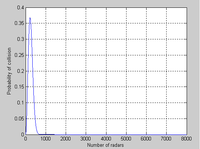
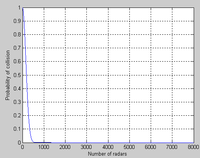
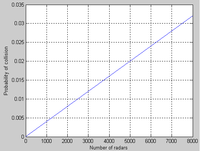
2) the attachments results for: probability of 1 collision, pfavorable(1 collision), punfavorable(1collision).
Not showing probability of 2 collisions cause it exceeds 1 :eek:

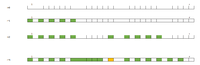
3) a graphical representation of how I tried to tackle the problem (yellow cell = collision), Which I try to better explain here.
There is a sample time (1.25 seconds) during which a certain number of independent radars (1 to 8000) could decide to emit their pulses (5 per each radar). This takes into account their rotation phase and timing randomness.
The number of free slots (1250000) in this sample time is the sample time divided by the pulse duration (1 us each). We are assuming for simplicity the same pulse duration.
I would like to assess the p(x collisions) depending on the number of radars.


4) with Bernoulli I meant the Bernoulli trial, excerpt from my reference source:
"A Bernoulli Trial is a random experiment that has two possible outcomes which we
can label as "success" and "failure," such as
• You toss a coin. The possible outcomes are "heads" and "tails." You can define "heads" as success and "tails" as "failure" here.
• You take a pass-fail test. The possible outcomes are "pass" and "fail."
We usually denote the probability of success by and probability of failure by . If we have an experiment in which we
perform independent Bernoulli trials and count the total number of successes, we call it a binomial experiment. For example, you
may toss a coin times repeatedly and be interested in the total number of heads."

5) I still think that the technical details might offuscate the problem. I see an analogy with a simpler pick problem. r numbers, n pickers, u picks per picker, p(e) probability to extract x times the same number.


I have many doubts regarding how I stated the problem and if the Binomial formula is correct. Not convinced the radars are independent (the third radar has more favorable probability of collision than the second.., so there is dependence).
Thanks for your patience for reading through all this.
 

Attachments

  • Concept.png
    Concept.png
    6.2 KB · Views: 1
  • probability of 1 collision.png
    probability of 1 collision.png
    8.5 KB · Views: 1
  • punfav(1).png
    punfav(1).png
    7.3 KB · Views: 1
  • pfavorable(1).png
    pfavorable(1).png
    6.9 KB · Views: 0
5) I still think that the technical details might obfuscate the problem. I see an analogy with a simpler pick problem. r numbers, n pickers, u picks per picker, p(e) probability to extract x times the same number.

I have many doubts regarding how I stated the problem and if the Binomial formula is correct. Not convinced the radars are independent (the third radar has more favorable probability of collision than the second.., so there is dependence).
Thanks for your patience for reading through all this.

Not looking at your work itself, I'll just point out that what I myself suggested you do was not to show any math or programming, but to state the problem itself as clearly as possible. That is, you have n radar systems, each of which emits u pulses (over a specified time? all at the same rate, or at different rates? or at random times?) each of length r (all the same?), and two pulses are considered to interfere if they overlap in time at all (?). You want the probability that there will be x collisions between any of the radars within a specified time (or is it with one specified radar?). I'm not looking for technical details, unless they affect the question at this level (e.g. if the radars only interfere under certain circumstances). Since you expressed uncertainty about whether this can be modeled as Bernoulli trials, that (or some other model) needs to be determined before any math can be done.

You answered some of my questions in (3), but I have to say I don't understand the picture, as it looks like there are a lot of collisions, not just the one, and the radars aren't each making 5 pulses as you seem to have said. It's understandable that you are simplifying things by supposing aligned microsecond slots; but the most important thing might be how a radar decides which slots to use.

But your concern about the third having more chance of collision than the second is probably not an issue, as that is not a dependence among individual events. It does, however, contribute to doubting your model, merely in that collision is not an event determined by each radar in itself, but by the interaction of all of them.
 
Hello, I will try to give more details to clarify the points you have raised.

you have n radar systems, each of which emits u pulses (over a specified time? all at the same rate, or at different rates? or at random times?)
u pulses are emitted in the observation time by each one of the radars. Rate, time relation among pulses are assumed not relevat to simplify the problem.
The obervation time takes some of the parameters into account.

each of length r (all the same?), and two pulses are considered to interfere if they overlap in time at all (?).
the length of each pulse is 1, over the r total number of pulse slots available. They interfere in case of overlap (multiple picks of the same number).
You want the probability that there will be x collisions between any of the radars within a specified time (or is it with one specified radar?).
Yes, I would like to know the probability of collision among any of the pulses emitted by the radars.
I'm not looking for technical details, unless they affect the question at this level (e.g. if the radars only interfere under certain circumstances).
To simplify I would assume collision once the same slot is taken by more than 1 radar.
Since you expressed uncertainty about whether this can be modeled as Bernoulli trials, that (or some other model) needs to be determined before any math can be done.

You answered some of my questions in (3), but I have to say I don't understand the picture, as it looks like there are a lot of collisions, not just the one, and the radars aren't each making 5 pulses as you seem to have said.
The picture was an attempt to simplify the concept. Sorry if it was not clear. I meant to show collision (two pulse on the same slot) and slots occupation progressively changing.

It's understandable that you are simplifying things by supposing aligned microsecond slots; but the most important thing might be how a radar decides which slots to use.
I would chose a simplified approach in which slots are randomly taken by the radars, without correlation. Only rule would be that one radar does not collide with itself.

Thanks for your questions.
 
Okay ... here's my current understanding of the simplified model:
  • There are n radars.
  • We observe them over a period of r microseconds, thinking of this as r discrete times at which pulses can occur.
  • Each of the n radars emits u pulses during that time, at random times (so that they could happen to be successive microseconds, or spaced out over the whole time, or anywhere in between). I suppose we could consider each of the rCu possible combinations of slots to be equally likely. We definitely don't think of them as periodic, with a pulse every r/u slots; nor are we saying that the probability of a given radar emitting a pulse in a given slot is fixed (e.g. p = u/r) since that would not result in a fixed number of pulses over the time interval. (This is where the problem becomes definitely not a matter of Bernoulli trials.)
  • We want to find the probability that at least one slot is shared by two or more radars.
  • In particular, for example, if nu>r, we would get a probability of 1, since they wouldn't all fit into the time available.
Does that sound right?
 
Hello Dr. Peterson,
thanks for your follow up.
I agree with the summary but regarding the objectives I would like to know how to find the probability that X slots are shared by two or more radars
(so the exact number of collisions).
Thanks
 
Hello Dr. Peterson,
thanks for your follow up.
I agree with the summary but regarding the objectives I would like to know how to find the probability that X slots are shared by two or more radars
(so the exact number of collisions).
Thanks
Yes, I misstated that.

But I do want to emphasize that the assumption that each radar randomly chooses exactly u slots to use seems utterly unrealistic, which decreases my willingness to try to work this out. I'm hoping someone else will join in here, either to propose a model that is both realistic and easy enough to solve, or to solve it as is.

But given this model, we might think of it as n jars, each containing u red balls and r-u black balls. We pick a ball from each bin on every turn, and note how many of r turns include at least two red balls. This is our random variable X.
 
Top