
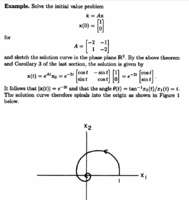
C ChuckNoise New member Joined Mar 5, 2019 Messages 8 Nov 2, 2020 #1 Hi I got this example in my textbook, where i need a little help. The problem i am having is only sort of related to the differential equation, nonetheless can anyone tell me why it follows that |x(t)| = e^-2t? Thanks!
Hi I got this example in my textbook, where i need a little help. The problem i am having is only sort of related to the differential equation, nonetheless can anyone tell me why it follows that |x(t)| = e^-2t? Thanks!
Dr.Peterson Elite Member Joined Nov 12, 2017 Messages 16,865 Nov 2, 2020 #2 What does |x(t)| mean here? It is the magnitude of a vector, and if you expand that and apply the Pythagorean identity, you get e^{-2t}.
What does |x(t)| mean here? It is the magnitude of a vector, and if you expand that and apply the Pythagorean identity, you get e^{-2t}.
C ChuckNoise New member Joined Mar 5, 2019 Messages 8 Nov 2, 2020 #3 Dr.Peterson said: What does |x(t)| mean here? It is the magnitude of a vector, and if you expand that and apply the Pythagorean identity, you get e^{-2t}. Click to expand... Of course! What a stupid mistake Thanks for pointing that out, in my mind i treated it like a scalar. Thanks a lot
Dr.Peterson said: What does |x(t)| mean here? It is the magnitude of a vector, and if you expand that and apply the Pythagorean identity, you get e^{-2t}. Click to expand... Of course! What a stupid mistake Thanks for pointing that out, in my mind i treated it like a scalar. Thanks a lot