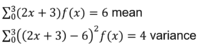
I know how to solve this problem if there was only the probability distribution table. In this case the expected value would be 1.5, the variance 1 and the standard deviation 1. But in this exercise I don't know what to do with the function g(x) =2x+3, so any help you can give me is appreciated.
[MATH]E[2X+3] = 2E[X] + 3 = 6\\
Var[2X+3] = 2^2 Var[X] = 4[/MATH]
While your method is valid it missed the point of the problem which Harry_the_cat tried to convey to you.
Thank you both for the answers.
About the first method var(aX+b), it refers to any function that has that kind of structure? for example g(x)= 9x+3 would be: 9^2Var[X]= 81 ?
Thank you both for the answers.
About the first method var(aX+b), it refers to any function that has that kind of structure? for example g(x)= 9x+3 would be: 9^2Var[X]= 81 ?
This site uses cookies to help personalise content, tailor your experience and to keep you logged in if you register.
By continuing to use this site, you are consenting to our use of cookies.