Im looking for the type of probability i need

Richard Kelly

New member
Joined
Jan 26, 2021
Messages
9
Hi, I want to know what this is called so I can find the appropriate calculator. I found many online calculators for "combinations of balls"
And I read about something called "stars and bars" but the combination calculator is one field short on the input field.

In lotteries, they have numbered balls. For example 1 - 59 and you have odds on the numbers you choose.

But when the balls have Colours as well as numbers....

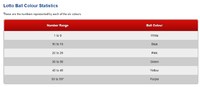
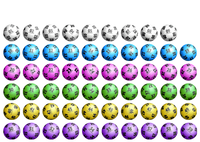
For example White, Blue, Pink, Green, Yellow, Purple. So 6 colours.

There are 9 white, 10 Blue, 10 Pink, 10 Green, 10 Yellow, 10 Purple.

How do I calculate the probability of certain colour combinations. And what type of problem is this called please? With the added colour factors?

So how do I work out the probability for example...

That if 5 or 6 or 7 total balls are randomly chosen..

What are the probability that there will be for example 2 white, 1 blue, 1 yellow and a purple (if you draw only 5 balls)

Or there will be 2 white, 1 blue, 1 yellow. (4 colours chosen) even if you still pick say 6 balls.


And how to calculate the total possible combinations of colours, from the whole set of 59 balls, if 6 balls are chosen?
If 5 balls are chosen? Or 7 balls?

There must be a calculator somewhere that has an additional field for the colours.

Not just number of balls and number chosen.
 
google/wiki multinomial hypergeometric distribution and all will be revealed
 
Why not learn how to solve the problem and then use a calculator to do the calculation. That way you know that it is doing the correct work.

What have you tried with your problem? Where are you stuck. Please post back with you attempt so the helpers here will know how to help you..
 
I will look into multinomial hypergeometric distribution. Thank you.

Jomo, I am not a mathematician. Unfortunately very bad at math. I am better at history or other subjects.

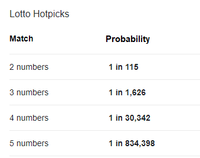
I just watch the National Lottery and they give all probability published for the numbers drawn and I thought it would be interesting to know the probability of various colour combinations.

I really wouldn't know how to work that out, though!
I am happy to do some research just need pointing in the right direction ?.
 
I uploaded these images which help.

Ive actually thought that the question can be put a lot simpler. And you can probably give me the problem or sum.

It will be this: for probability of 2 white, 1 blue and 1 yellow being drawn. (It can be done either including or excluding the bonus ball)

what is the probability of 2 numbers being drawn between 1 and 9. And 1 number between 10 and 19. And 1 number between 40 and 49.


That's likely the easier way to calculate it


[img src="https://i.ibb.co/GQjKLRT/...] [url href="https://imgbb.com/"][/url][/img]
 
Sorry, I didn't know what the image tags were for this platform, I see you can just directly upload.

One important algebra fact here to note.


Colour = "number set"

So we are looking at probability of "multiple choice" of "a range of numbers" which will appear.

When we select certain choices or numbers of choices..

Also, what are the total number combinations possible? Given this set of corresponding number sets allocated to each colour?
What are the number of possible frequency combinations (not limited to order drawn)
So if you only choose 1 colour (number set)

Its about 1/6 probability but the fact there are only 9 numbers in the white set, will slightly alter the probability.

If you choose the white number set twice...
Will it still be 1/6 probability?? Even when 6 random balls are drawn? Or including the 7th bonus ball??

I am guessing it cannot be 1/6 probability for correctly choosing all 6 colours, or all 6 and the bonus ball?


pick_colours.pngPROBABILITY.pngball-colours.png1_lottery.jpg
 
It's really quite simple using the MHD.

You've got 6 groups. 1 group has 9 elements. 5 of them have 10.
The probability of picking any given ball is uniform.

You pick n balls

[MATH]P[\{w,b,g,pi, y, pu\}] = \dfrac{\dbinom{9}{w}\dbinom{10}{b}\dbinom{10}{g}\dbinom{10}{pi}\dbinom{10}{y}\dbinom{10}{pu}}{\dbinom{59}{n}}[/MATH]
where [MATH] w+b+g+pi+y+pu=n[/MATH]
The numerator above is how many combinations exist of the type you have specified.
The denominator is the total number of combinations that exist given the number of balls you choose.

Note that sometimes what you want will require the sum of terms like the above.
Also sometimes, quite often actually, it's easier to find the complement of what you want and subtract that probability from 1.
 
Last edited:
Thanks for this! Sorry but my little brain doesn't fully understand it completely, though am I correct to say that what I think you are saying... is that if I'm going to choose the correct colours drawn of the main 6 balls (excluding the bonus ball) then its literally the same odds or difficulty as just correctly choosing 1 of the numbers?

So getting the correct colours drawn (main balls)
Would only be no harder than only needing to get one correct number?

So if I only needed to match four colours correctly out of 6 drawn... its actually very easy compared to even just getting 1 number right, which is much more difficult..

So likely why they don't bother offering the choice of choosing colours? ?

I guess once you start to try to predict the order they are drawn .. then it can get quite complicated ?
 
You're writing so much stuff it's very difficult to understand what exactly you are asking.

Let's look at one of your questions.

what is the probability of 2 numbers being drawn between 1 and 9. And 1 number between 10 and 19. And 1 number between 40 and 49.

This is the same as 2 white balls, a blue ball, and a yellow ball. We plug this into the formula

[MATH]P[\{2,1,0,0,1,0\}] = \dfrac{\dbinom{9}{2}\dbinom{10}{1}\dbinom{10}{0}\dbinom{10}{0}\dbinom{10}{1}\dbinom{10}{0}}{\dbinom{59}{4}} = \dfrac{36 \cdot 10 \cdot 1 \cdot 1 \cdot 10 \cdot 1}{455126} = \dfrac{3600}{455126} = \dfrac{1800}{227563} \approx 0.8\% [/MATH]

Here's another one of your specific questions

What are the probability that there will be for example 2 white, 1 blue, 1 yellow and a purple (if you draw only 5 balls)

[MATH]P[\{2,1,0,0,1,1\} = \dfrac{\dbinom{9}{2}\cdot 3\dbinom{10}{1}}{\dbinom{59}{5}} =\dfrac{540}{2503193} \approx 0.02\% [/MATH]
Is this making any more sense to you?
 
What are the probability that there will be for example 2 white, 1 blue, 1 yellow and a purple (if you draw only 5 balls)
If there are balls of six different colors, lets say that there six balls of each color.
There are \(\dfrac{11!}{5!\cdot 6!}=462\) different possible color combinations in drawing six balls.
There are \(\dfrac{10!}{5!\cdot 5!}=252\) different possible color combinations in drawing five balls.
What I do not understand is why confuse numbered balls & colored balls?
In a usual forced air drawing of a lottery of fifty-nine numbers, six balls are 'drawn'.
What is the probability no two consecutive numbers will be drawn?
That was an actual question concerning a small state lottery.
 
PKA .. true but the probability is different for choosing correctly 5 balls if only 5 are drawn and choosing 5 balls correctly when 6 are drawn because you get another chance again on the last ball.

I was wanting the probability of 4 balls correctly when 6 are drawn.

Your 462 different combinations are fantastic though. Deeply appreciated.

Romsey, I do algebra ok. But I'm just not learned in formula. Sorry. I know in a notoriously difficult subject for many people maths equations!
 
PKA .. true but the probability is different for choosing correctly 5 balls if only 5 are drawn and choosing 5 balls correctly when 6 are drawn because you get another chance again on the last ball.
I was wanting the probability of 4 balls correctly when 6 are drawn.
What in the world does the phrase "the probability of 4 balls correctly " mean?
 
[MATH]\dbinom{n}{k} = \dfrac{n!}{k!(n-k)!}[/MATH]
That's the only thing in any of that you might not have seen before. It's on calculators these days.

ps. Don't call me Romsey :/
 
Okay guys, I haven't checked the thread since I last posted..

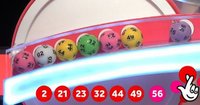
But what I wanted the exact probability on actually just happened earlier this evening


As you see (not counting the bonus ball)

We have two white, 1 yellow and 1 blue (in no particular order)
So what was the probability on that???

Notice that there were two pink as well which I didn't need but could have potentially also been the desired colours but weren't required.
 
Last edited:
Hi guys...
Well it happened again and also a third time too!


For me its hard to work out our probability that

2 white balls, 1 yellow and 1 blue will come out.

When 6 main balls are drawn. And don't include the bonus (7th) in the calculation.

You are allowed to have more than 1 blue and yellow. That counts. As long as there is at least 2 white. And at least 1 blue and at least 1 yellow.
So there are 6 chances in the draw, to obtain only the four items.

Unlike the numbers drawn.. there is only 1 of each number in the container. So a number can only be drawn once.

But because there are more than 1 of the colours they can be drawn again and again in fact as there are more colours in the container in each colour group.. more than the number of balls drawn... you could actually end up with all balls the same colour.

How about the probability on all balls being pink?
There are 10 pink balls.

So every ball drawn could be pink. And there would still be 3 pink left inside the container (if the bonus was pink as well)

Basically if you can tell me the probability of AT LEAST 4 pink balls coming out.
So IF 4 or more pink balls are drawn.

Vs if LESS than 4 pink or no pink are drawn?

So, 3 pink, 2 pink, 1 pink, or no pink doesn't count.


I actually don't think it matters what the colours are at all.

Its the probability of matching at least 4.

Thanks
 
Top