
You are using an out of date browser. It may not display this or other websites correctly.
You should upgrade or use an alternative browser.
You should upgrade or use an alternative browser.
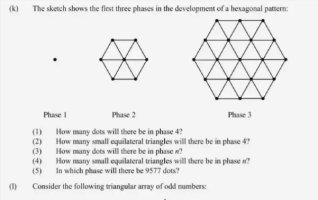
please help with q2 to q5
- Thread starter sus
- Start date

The Highlander
Senior Member
- Joined
- Feb 18, 2022
- Messages
- 1,231
Hi @sus,please help with q2 to q5
How did you get your answer to q1? What was your answer?
Did you construct the pattern at phase 4 on a piece of paper? (You should have.)
The key word in this problem is: "pattern". You have to identify what the patterns are for both the increasing number of dots and triangles. Then you are expected to create a formula that will allow calculation of the number of dots (or triangles) at any phase (n).
Things would have been a lot easier if they had numbered the phases starting at zero (0) instead of 1 which is what I would have done if I had been setting this problem for a Maths class!
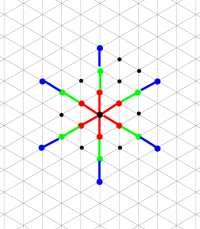
There are many different ways to think of how a pattern may be progressing but you should have set out by constructing the pattern on a sheet of paper. I chose to think of the construction as six 'spokes' (like on a wheel) radiating out from the central dot in Phase 1. See my diagram, below. I used different colours to represent each phase: red to 'grow' the figure into Phase 2, green to extend it to Phase 3 and blue to create Phase 4. This way I got six red dots in Phase 2, six green dots in Phase 3 and six blue dots in phase 4 and I was able to 'see' that: each red dot was followed by no black dots, each green dot was followed by one black dot and each blue dot was followed by two black dots.
Already a pattern was beginning to form in my mind!
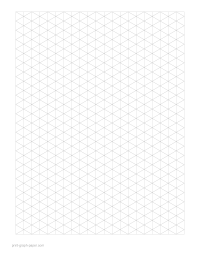
You should now draw your own version of the pattern. I have attached a sheet of isometric graph paper for you convenience. If you can print out a sheet of this paper it will make it much easier to construct the diagram accurately. You don't need to use any colours (unless you want to) but you should
draw in the black lines forming the triangles at each phase. I didn't bother because it was too time consuming in a graphics program and I got all the information I needed without them.


Continued in next post...
Attachments
The Highlander
Senior Member
- Joined
- Feb 18, 2022
- Messages
- 1,231

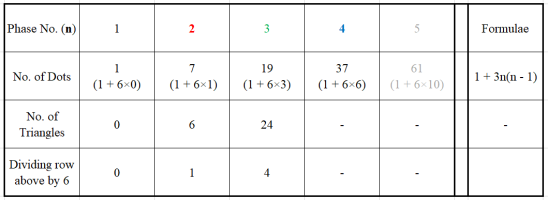
I completed the first row in its entirety for you. You can see that the number of dots is 1 plus 6 multiplied by the sequence: 0, 1, 3, 6, 10, ... (which is called the triangular numbers). A formula for these numbers is: \(\displaystyle \frac{n(n-1)}{2}\)which allowed me to create the formula that will calculate how many dots there will be in any phase (n). I did it for you because I thought, perhaps, this might be a bit 'beyond' you given that you haven't been able to answer any of the questions after the first.
You should now go on to complete the table and create a formula to calculate the number of triangles in any phase. (That is much simpler than the one for the dots. If you complete the bottom row it should become obvious what is going on.
 )
)In order to answer q5, you need to use the formula for the number of dots and set it equal to 9577.
For example, in Phase 3 there are 19 dots so if you were asked to say which phase has 19 dots you would write the following...
\(\displaystyle \qquad\>\,19=1+3n(n-1)\\\implies 18=3n(n-1)\\\implies\frac{18}{3}=n(n-1)\\\implies6=n(n-1)\\\implies6=n^2-n\\\implies n^2-n-6=0\\\implies(n+2)(n-3)=0\\\implies n=3\text{ or }n=-2\)
but, since a negative number cannot be correct in this situation, n must be 3.
Please come back and show us what you have done to answer q2 to q5.
Hope that helps.