
You are using an out of date browser. It may not display this or other websites correctly.
You should upgrade or use an alternative browser.
You should upgrade or use an alternative browser.
Trigonometry problem
- Thread starter chijioke
- Start date
 everyone.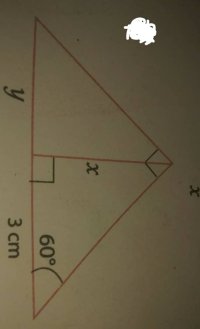
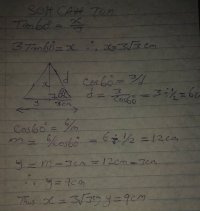

Dr.Peterson
Elite Member
- Joined
- Nov 12, 2017
- Messages
- 16,958
That looks correct. There are, of course, several other ways you could have solved it.
Is there a reason you were not sure?
Is there a reason you were not sure?
That looks correct. There are, of course, several other ways you could have solved it.
Is there a reason you were not sure?
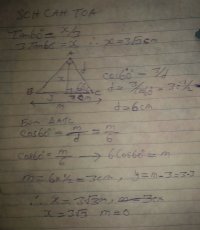
1 think I used the cosine ratios wrongly. It should be CAH and not CHA when I was trying to compute for m in the first work I posted. But by main looking m should be more than y, not the same as y because that would be impossible in real life.
Last edited:
Dr.Peterson
Elite Member
- Joined
- Nov 12, 2017
- Messages
- 16,958
1 think I used the cosine ratios wrongly. It should be CAH and not CHA when I was trying to compute for m in the first work I posted. But by main looking m should be more than y, not the same as y because that would be impossible in real life.
The first work still looks right to me. In calculating m, you used cos(60) = d/m = 6/m, which is correct; that is adjacent over hypotenuse, as you say. And you did find that m was greater than y, namely 12 as compared to 3. Why do you say you did that wrong?
As for the new work, there you say cos(60) = m/d = m/6, which is wrong. Obviously y = 0 is wrong. Are your comments really about this rather than the original?
The first work still looks right to me. In calculating m, you used cos(60) = d/m = 6/m, which is correct; that is adjacent over hypotenuse, as you say. And you did find that m was greater than y, namely 12 as compared to 3. Why do you say you did that wrong?
As for the new work, there you say cos(60) = m/d = m/6, which is wrong. Obviously y = 0 is wrong. Are your comments really about this rather than the original?

I said it is wrong because when I am making reference to triangle ABC, I am seeing the hypotenuse as d because the right angle the altitude |AR| makes with |RC| at point R. I am then seeing the adjacent as |BC| =m and the opposite as |BA| because angle 60 degrees faces |BA|.
Please could you correct my thinking as to what is the hypotenuse, adjacent and opposite sides respectively, when making reference to triangle ABC?
Dr.Peterson
Elite Member
- Joined
- Nov 12, 2017
- Messages
- 16,958
I said it is wrong because when I am making reference to triangle ABC, I am seeing the hypotenuse as d because the right angle the altitude |AR| makes with |RC| at point R. I am then seeing the adjacent as |BC| =m and the opposite as |BA| because angle 60 degrees faces |BA|.
Please could you correct my thinking as to what is the hypotenuse, adjacent and opposite sides respectively, when making reference to triangle ABC?
Surely you know that the hypotenuse is opposite the right angle, and that in triangle ABC, the right angle is at A. Point R is irrelevant to that triangle, because that is not a vertex of ABC.
It may help if you redraw the figure to isolate one triangle at a time. To find x, you used only triangle ARC, with right angle at R:
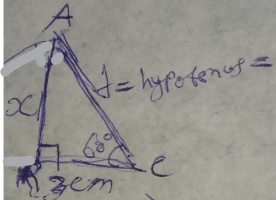
But to find m, you are using triangle ABC, with right angle at A:
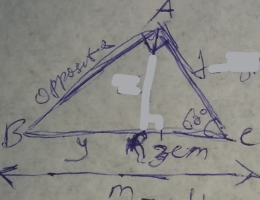
Do you see now that m is the hypotenuse?
Yes I fully understand now? But I still want to ask. How will one know that angle BAC is 90 degree? I am asking this question because I know that the hypotenuse m should face M that is side BC.Surely you know that the hypotenuse is opposite the right angle, and that in triangle ABC, the right angle is at A. Point R is irrelevant to that triangle, because that is not a vertex of ABC.
It may help if you redraw the figure to isolate one triangle at a time. To find x, you used only triangle ARC, with right angle at R:
View attachment 39967
But to find m, you are using triangle ABC, with right angle at A:
View attachment 39968
Do you see now that m is the hypotenuse?

The Highlander
Senior Member
- Joined
- Feb 18, 2022
- Messages
- 1,229
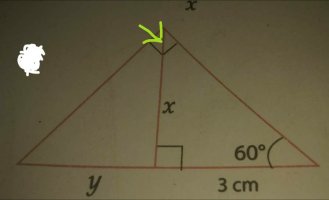
You know that ∠BAC is 90° because it is marked as such (in the original drawing).Yes I fully understand now? But I still want to ask. How will one know that angle BAC is 90 degree? I am asking this question because I know that the hypotenuse m should face M that is side BC.
You mean that sign I indicated with green arrow is a sign of a right angle?You know that ∠BAC is 90° because it is marked as such (in the original drawing).
Attachments
The Highlander
Senior Member
- Joined
- Feb 18, 2022
- Messages
- 1,229
Yes, that is the symbol for a right angleYou mean that sign I indicated with green arrow is a sign of a right angle?

and, although the altitude appears to bisect the apex, it clearly does not (as seen by the angles I have now added in).
Furthermore, although this looks like an isosceles triangle, again it is not; you have to interpret the diagram by the given parameters, not by how it looks (as with any "sketch").
Last edited:
I am now very cleared. Thank you so much.Yes, that is the symbol for a right angleView attachment 39979
and, although the altitude appears to bisect the apex, it clearly does not (as seen by the angles I have now added in).
Furthermore, although this looks like an isosceles triangle, again it is not; you have to interpret the diagram by the given parameters, not by how it looks (as with any "sketch").
The Highlander
Senior Member
- Joined
- Feb 18, 2022
- Messages
- 1,229
With the sketch marked up the way I have done above, you might then see a more direct (& elegant?) way to determine the lengths of x & y. For example....
Using exact values for the trig ratios: \(\displaystyle tan\, 60°=\sqrt{3} \text{ and } tan\,30°=\frac{1}{\sqrt{3}}\)
From the diagram...
\(\displaystyle tan\,60°=\frac{x}{3}\implies x=3\times tan\,60°=\underline{\underline{3\sqrt{3}}}\quad(\approx 5.196)\)
\(\displaystyle tan\,30°=\frac{x}{y}\implies y=\frac{x}{tan\,30°}=\frac{3\sqrt{3}}{\frac{1}{\sqrt{3}}}=3\times\sqrt{3}\times\sqrt{3}=3\times3=\underline{\underline{9}}\)
Therefore: x = 3\(\displaystyle \sqrt{3}\) cm (≈ 5.196 cm) and y = 9 cm.
Hope that helps.
Using exact values for the trig ratios: \(\displaystyle tan\, 60°=\sqrt{3} \text{ and } tan\,30°=\frac{1}{\sqrt{3}}\)
From the diagram...
\(\displaystyle tan\,60°=\frac{x}{3}\implies x=3\times tan\,60°=\underline{\underline{3\sqrt{3}}}\quad(\approx 5.196)\)
\(\displaystyle tan\,30°=\frac{x}{y}\implies y=\frac{x}{tan\,30°}=\frac{3\sqrt{3}}{\frac{1}{\sqrt{3}}}=3\times\sqrt{3}\times\sqrt{3}=3\times3=\underline{\underline{9}}\)
Therefore: x = 3\(\displaystyle \sqrt{3}\) cm (≈ 5.196 cm) and y = 9 cm.
Hope that helps.
Last edited: