Cross Section Length of a Pentagon

sjohnson89

New member
Joined
May 21, 2019
Messages
2
if we have a cube with side lengths of 2 inches each, what would have to be the side lengths of a regular pentagon fitted inside the cube (the cross section) Are there any formulas for this specific problem and where would we start first?
 
if we have a cube with side lengths of 2 inches each, what would have to be the side lengths of a regular pentagon fitted inside the cube (the cross section) Are there any formulas for this specific problem and where would we start first?
What in the world does that mean? Have you tried to inscribe a regular pentagon in a cube?
If inscribe is the wrong word then what does "fitted in" mean?
 
Cross Section Length of a Pentagon ...

inside the cube (the cross section) ...
I don't understand 'cross-section of a pentagon', but the cross-section of a cube is a square -- as long as the cube is cut along a plane parallel to one of its faces.

Are you talking about a pentagon inscribed within a 2-inch square?

?
 
I don't understand 'cross-section of a pentagon', but the cross-section of a cube is a square -- as long as the cube is cut along a plane parallel to one of its faces.

Are you talking about a pentagon inscribed within a 2-inch square?

?
What in the world does that mean? Have you tried to inscribe a regular pentagon in a cube?
If inscribe is the wrong word then what does "fitted in" mean?

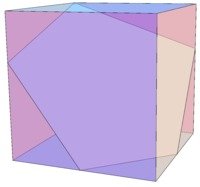
Sorry I didn’t explain it that well but I think the image represents what I’m trying to show. If we have a pentagon inside the cube with side lengths of 2 inches each, what would be the side lengths for the pentagon if it had to be a regular pentagon.
 

Attachments

  • DB52C030-DB86-49D8-B35D-625E879AA285.jpeg
    DB52C030-DB86-49D8-B35D-625E879AA285.jpeg
    12.2 KB · Views: 7
Why do you think it is possible for this to be a regular pentagon?

The site from which you appear to have taken the image says it is irregular.

You could describe the figure in terms of two variables locating the intersections with sides, and solve to make the sides of the "pentagon" equal, but you would also have to show that it is planar, and that the angles are equal. There are too many conditions.
 
Since the edge of a regular pentagon inscribed in a unit cube is approximately 0.77437 76951 36495 67221 40842 57670 14333 23639, your answer is just twice this number.

The question concerning regular polygons inscribed in a cube is quite challenging. It's obvious how to place the largest equilateral triangle inside a cube and the larger possible hexagon is also well known. The placement for the largest square is not so obvious but the length of the edge of the largest square in a unit cube is 1.060660172=(sqrt(2*0.75^2)). The largest pentagon lies as shown in the diagram. Three of the edges lie in three of the cube faces; the other two edges are inside the cube and their intersect is on the top face of the cube. The center of this pentagon does not coincide with the center of the cube. As far as I know, the size of regular polygons with more than 6 edges that can be inscribed in a cube have not been calculated.
 
Last edited by a moderator:
Oops. There is a typo in my previous response. The largest square that can be inscribed in a unit cube is 1.06066017 but the formula should have been sqrt(2*0.752)....(corrected)
 
The value given above for the side of the largest pentagon in a unit cube is correct. The exact value is:

(1+sqrt(3)+sqrt(5)-sqrt(15))/sqrt(2) ... sorry I don't know how to enter it in LaTex so it would look much nicer.
 
The value given above for the side of the largest pentagon in a unit cube is correct. The exact value is:

(1+sqrt(3)+sqrt(5)-sqrt(15))/sqrt(2) ... sorry I don't know how to enter it in LaTex so it would look much nicer.
I found your expression a little bit ambiguous.

Did you mean this: [imath]\frac{1+\sqrt{3}+\sqrt{5}-\sqrt{15}}{\sqrt{2}}[/imath] or this: [imath]1+\sqrt{3}+\sqrt{5}-\frac{\sqrt{15}}{\sqrt{2}}[/imath]

You're right, of course, that putting it into LaTex will make it look not just "nicer" but a lot clearer too.

However, there's no need to learn anything (much) new in order to use LaTex.

You can use this site (qv) to create your expression(s) and then simply '
Paste (as plain text)' the code generated into you post(s).

You just 'bookend' this code with: "math & /math" or "imath & /imath" or "tex & /tex". These need to go inside square brackets to mark the beginning & end of your LaTex code; using "math" will place your LaTex expression on a new line whereas the other two will place it inline with your current text.

For example:-

Untitled.png

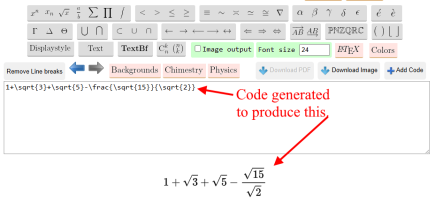
produces this: [imath]1+\sqrt{3}+\sqrt{5}-\frac{\sqrt{15}}{\sqrt{2}}[/imath] using the code generated on the website thus...

2026-03-20.png
Hope that helps. 😊
 
I found your expression a little bit ambiguous.

Actually, tfmcbride's expression is not ambiguous.

In the expression (1+sqrt(3)+sqrt(5)-sqrt(15))/sqrt(2) , the first leftmost open parenthesis and the second close parenthesis
(immediately before the "/") unambiguously place the expression 1 + sqrt(3)+sqrt(5)-sqrt(15) as the numerator.
This is the first expression in Latex you asked tfmcbride about.

To be equal to the second Latex expression, a pair of parentheses would be removed:

1+sqrt(3)+sqrt(5)-sqrt(15)/sqrt(2)
 
Actually, tfmcbride's expression is not ambiguous.

In the expression (1+sqrt(3)+sqrt(5)-sqrt(15))/sqrt(2) , the first leftmost open parenthesis and the second close parenthesis
(immediately before the "/") unambiguously place the expression 1 + sqrt(3)+sqrt(5)-sqrt(15) as the numerator.
This is the first expression in Latex you asked tfmcbride about.

To be equal to the second Latex expression, a pair of parentheses would be removed: 1+sqrt(3)+sqrt(5)-sqrt(15)/sqrt(2)
You're right, I simply didn't notice that pair of brackets after the "sqrt(15" which does, indeed, render their (his/her) expression entirely unambiguous. Thank you for pointing that out.
However, you're wrong (IMHO) to suggest that removing the said parentheses renders the expression "
equal to the second Latex expression" because doing so makes the expression subject to the very ambiguity that I alluded to in my post.

Notwithstanding that, the whole point of my post was not to pick holes in their rendering of the expression but to offer them a simple(?) way to make use of LaTex in any future post(s).

It was my hope that s/he (and many others?) might benefit from that information more than from any need to carefully scrutinise in painful detail any & every plain text renditions of mathematical expressions.
 
However, you're wrong (IMHO) to suggest that removing the said parentheses renders the expression "equal to the second Latex expression" because doing so makes the expression subject to the very ambiguity that I alluded to in my post.

I would like you to stay on the topic with the expression that has the pair of parentheses removed:

1+sqrt(3)+sqrt(5)-sqrt(15)/sqrt(2). In particular, it has to do with the sqrt(15)/sqrt(2) part. There is
no ambiguity in that part being equivalent to \(\displaystyle \dfrac{ \sqrt{15}}{ \sqrt{2}}. \) This is true, because the square roots are executed
first and then the quotient is done.


If the grouping symbols were placed differently as sqrt(15/sqrt(2)), then there would be no ambiguity
in that being equivalent to \(\displaystyle \sqrt{ \dfrac{15}{ \sqrt{2}}}. \)

This is my world of expertise of grouping symbol placement and the non-ambiguity of these expressions.

- - - - --

By the way, tfmcbride's form of the expression in post #8 did not give me any doubts because I saw/see
matching parentheses. Then, I cut-and-pasted that expression of his/hers into WolframAlpha and saw
that it matched the value given by tfmcbride in the top of his/her post #6.
 
Last edited:
I would like you to stay on the topic with the expression that has the pair of parentheses removed:

1+sqrt(3)+sqrt(5)-sqrt(15)/sqrt(2). In particular, it has to do with the sqrt(15)/sqrt(2) part. There is
no ambiguity in that part being equivalent to \(\displaystyle \dfrac{ \sqrt{15}}{ \sqrt{2}}. \) This is true, because the square roots are executed
first and then the quotient is done.


If the grouping symbols were placed differently as sqrt(15/sqrt(2)), then there would be no ambiguity
in that being equivalent to \(\displaystyle \sqrt{ \dfrac{15}{ \sqrt{2}}}. \)

This is my world of expertise of grouping symbol placement and the non-ambiguity of these expressions.

- - - - --

By the way, tfmcbride's form of the expression in post #8 did not give me any doubts because I saw/see
matching parentheses. Then, I cut-and-pasted that expression of his/her into WolframAlpha and saw
that it matched the value given by tfmcbride in the top of his/her post # 6.

YYSSW!
Well we'll just have to agree to disagree on that (since I don't particularly care what "topic" you want to stay on) and if you don't wish to agree to disagree then, tough, because I'm not going to enter into any further discussion on the matter.
I know (from personal experience & the comments of others) that doing so with you is a complete waste of time & effort.
So, thank you for your original contribution but don't bother to respond any further; I won't be doing so.
 
Last edited:
YYSSW!
Well we'll just have to agree to disagree on that (since I don't particularly care what "topic" you want to stay on) and if you don't wish to agree to disagree then, tough, because I'm not going to enter into any further discussion on the matter.
I know (from personal experience & the comments of others) that doing so with you is a complete waste of time & effort.
So, thank you for your original contribution but don't bother to respond any further; I won't be doing so.

No, we will not agree to disagree. As I know my subject, you're going to have care to stay on the topic, because I am schooling
and correcting you, that's why. Commit to heart what I have explained. I did not waste my posts because I do not want you
passing on misinformation/disinformation because you happen to be sufficiently ignorant about it. I care about the correctness
for everyone.

You found an error where there was none with the forum user in post #8, and then you went off on a needless subdiscussion of
trying to fix what wasn't broken to begin with.


Pardon the accidental bold text. It would have been easy to avoid if you had not been an entitled forum user and had not used
large/yelling text ever since you got on the forum.
 
Last edited:
From now on, lookagain, I am encouraging you to follow me around on my posts
in the various forum threads to critique and correct me at your discretion.

Consider it done! I look forward to doing so, but I am often busy, so I am likely to miss certain posts of yours here
and there that may cry out for further attention.

What is odd is that in post #13 you claimed that you would not be responding to me any further, but in post #16
you did. (There must be some sort of a glitch in the Matrix.)
 
Top