King Friday
New member
- Joined
- May 25, 2026
- Messages
- 13


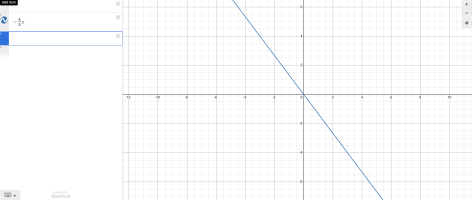
The graph represents the equation [imath]y=-\frac{4}{3}x[/imath]. For any x, you can calculate y, and plot the point [imath](x,y)[/imath].
How do I assume that x = 0? I'm not seeing the rise/run in this.The graph represents the equation [imath]y=-\frac{4}{3}x[/imath]. For any x, you can calculate y, and plot the point [imath](x,y)[/imath].
For example, if [imath]x=0[/imath], then [imath]y=-\frac{4}{3}\cdot0=0[/imath], so you plot [imath](0,0)[/imath].
If [imath]x=3[/imath], then [imath]y=-\frac{4}{3}\cdot3=-4[/imath], so you plot [imath](3,-4)[/imath].
Then draw a straight line through those points; or plot more points to convince yourself they all lie on a line.

You don't. But you can see in the graph that [imath]y(0) = 0[/imath], and you can safely assume that the graph is a straight line. Finding another point (y(3) in the @Dr.Peterson's example) gives you enough info to figure out the equation.How do I assume that x = 0?
Oh. So if the b expression is absent, that is the same as it equaling Zero?You don't. But you can see in the graph that [imath]y(0) = 0[/imath], and you can safely assume that the graph is a straight line. Finding another point (y(3) in the @Dr.Peterson's example) gives you enough info to figure out the equation.
Not sure how to interpret this statement. But general equation for non-vertical lines is [imath]y=ax+b[/imath]. What do you get for [imath]y(0)[/imath] in the general case?Oh. So if the b expression is absent, that is the same as it equaling Zero?
How do I know the b expression is Zero? I have no starting point to plot points from if all I have is [math]-\dfrac{4}{3}[/math]Not sure how to interpret this statement. But general equation for non-vertical lines is [imath]y=ax+b[/imath]. What do you get for [imath]y(0)[/imath] in the general case?
Which expression? Can you answer my question from the previous post?How do I know the b expression is Zero?
It is a chapter test for my Udemy Course:Not sure how to interpret this statement. But general equation for non-vertical lines is [imath]y=ax+b[/imath]. What do you get for [imath]y(0)[/imath] in the general case?
Oh. So if the b expression is absent, that is the same as it equaling Zero?
And that is where we plot our next two points from.
It would have been helpful if your initial question focused on your specific thoughts about the problem. It appears that you are not just asking about the equation in general, but about its relation to the "slope-intercept form", which in America is written as y = mx + b. Since your equation is not exactly written in this form, you wonder how to make it fit. Right?How do I know the b expression is Zero? I have no starting point to plot points from if all I have is [math]-\dfrac{4}{3}[/math]
It is given : 0 !I having trouble with question 13 on the test: What's stumping me is there is no y intercept given.
It is a chapter test for my Udemy Course:
The Beginner's Guide To Understanding Algebra 1 & Algebra 2
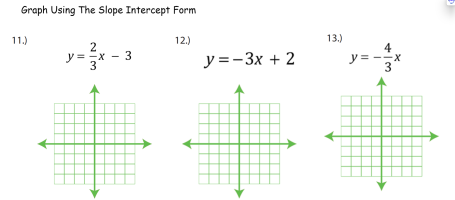
I having trouble with question 13 on the test: What's stumping me is there is no y intercept given. View attachment 40018
So, the absence of the y intercept is to be interpreted as "0" To state it would be redundant?It would have been helpful if your initial question focused on your specific thoughts about the problem. It appears that you are not just asking about the equation in general, but about its relation to the "slope-intercept form", which in America is written as y = mx + b. Since your equation is not exactly written in this form, you wonder how to make it fit. Right?
To put [imath]y=-\frac{4}{3}x[/imath] in the form [imath]y=mx+b[/imath], we can observe that the one term you have, containing x, corresponds to mx (slope times x), and the b term (y-intercept) is absent. So we can write your equation as [math]y=-\frac{4}{3}x+0[/math]
This makes it clear that the slope (rise/run) is -4/3, so you can use a rise of -4 (fall of 4) with a run of 3. And the y-intercept is 0, meaning that the graph starts at (0,0).
My question exactly. It's needlessly confusing to a someone early in the path.Now that you've shown the source of your question, I hope my answer helps; but I'm a little surprised the course would not have included an example like this with b=0.
It's not that there isn't a y-intercept, but that there is no need to write a 0 term in an equation.So, the absence of the y intercept is to be interpreted as "0" To state it would be redundant?
Maybe this course is not as detailed as you need. Different people need different amounts of support, based on their level of experience.My question exactly. It's needlessly confusing to a someone early in the path.
It is rather detailed and I'm making good progress. I'm just noticing some minor shortcomings that matter. Mostly in the chapter tests.It's not that there isn't a y-intercept, but that there is no need to write a 0 term in an equation.
What we are doing here is rewriting any equation of a line in a particular form, from which we can infer the slope and intercept. If the equation as given has only an "mx" term, then you can write "+0" to make it explicitly look like "mx+b". Or, as we do with experience, just imagine it being there. The key idea is that the equation you're given will not always directly show these numbers; you have to make them visible by the way you rewrite it.
Maybe this course is not as detailed as you need. Different people need different amounts of support, based on their level of experience.
I did go through the course description and it is for Beginners. I'm 68 years old and this is something I should have learned in school, had I been paying attention.Or maybe it was mentioned somewhere, but you didn't notice it! Sometimes there is a separate section on special cases (line through the origin, horizontal line, vertical line), and this would be emphasized there; sometimes it is just mentioned in one of several examples., and you need to have read closely to see it.