
Another arithmetic sum series

radnorgardens

New member
Joined
Dec 2, 2014
Messages
26
Question: The first term of an arithmetic series is 16 (a). The 30th term (n) is 100. Calculate S30.

So again, I have the formula:
Sn=n/2[2(a)+(n-1)d].

Using the data above:
S30=30/2[2(16)+(30-1)d]
S30=30/2[32+29d]

Again, I don't understand my next step, or maybe my initial steps are completely wrong. I don't know what to do with the '100', nor 'd' (the common difference). Another attempt:

1st term = 16
30th term = 100

Stuck!

Thanks for any pointers.
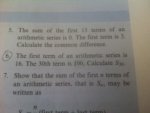
 
Question: The first term of an arithmetic series is 16 (a). The 30th term (n) is 100. Calculate S30.

So again, I have the formula:
Sn=n/2[2(a)+(n-1)d].

Using the data above:
S30=30/2[2(16)+(30-1)d]
S30=30/2[32+29d]

Again, I don't understand my next step, or maybe my initial steps are completely wrong. I don't know what to do with the '100', nor 'd' (the common difference). Another attempt:

1st term = 16
30th term = 100

Stuck!

Thanks for any pointers.

The equation can be re-written as:

Sn= n/2 * [a1 + an]

you are given a1 =16 & a30 = 100 → solve for S30
 
Something's wrong with that. Check the original problem.
1st term should be 13 OR 100 is the 29th term.
As is, d = 84/29

That is no-doubt a "funky" d - improbable but not impossible.

I believe the objective of the problem was to use the equation I posted - the author probably did not check for value of 'd'.
 
Thank you, but to understand the formula?

S30 = 30/2 * [a1 + an]
S30 = 15 * [116]
S30 = 1740

Great - thanks, that tallies up with the answer key, but how do you get from:
Sn= n/2 * [2(a)+(n-1)d]
to
Sn= n/2 * [a1 + an] ?
 
....how do you get from:
Sn= n/2 * [2(a)+(n-1)d]
to
Sn= n/2 * [a1 + an] ?
Well, a = a1, right? And what is the formula for an, in terms of a = a1, n, and d? When you plug that all in to the second formula, what do you get when you simplify down? ;)
 
Top