shahar
Full Member
- Joined
- Jul 19, 2018
- Messages
- 552
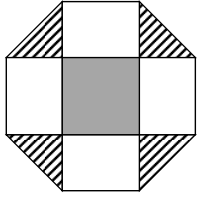
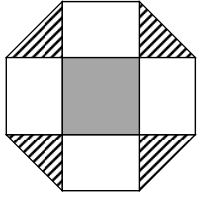
Where is "the area [(2)] of the square area) "? What other information are given?How Can I prove that the areas equal? (the striped trinagles' area [(1}] and - the area [(2)] of the square area)
It came from a Question of the Israeli SAT test.
(I can't log in to another site or use AI because the computer of me now is very old)
View attachment 39969
Name the verticesHow Can I prove that the areas equal? (the striped trinagles' area [(1}] and - the area [(2)] of the square area)
It came from a Question of the Israeli SAT test.
(I can't log in to another site or use AI because the computer of me now is very old)
View attachment 39969
Assuming that the overall shape forms a regular octagon, meaning all outer edges are equal in length, then the central square has side length the same as the octagon's sides; let us call that "s".
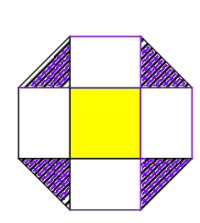
Please respond to the following questions:Why does the purple area equals to yellow area?
View attachment 39970
I see it but I don't understand how to prove it?
Thank you. Long time I haven't deal with geometry.Assuming that the overall shape forms a regular octagon, meaning all outer edges are equal in length, then the central square has side length the same as the octagon's sides; let us call that "s".
The hypotenuse of each triangle is also "s" so the legs of the triangles (let's call them "l" as they are all the same length too) are related to the sides of the octagon via Pythagoras' Theorem, ie:-
\(\displaystyle s^2=l^2+l^2=2l^2\)
Having established that \(\displaystyle s^2=2l^2\), you can now calculate the areas of the central square (whose side is s) and that of the four triangles (for each, use A=½×base×height and treat one leg (l) as the base and the other leg as the height).
Finally, comparing the expressions you get for these areas you should be able to confirm that they are equal.
If you can't finish from there I can only complete the problem for you (further "help" is difficult to provide) so please try to finish it yourself.
However, if you're still really stuck, the answer can be provided.
Hope that helps.![]()
So, have you completed the exercise?Thank you. Long time I haven't deal with geometry.

Yes.So, have you completed the exercise?
Please show us your working...
(Laid out like this?)
It is easily demonstrated that, by Pythagoras, \(\displaystyle s^2=2l^2\)
View attachment 39975
The sides of the central square are s units \(\displaystyle \implies AREA_{SQUARE}=\underline{\underline{ }} \)
The top, left triangle has base l and height l, therefore...
\(\displaystyle AREA_{TRIANGLE}=\frac{1}{2}\times\underline{ }\times \underline{ }=\underline{ }\)
Therefore, the area of all four triangles is: \(\displaystyle 4\times\underline{ }=\underline{\underline{ }}\)
But we already know that: \(\displaystyle s^2=2l^2\)
Therefore, the area of the central square is the same as QED
(you can just copy it out onto a sheet of paper, fill in the blanks and then post a picture of your work.)
Hope that helps.![]()
I'm afraid that is very poorly written out!Yes.
The first blank space is l^2
tbe -nd is 1/2 * l * l = (l^2)/2
s^2 = 2l^2
in the -rd is 1/2(4 * l^2) = 2l^2
now, Areas are equal.
Yes. I do my Math matriculation in 2000.I'm afraid that is very poorly written out!
I'm doubtful if it would gain you anything close to full marks in a test but (I think) you may have understood the proof (though I'm not at all clear about your exposition of it).
Not a problem, I know English is not your native tongue (Hebrew, is I believe?) and that English is a very difficult language to master; I am happy to make allowances for you in that respect.Yes. I do my Math matriculation in 2000.
So, Now as Adult I forgot many things.
I tried to edit your message and to put in, but I very confused to deal with the writting.
In conclusion, I have a white hair in my face. O.K.?
I take English lessons but it's very difficult to use it because English language is very rich langauge.
Thanks, it warn my heart. Thank you.Not a problem, I know English is not your native tongue (Hebrew, is I believe?) and that English is a very difficult language to master; I am happy to make allowances for you in that respect.
However, if you had just (as I suggested) copied out my post onto a piece of paper and then filled in all the blanks, then you would have had an ideal solution to the problem.
Having re-read your earlier post I now see that you were trying to provide (just) the answers that I left blank in my post. Unfortunately that does mean that you did not get that right either.
The first "blank" you said was: "l^2" but that is not correct; it should have been: \(\displaystyle s^2\) (or "s^2")!
Perhaps that error may just have been because you were "rushing" to post a reply but that is also why I suggested writing the solution out in full (to take your time and ensure you understand it completely).
I would still recommend that you copy out my post on a sheet of paper (or on a page in your notebook/workbook). You don't need to post the result if you can't be bothered but that will give you a written record of the solution that you can keep to hand without having to log back into this forum to remind yourself of how the desired result can be proved.
I'm not sure what "a white hair on your face" actually means (I've never heard that expression before); did you mean "egg on your face"? But, in any case, that's not the aim here; I only point out any faults I might see to help you, not to cause you any embarassment.
Hope that helps.

So am I but that's not a problem either because you can teach an old dog new tricks!Thanks, it warn my heart. Thank you.
I meant the my hair dye is black and white because I am old.