H hdancarey New member Joined Oct 5, 2009 Messages 1 Oct 5, 2009 #1 show that x=1 and y=2x+3 are asymptoes for f(x)=(2x**2+x-1)/(x-1). I understand x=1 but do not understand how the y=2x+3 was determined.
show that x=1 and y=2x+3 are asymptoes for f(x)=(2x**2+x-1)/(x-1). I understand x=1 but do not understand how the y=2x+3 was determined.
D Deleted member 4993 Guest Oct 5, 2009 #2 hdancarey said: show that x=1 and y=2x+3 are asymptoes for f(x)=(2x**2+x-1)/(x-1). I understand x=1 but do not understand how the y=2x+3 was determined. Click to expand... For a quick review, go to: http://www.purplemath.com/modules/asymtote.htm
hdancarey said: show that x=1 and y=2x+3 are asymptoes for f(x)=(2x**2+x-1)/(x-1). I understand x=1 but do not understand how the y=2x+3 was determined. Click to expand... For a quick review, go to: http://www.purplemath.com/modules/asymtote.htm
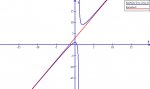
G galactus Elite Member Staff member Joined Sep 28, 2005 Messages 7,203 Oct 5, 2009 #3 The 2x+3 is called an oblique asymptote. When we long divide \(\displaystyle \frac{2x^{2}+x-1}{x-1}\), we get \(\displaystyle \frac{2}{x-1}+\underbrace{2x+3}_{\text{oblique asymptote}}\) As we can see, the oblique asymptote is a line the function approaches as \(\displaystyle x\to \pm{\infty}\) See the graph I included. Attachments oblique.jpg 24.8 KB · Views: 52
The 2x+3 is called an oblique asymptote. When we long divide \(\displaystyle \frac{2x^{2}+x-1}{x-1}\), we get \(\displaystyle \frac{2}{x-1}+\underbrace{2x+3}_{\text{oblique asymptote}}\) As we can see, the oblique asymptote is a line the function approaches as \(\displaystyle x\to \pm{\infty}\) See the graph I included.