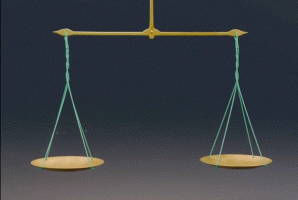
Balance diagram

leanne.d86

New member
Joined
Apr 27, 2026
Messages
1
Hello

My Son received this question in an assessment at school and got it wrong. I’ve never seen anything like it before. Can anyone help solve it please? I would think the bottom right circle would be 3 since it is balanced. Apart from that, my brain is fried trying to figure it out. There are none in any of the textbooks for his level.
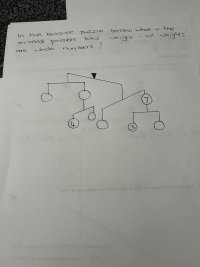
 

Attachments

  • IMG_7974.jpeg
    IMG_7974.jpeg
    2.2 MB · Views: 5
Hello

My Son received this question in an assessment at school and got it wrong. I’ve never seen anything like it before. Can anyone help solve it please? I would think the bottom right circle would be 3 since it is balanced. Apart from that, my brain is fried trying to figure it out. There are none in any of the textbooks for his level.
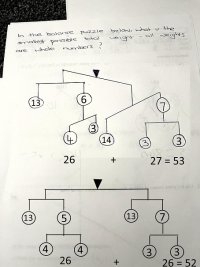
It strikes me that there may be TWO possible answers (52 or 53) depending on what you are supposed to do with this type of problem.

It looks to me as though there must be further information in the original question or the your son must have been shown what is required in class prior to the assessment.

My alternatives...


Balance diagram.jpg

Hope that helps 😊
 
It strikes me that there may be TWO possible answers (52 or 53) depending on what you are supposed to do with this type of problem.
What interpretation justifies your first answer? It isn't clear what you are thinking.
Hello

My Son received this question in an assessment at school and got it wrong. I’ve never seen anything like it before. Can anyone help solve it please? I would think the bottom right circle would be 3 since it is balanced. Apart from that, my brain is fried trying to figure it out. There are none in any of the textbooks for his level.
Were any similar "balance puzzles" presented in class that would explain what it is asking for?

To my mind, the key is that if each rod is split exactly in half (an assumption that needs to be stated), then regardless of the angle it sits at, the two sides must have the same weight in order for it to remain in that position. If they were not, then it would not merely be tilted, but rapidly moving to a vertical position! But this depends on the student having a good feel for how balance works, not just for arithmetic. That's why I think it must have been explained in class.
 
What interpretation justifies your first answer? It isn't clear what you are thinking.

Were any similar "balance puzzles" presented in class that would explain what it is asking for?

To my mind, the key is that if each rod is split exactly in half (an assumption that needs to be stated), then regardless of the angle it sits at, the two sides must have the same weight in order for it to remain in that position. If they were not, then it would not merely be tilted, but rapidly moving to a vertical position! But this depends on the student having a good feel for how balance works, not just for arithmetic. That's why I think it must have been explained in class.
I too have never come across a problem presented in this fashion and I also suspect (as I stated) that pupils facing this assessment must have been exposed to (very) similar problems in class or the assessment itself contained explicit instructions as to what the exact aim of the problem is and it seemed to me that there were two possibilities:-

1. the student was to determine the minimum total weight that would bring all the the balances level; ie: the situation I have illustrated in my second answer (with a total of 52).
or
2. the student was to enter weights that would be consistent with the diagram as shown; ie: the way I have completed my first answer (with a total of 53).

In a real balance the beam would never be able to rotate to a completely vertical position simply due to the mechanical construction of such a device but I take your point about how with notional, straight lines, such as are shown in the diagram, any imbalance ought to lead to the beam rotating to a vertical final position.

However, I would argue that this kind of diagram is intended to show simply that there exists an imbalance between the masses suspended at each side of the beam; it is not meant to portray the actual result of hanging different weights at either end of a real beam.

This isn't "real" either but it demonstrates the "idea" of what happens when one side is heavier than the other


balance.gif

and, of course, the user of such balances wasn't at all interested in what happened when the sides held unequal masses, only what was needed to bring both sides into balance.

I trust that explains my thinking for you?
 
Hello

My Son received this question in an assessment at school and got it wrong. I’ve never seen anything like it before. Can anyone help solve it please? I would think the bottom right circle would be 3 since it is balanced. Apart from that, my brain is fried trying to figure it out. There are none in any of the textbooks for his level.
Have our contributions been of any help?
Please let us know.
 
I trust that explains my thinking for you?
I see what you were thinking; just as they need to have explained the intended interpretation; you had to explain yours in order for it to make sense (namely, that you are assuming the side shown as lower is heavier, perhaps implying that there is some sort of stop to prevent them tilting too far).

Now that I think about it, only your interpretation explains why they ask for "the smallest possible total weight" in which all weights are whole numbers; that is not needed in my (physically more rational) interpretation. So we need all the more to see what was taught, and the parent is fully justified in being confused.

I searched to see if such problems are given elsewhere, and found this site using your version (in the last half):

It's unfortunately common for mathematics problems to make inaccurate physics assumptions like this.
 
Top