Dear Fresh_42, I'll try and make sense of it.
Can I ask the best way to begin learning and manipulating linear equations for a complete beginner?.
I thought David Acheson's book would be a gentle 'conceptual' book on algebra - but it's not conceptual.
I was taught this subject as three methods of solving linear equations: substitution, addition, and one I have forgotten the name of and how. There was much wind about nothing. So instead of creating confusion, I would teach it as follows:
Step one: Bring all variables (unknowns) on one side and add and multiply out whatever can be added and multiplied, and the constant term on the other.
Example: [imath] 2(x+3y)-y= 5y- 3(x-y) +15 [/imath] becomes
[math]\begin{array}{lll}
2x+6y-y&=5y-3x+3y+15\\
2x+5y&=8y-3x+15\\
5x-3y&=15
\end{array}[/math]
Step two: Choose a variable to separate and express its value in terms of the remaining variables.
Example: [imath] 5x-3y=15 [/imath] becomes [imath] x=\dfrac{1}{5}\left(15+3y \right)=3+\dfrac{3}{5}y [/imath]
Step three: Proceed with this method for the next variable (unknown) where you substitute [imath] x [/imath] by [imath] 3+\dfrac{3}{5}y [/imath] whenever it occurs. This way, you eliminated [imath] x [/imath] and have an equation less (the first) and a variable (unknown) less (the [imath] x [/imath]).
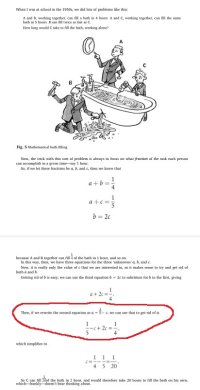
The given problem has already done step one, except that the third equation by my method reads [imath] b-2c=0. [/imath] Step two gives us [imath] a=\dfrac{1}{4}-b [/imath] from the first equation. Step three then is the following system:
[math]\begin{array}{lll}
\left(a=\dfrac{1}{4}-b\right)&\\[8pt]
a+c&=\dfrac{1}{4}-b+c=\dfrac{1}{5}\\[8pt]
b-2c&=0
\end{array}[/math]
These are now two equations with two unknowns, [imath] b [/imath] and [imath] c. [/imath] Now, we start again with step one
[math]\begin{array}{lll}
\dfrac{1}{4}-b+c&=\dfrac{1}{5} \Longrightarrow -b+c=\dfrac{1}{5}-\dfrac{1}{4}=-\dfrac{1}{20}\\[8pt]
b-2c&=0
\end{array}[/math]
Step two gives us [imath] b=c+\dfrac{1}{20} [/imath] and step three, plugging it into the last equation, yields
[math]\begin{array}{lll}
b-2c=c+\dfrac{1}{20}-2c=-c+\dfrac{1}{20}=0 \Longrightarrow c=\dfrac{1}{20}
\end{array}[/math]
For the other variables, go backward to the previous equations with your knowledge of [imath] c. [/imath] We then have
[math]\begin{array}{lll}
b=2c=\dfrac{2}{20}=\dfrac{1}{10}\\[8pt]
a=\dfrac{1}{4}-b=\dfrac{1}{4}-\dfrac{1}{10}=\dfrac{5}{20}-\dfrac{2}{20}=\dfrac{3}{20}
\end{array}[/math]
This is not the most elegant way, or the shortest, but it works. E.g., we could reorder the variables and start with [imath] b=2c [/imath] and substitute [imath] b [/imath] everywhere so we will be left with equations in [imath] a [/imath] and [imath] c. [/imath]
There is a shortcut for two equations and two variables, but I don't want to confuse you. It's a kind of magical trick.