jnicholson926
New member
- Joined
- Mar 1, 2015
- Messages
- 5
.
Last edited:

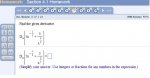
In my homework on pearsonmymathlabandmastering we get homework after every class and we have just gone over derivatives, I think I am in decent shape except for one problem and I keep missing it. Can someone show me how to get the solution for:
Find the given derivative.
dx (5x^-1/3) + (3/x^5/3)
Thanks, Jon

What is -5/3 - 3/3 = -5/3 + (-3/3) = (-5 + (-3))/3?3. Constant times a function rule
5* Dx (x^-1/3) + 3* Dx (x^-5/3)
4. Then power rule ( this is where I mess everything up even though I know what a power rule is and what it does I always write it wrong for this resulting in another question coming up.)
5( -1/3x^-5/3) + 3(???)

Yes; I saw that. Since you did not explain how you're "stuck" at the point you'd indicated, I guessed that you were having trouble with the fractional power on the variable, and provided a hint. Is your difficulty with some other aspect of the exercise?the exponents on x, they are fractions.
Okay. We can't help you fix errors until we can see all of your work so far. What did you do with the fraction help I'd provided earlier?No I just cannot get to the solution that is as far as I get. Everything gets tangled and I cannot see where the other exponents to finish the problem come from, I have missed this type of problem several times.
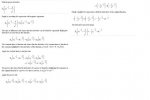
The problem should be an attachment this is what I would get when I do it with a step by step. Sorry about all the numbers here it's hard to see what is all going on.
Dx: (5x^-1/3 + 3/x^5/3)
1. Begin by rewriting expression with negative exponents
(5x^-1/3 + 3x^ -5/3)
2. Then I use the Sum or Difference rule
Dx (5x^-1/3) + Dx (3x^-5/3)
3. Constant times a function rule
5* Dx (x^-1/3) + 3* Dx (x^-5/3)
4. Then power rule ( this is where I mess everything up even though I know what a power rule is and what it does I always write it wrong for this resulting in another question coming up.)
5( -1/3x^-5/3) + 3[{-5/3}x^(-8/3)]
5. Then simplify but I am lost by this point.