
Chain Rule to get the Derivative

hopelynnwelch

Junior Member
Joined
Jan 16, 2015
Messages
60
f(x)=ln((e^x-e^(-x))/x)

Here is what I have done:

f(x)=ln(e^x-e^(-x))-ln(x)

f(x)=(e^x+e^(-x))/(e^x-e^(-x)) - (1/x)

f(x)=(xe^x+xe^(-x)-e^x+e^(-x))/(x(e^x-e^(-x))

but the derivative calculator I use to check my work and make sure that I am understanding these is giving me this:
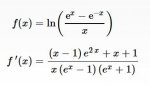
DCALC.JPG

I have no idea how to get there. Need some help please!
 
f(x)=ln((e^x-e^(-x))/x)

Here is what I have done:

f(x)=ln(e^x-e^(-x))-ln(x)

f(x)=(e^x+e^(-x))/(e^x-e^(-x)) - (1/x)

f(x)=(xe^x+xe^(-x)-e^x+e^(-x))/(x(e^x-e^(-x))

but the derivative calculator I use to check my work and make sure that I am understanding these is giving me this:

View attachment 4976

I have no idea how to get there. Need some help please!
You are correct but to get the other answer start with your
f'(x)=(xe^x+xe^(-x)-e^x+e^(-x))/(x(e^x-e^(-x))
= (xex+xe-x-ex+e-x)/(x(ex-e-x)
collect terms for ex and e-x
f'(x) = \(\displaystyle \frac{(x-1) e^x + (x+1)e^{-x}}{x (e^x - e^{-x})}\)
multiply through top and bottom by ex
f'(x) = \(\displaystyle \frac{(x-1) e^{2x} + (x+1)}{x (e^{2x} - 1)}\)
Now note that the denominator contains a difference of squares and factor it into the sum and difference
f'(x) = \(\displaystyle \frac{(x-1) e^{2x} + x + 1}{x (e^x - 1) (e^x+1)}\)
 
okay. i am trying this by putting 1 over e^x for all the e^(-x)'s because e^-x is really 1/e^x

So I am now getting it down to this:

(xe^(2x)+x-e^(2x)-1)/(x(e^x+1)(e^x-1))

Is my numerator right? I'm trying to get where you went this way. I can go back and try it your way too though.
 
Top