Challenge

logistic_guy

Senior Member
Joined
Apr 17, 2024
Messages
2,213
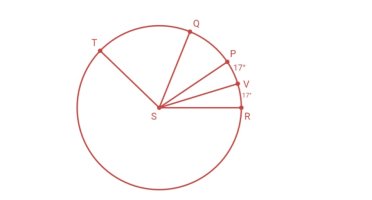
\(\displaystyle \overrightarrow{SQ}\) bisects \(\displaystyle \angle RST\), \(\displaystyle \overrightarrow{SP}\) bisects \(\displaystyle \angle RSQ\), and \(\displaystyle \overrightarrow{SV}\) bisects \(\displaystyle \angle RSP\). The measure of \(\displaystyle \angle VSP\) is \(\displaystyle 17^{\circ}\). Find \(\displaystyle m\angle TSQ\). Explain.
 
Beer drenched reaction follows.
\(\displaystyle \overrightarrow{SQ}\) bisects \(\displaystyle \angle RST\), \(\displaystyle \overrightarrow{SP}\) bisects \(\displaystyle \angle RSQ\), and \(\displaystyle \overrightarrow{SV}\) bisects \(\displaystyle \angle RSP\). The measure of \(\displaystyle \angle VSP\) is \(\displaystyle 17^{\circ}\). Find \(\displaystyle m\angle TSQ\). Explain.
\(\displaystyle \textcolor{blue}{68^{\circ}}\)


Well, I will leave this part for the audience to think!
Relax laddie.
This is hardly a challenge and there's very little to think about.

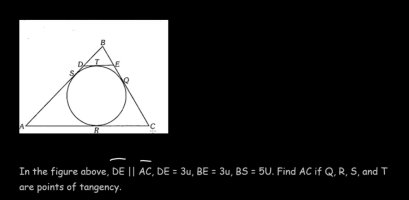
Screenshot_20250804-212038_Chrome.jpg

Maybe you'll enjoy this little challenge that I came across sometime ago.

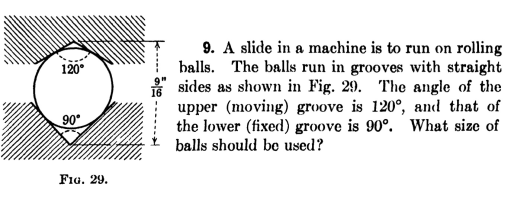
Screenshot_20250804-204935_Gallery.jpg
 
Last edited:
This is hardly a challenge and there's very little to think about.
It is. The difficulty is not how to find the value of the angle after you get the right sketch. It is rather how to sketch the given information correctly. And thank you for the sketch babie!

Maybe you'll enjoy this little challenge that I came across sometime ago.
Sure. I will work on it. But I don't cheat, so it will take me some time! We are able to solve problems related to the collision of two atoms, do you think that this problem is more difficult?

😏😏
 
Last edited:
Beer drenched non sequitur ramblings follow.

Once you have their money, you never give it back.
At first glance. I have noticed the following.

\(\displaystyle \Delta ABC \sim \Delta DBE\)

Then,

\(\displaystyle \frac{AB}{DB} = \frac{BC}{BE} = \frac{AC}{DE}\)

I am half way to the glory!

😍🥳🤩
 
Beer drenched reaction follows.
... We are able to solve problems related to the collision of two atoms, ...
What's this "We"?
Are you referring to just yourself, your ego, your echo, and your shadow?
Or is there more than one person behind logistic_guy's username/account?
It would sure explain a lot on how logistic_guy seems incompetent with rather simple geometry stuff and yet looking like some capable jack of all trades in other posts if it's the latter case.
Just wondering.
 
What's this "We"?
We \(\displaystyle \rightarrow\) me, myself, and mario\(\displaystyle 99\).

It could also refer to anyone who understands quantum theory and the models of the atom.

You, Aion, Highlander, professor Dave, and many others have been solving geometry for years. It is true that you all are better than me (for now) in this field as I have just started recently, but I have collected enough Theorems and ideas to push me forward.

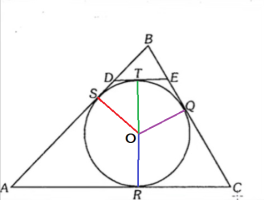
Now I am trying to understand how the circle inscribed inside is going to help me solve this problem. I made the point \(\displaystyle O\) as the center of the circle. Now we have this extra information:

\(\displaystyle SO = TO = QO = RO\)

It is better to provide a sketch for future calculations.
jonah_3.png


Also we have:

\(\displaystyle AS = AR\)
\(\displaystyle CQ = CR\)
\(\displaystyle BS = BQ\)

you'll enjoy this little challenge
You're right, I am enjoying by figuring out little facts about this problems slowly. Because I don't like to cheat I will have to open my geometry book and read more about the properties of circles inscribed inside triangles.

 
Last edited:
I spent a lot of time to come up with the following.

In post number \(\displaystyle 6\), I said:

\(\displaystyle \frac{AB}{DB} = \frac{BC}{BE} = \frac{AC}{DE}\)

For now, I will use:

\(\displaystyle \frac{BC}{BE} = \frac{AC}{DE}\)

Or

\(\displaystyle \frac{BQ + QC}{BE} = \frac{AR + RC}{DE}\)

Or

\(\displaystyle \frac{5 + QC}{3} = \frac{AR + RC}{3}\)

We know that \(\displaystyle QC = RC\), then

\(\displaystyle \frac{5 + RC}{3} = \frac{AR + RC}{3}\)

\(\displaystyle 5 + RC = AR + RC\)

\(\displaystyle AR = 5\)

We know that

\(\displaystyle BQ = BS = 5\)

\(\displaystyle BQ = BE + EQ\)

\(\displaystyle EQ = BQ - BE = 5 - 3 = 2\)

\(\displaystyle ET = EQ = 2\)

\(\displaystyle DT = DE - ET = 3 - 2 = 1\)

\(\displaystyle DS = DT = 1\)

\(\displaystyle BD = BS - DS = 5 - 1 = 4\)

We go back to post # \(\displaystyle 6\)

\(\displaystyle \frac{AB}{DB} = \frac{BC}{BE} = \frac{AC}{DE}\)

I will use now:

\(\displaystyle \frac{AB}{DB} = \frac{AC}{DE}\)

Or

\(\displaystyle \frac{AS + SB}{DB} = \frac{AC}{DE}\)

\(\displaystyle AS = AR = 5\), then

\(\displaystyle \frac{5 + 5}{4} = \frac{AC}{3}\)

\(\displaystyle \frac{10}{4} = \frac{AC}{3}\)

\(\displaystyle \frac{5}{2} = \frac{AC}{3}\)

\(\displaystyle 15 = 2AC\)

Or

\(\displaystyle AC = \frac{15}{2} = \textcolor{blue}{7.5 \ \text{u}}\)
 
Quite an interesting little problem though the solution is fairly straightforward when you spot the optimal approach but that led me to wonder what convoluted and tortuous attempts (employing Double Integration? lmao.🤣) the Village Idiot might post (over the next few weeks)!

I wouldn't normally see them (since I have him on Ignore) but if you, or anyone else, were to respond to whatever drivel he comes up with, I would then get an email re a new post in this topic and would (automatically) just hit the "View this thread" button and then be exposed to his detritus (and would feel obliged to read it just to see how far off the mark he wanders!).

I decided, therefore, just to provide (the simplest?) solution in the hope that he might not bother to post anything further in the thread (as it would be utterly redundant) --- though he has had the effrontery in the past to suggest that his outlandish method(s) are actually "better" than the way other people (who know what they're doing) solve Geometric problems. (See this thread, for example! lol.😂)

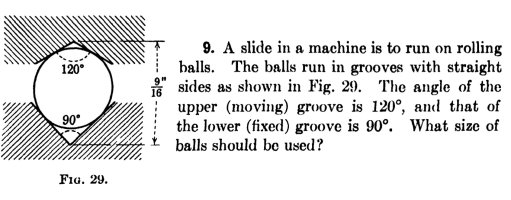
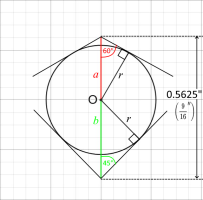
So, first, re-drawing (accurately, in Desmos) the situation described focussing on the main features and incorporating salient additions, one might get this...


Slide.png

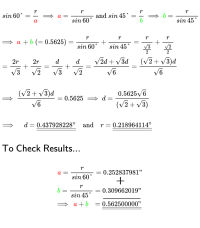
Now, let d be the diameter of the ball and r its radius (and so 2r = d, of course), then...
Calcs.png
I have just worked to the "accuracy" of my wee (Poundland, lol.🙂👍) calculator since, having used exact values throughout, there were only four calculations needing to be done on it. Of course anything beyond six decimal places is tosh! Ball-bearings can be precision ground to within millionths of an inch but I very much doubt if this application would require that level of finish.

I would, therefore, just round my final answer to no more than four decimal places (esp. since the only number provided in the question was accurate to that level), so my final answer would be:-

Balls of 0.4379 inch diameter should be used.

(Though I suspect that, in practice, balls (readily) available in an Imperial size would actually be used, for example,
\(\displaystyle \frac{7}{16}\) (0.4375) inch diameter balls might be available (cheaply and in abundance) "off the shelf" and, given that there is only four ten-thousandths of an inch difference involved, I reckon they would work fine!

I trust that will provide a suitable conclusion to this thread (and we need see no further ramblings from our local numpty, lol).

Cheers. 😊
 
Beer drenched reaction follows.
... but that led me to wonder what convoluted and tortuous attempts (employing Double Integration? lmao.🤣) the Village Idiot might post (over the next few weeks)! ...
But seeing them convoluted and tortuous attempts have become a major source of my amusement! Notwithstanding your post, knowing him, he will definitely "ignore" or as he likes to put it, "not cheat" by not looking at your post and put up his own "original personal attempt" of a solution (even emphasizing further that he did not peek at your solution suggestion although it's already right in front of him).

P.S. I'm unable to duplicate on my phone that trick you do when you're quoting someone's attachment where you are somehow able to reduce its display.
 
Beer drenched reaction follows.

P.S. I'm unable to duplicate on my phone that trick you do when you're quoting someone's attachment where you are somehow able to reduce its display.
Hi Jonah,

I presume the "
trick" you are referring to is what I explained here (at the end of this thread: "very simple trigonometry & geometry").

If I remember correctly, it was you who asked me how I managed to get an actual image (rather than a hyperlink to it) to appear when 'quoting' previous posts in my replies, yes?

I do have a (not anywhere near as feckin') smart (as it thinks it is or I'd like it to be. lol) phone but I stringently avoid (as far as humanly possible) doing anything on the Internet with it!

Everything I do in here is done on my Desktop PC.

I'm afraid that, if the procedure I outlined in my previous response to your query doesn't work on your phone, then I simply cannot offer any advice on how to achieve the same result on a mobile; I just don't have any expertise in that area. 🤷‍♂️

Sorry. 😢

(But) Hope that helps. 😊
 
Top