
Hello all,
i'm not a student, just want to make my point to a friend in an argument but failed to calculate the probabilities.
We have a pool of 400 elements (let's say balls), where 4 elements are special (let's say red) and 396 elements are normal (let's say black). We are taking a random sample from this pool. The samplesize is 10.
I want to calculate 3 probabilities:
1. The probabitity that no red ball ends up in our sample.
2. The probability that exactly 1 red ball ends up in our sample.
3. The probability that all 4 red balls end up in our sample.
**************************************************************************
The first was easy (i guess). In our first draw the probability of black ball is 396/400, in the second draw it is 395/399... in the 10. draw it is 387/391. If we multiply them, we get 90,3338%
**********************************************************
The second one: i'm sure, there's an easier way, but i calculated the probability that i will draw a red ball at first 4/400, then only black balls 396/399, 395/398.... 388/391. Then multipied them, so at the end i got that the probability that i draw one red ball first and all the others are black is 0,933683%
Because the red ball can be anywhere in the 10 spots, i multiplied this probability by 10 and got that the probability of having exactly 1 red ball is 9,33683%
Please check if this calculation is correct, and i'm sure, there is an easier way, please, could you show me!
***********************
The third one: I'm completly stuck! I tried to draw a tree like
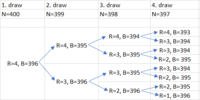
but realized, that it would take a lot of time, to reach the 10. draw, because at the end it will have 2^10 rows.
Please, could you show me, how to calculate this!
Thank you for your help (and sorry for my english)
i'm not a student, just want to make my point to a friend in an argument but failed to calculate the probabilities.
We have a pool of 400 elements (let's say balls), where 4 elements are special (let's say red) and 396 elements are normal (let's say black). We are taking a random sample from this pool. The samplesize is 10.
I want to calculate 3 probabilities:
1. The probabitity that no red ball ends up in our sample.
2. The probability that exactly 1 red ball ends up in our sample.
3. The probability that all 4 red balls end up in our sample.
**************************************************************************
The first was easy (i guess). In our first draw the probability of black ball is 396/400, in the second draw it is 395/399... in the 10. draw it is 387/391. If we multiply them, we get 90,3338%
| 1. draw | 2. draw | 3. draw | 4. draw | 5. draw | 6. draw | 7. draw | 8. draw | 9. draw | 10. draw | |
| Number of black | 396 | 395 | 394 | 393 | 392 | 391 | 390 | 389 | 388 | 387 |
| Number of balls | 400 | 399 | 398 | 397 | 396 | 395 | 394 | 393 | 392 | 391 |
| Prob. | 0,99 | 0,989975 | 0,9899497 | 0,989924 | 0,989899 | 0,989873 | 0,989848 | 0,989822 | 0,989796 | 0,98977 |
| Prob. all: | 0,903338319 |
**********************************************************
The second one: i'm sure, there's an easier way, but i calculated the probability that i will draw a red ball at first 4/400, then only black balls 396/399, 395/398.... 388/391. Then multipied them, so at the end i got that the probability that i draw one red ball first and all the others are black is 0,933683%
| 1. draw | 2. draw | 3. draw | 4. draw | 5. draw | 6. draw | 7. draw | 8. draw | 9. draw | 10. draw | |
| Number of red | 4 | |||||||||
| Number of black | 396 | 395 | 394 | 393 | 392 | 391 | 390 | 389 | 388 | |
| Number of balls | 400 | 399 | 398 | 397 | 396 | 395 | 394 | 393 | 392 | 391 |
| Prob. | 0,01 | 0,992481 | 0,9924623 | 0,992443 | 0,992424 | 0,992405 | 0,992386 | 0,992366 | 0,992347 | 0,992327 |
| Prob. all. | 0,00933683 |
Because the red ball can be anywhere in the 10 spots, i multiplied this probability by 10 and got that the probability of having exactly 1 red ball is 9,33683%
Please check if this calculation is correct, and i'm sure, there is an easier way, please, could you show me!
***********************
The third one: I'm completly stuck! I tried to draw a tree like
but realized, that it would take a lot of time, to reach the 10. draw, because at the end it will have 2^10 rows.
Please, could you show me, how to calculate this!
Thank you for your help (and sorry for my english)


