The question reads : Delegates from 24 countries participate in a round table discussion. Find the number of seating arrangements where two specified delegates are never adjacent.
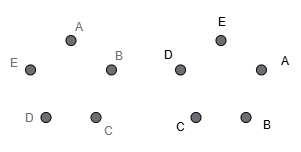
I don't know why I always feel confident after manually calculating the arrangements. I took total delegates to be from 5 countries as a prototype viz: ABCDE(It gave me 120 ways). I arranged them normally in a straight line and eliminated those arrangements which had AE or EA adjacent including those having A or E at the ends as clockwise or anticlockwise would not be seen as a distinct arrangement. Now I took those arrangements which have neither DC nor CD adjacent to each other including at the both ends. I am getting 40 arrangements.
Answer is supposed to be 12 ways using complement method( i.e Total number of circular arrangements of 5 delegates - Total number of arrangements in which CD are always adjacent.) If I want to know the number of arrangements without complement method is there a way?
First I would like to solve prototype.
I don't know why I always feel confident after manually calculating the arrangements. I took total delegates to be from 5 countries as a prototype viz: ABCDE(It gave me 120 ways). I arranged them normally in a straight line and eliminated those arrangements which had AE or EA adjacent including those having A or E at the ends as clockwise or anticlockwise would not be seen as a distinct arrangement. Now I took those arrangements which have neither DC nor CD adjacent to each other including at the both ends. I am getting 40 arrangements.
Answer is supposed to be 12 ways using complement method( i.e Total number of circular arrangements of 5 delegates - Total number of arrangements in which CD are always adjacent.) If I want to know the number of arrangements without complement method is there a way?
First I would like to solve prototype.