
I have one last Q on combinatorics.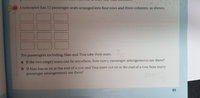
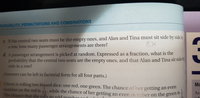
I have one last Q (I hope) on the topic and I am stuck on part (c). The answer seems obvious but I disagree slightly with the answer book. I think there are 4 possible positions that Alan and Tina may take, its top left or right, or bottom left or right. Since they can arrange themselves. So the total arrangements are 8 x 9! if you think of A and T as a container. But the book says answer is 8 x 8!. Its a slight disagreement. I am pretty sure my answer is wrong ! I wish I had not asked such a pedantic question. However I am completely unsure about part (d). I think the probability of part (c) divided by total arrangements. I think its 8*8! divided by 12!/2!, my answer is 2/1485
I have one last Q (I hope) on the topic and I am stuck on part (c). The answer seems obvious but I disagree slightly with the answer book. I think there are 4 possible positions that Alan and Tina may take, its top left or right, or bottom left or right. Since they can arrange themselves. So the total arrangements are 8 x 9! if you think of A and T as a container. But the book says answer is 8 x 8!. Its a slight disagreement. I am pretty sure my answer is wrong ! I wish I had not asked such a pedantic question. However I am completely unsure about part (d). I think the probability of part (c) divided by total arrangements. I think its 8*8! divided by 12!/2!, my answer is 2/1485
Last edited:

