Complicated limit question

jkjames

New member
Joined
Sep 26, 2015
Messages
3
Hello! I just signed up to this forum, mainly to ask this question but after clicking a few threads it seems like a good place.

This is the final question of my Calculus assignment and I can't figure it out at all.

lim x^4 sin (1/cube root of x)
x-0+

If someone can help me simplify this so I can find the limit I would really appreciate it. Thank you.
 
This is the final question of my Calculus assignment and I can't figure it out at all.

lim x^4 sin (1/cube root of x)
x-0+
This is where you need that one limit that they made such a big deal about; namely:

. . . . .\(\displaystyle \displaystyle \lim_{\theta\, \rightarrow \, 0} \dfrac{\sin(\theta)}{\theta}\, =\, 1\)

In your case, you'll need to edit things a bit in order to put things into the correct form. You have:

. . . . .\(\displaystyle \displaystyle \lim_{x\, \rightarrow \, 0^+} \, \left(\, x^4\, \sin\left(\dfrac{1}{\sqrt[3]{x}}\right)\, \right)\)

Note that the cube root is the one-third power, and that the fourth power is also the twelve-thirds power. In other words:

. . . . .\(\displaystyle x^{12/3}\, \sin\left(x^{-1/3}\right)\, =\, \left(\dfrac{x^{13/3}}{x^{-1/3}}\right)\, \sin\left(x^{-1/3}\right)\, =\, \left(x^{13/3}\right)\, \left(\dfrac{\sin\left(x^{-1/3}\right)}{x^{-1/3}}\right)\)

Can you see now how to proceed? ;)
 
Can you see now how to proceed? ;)

Hello! Thank you for your prompt reply. I tried to work on it further, and I think I have the answer. I'm a pretty bad first year student, I've been out of high school for many years so this stuff is like re-learning everything.

From there on I got ((x^13/3)/(x^-1/3)) * (sin(x^-1/3)/x^-1/3)

Giving me x^12/3 which equalled x^4 and the answer 0

Is this correct?

Thanks again.
 
Hello! I just signed up to this forum, mainly to ask this question but after clicking a few threads it seems like a good place.

This is the final question of my Calculus assignment and I can't figure it out at all.

lim x^4 sin (1/cube root of x)
x-0+

If someone can help me simplify this so I can find the limit I would really appreciate it. Thank you.

The way I would tackle it would be to note
0 \(\displaystyle \le\) |x4 sin(x-1/3)| \(\displaystyle \le\) x4 Now what happen to the left and right hand side when x goes to zero.
 
From there on I got ((x^13/3)/(x^-1/3)) * (sin(x^-1/3)/x^-1/3)
Where did the new factor (being the second cube root of x) come from? By what mathematical reasoning what this added?

Please be complete. Thank you! ;)
 
Where did the new factor (being the second cube root of x) come from? By what mathematical reasoning what this added?

Please be complete. Thank you! ;)

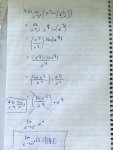
Hi! Sorry for the late reply and thanks again for your help, I've attached a picture of what I've done with all the steps to get that answer. If you wouldn't mind please let me know what I've done wrong, thank you.
 

Attachments

  • IMG_0596.JPG
    IMG_0596.JPG
    331.9 KB · Views: 4
Well, there are two small errors, but I don't believe that either effects the answer. The first error comes in this step here:

\(\displaystyle \displaystyle \lim _{x\to 0^+}\left(x^{\frac{12}{3}}sin\left(x^{-\frac{1}{3}}\right)\right)\)

Stapel wrote the following, and you copied it with analyzing it, but it's wrong...

\(\displaystyle x^{\frac{12}{3}}=\frac{x^{\frac{13}{3}}}{x^{-\frac{1}{3}}}\)

If you apply the rules of exponents, that equals x13/3 - (-1/3) = x14/3. Thinking about that, what you really want is:

\(\displaystyle x^{\frac{12}{3}}=\frac{x^{\frac{11}{3}}}{x^{-\frac{1}{3}}}\)

Which will give you x11/3 - (-1/3) = x12/3 = x4

The next error comes in this step (I've corrected the previous error, btw):

\(\displaystyle \frac{x^{\frac{11}{3}}\cdot sin\left(x^{-\frac{1}{3}}\right)}{x^{-\frac{1}{3}}}\)

Now, you have a fraction of the form \(\displaystyle \frac{ab}{c}\), which you've then interpreted to mean:

\(\displaystyle \frac{a}{c}\cdot \frac{b}{c}=\frac{ab}{c^2}\)

Can you see why that's not right? And see what you should do to correct it? ;)

All errors accounted for, you'll get down to the end and have:

\(\displaystyle \displaystyle \lim _{x\to 0^+}\left(x^{\frac{11}{3}}\right)=0^{\frac{11}{3}}=0\)

And finally... one last niggling detail. When you say the limit equals 0, you also wrote DNE. Why are you saying that a limit which equals 0, "does not exist?"

 
Top