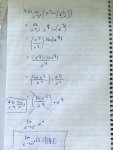
Well, there are two small errors, but I don't believe that either effects the answer. The first error comes in this step here:
\(\displaystyle \displaystyle \lim _{x\to 0^+}\left(x^{\frac{12}{3}}sin\left(x^{-\frac{1}{3}}\right)\right)\)
Stapel wrote the following, and you copied it with analyzing it, but it's wrong...
\(\displaystyle x^{\frac{12}{3}}=\frac{x^{\frac{13}{3}}}{x^{-\frac{1}{3}}}\)
If you apply the rules of exponents, that equals x
13/3 - (-1/3) = x
14/3. Thinking about that, what you really want is:
\(\displaystyle x^{\frac{12}{3}}=\frac{x^{\frac{11}{3}}}{x^{-\frac{1}{3}}}\)
Which will give you x
11/3 - (-1/3) = x
12/3 = x
4
The next error comes in this step (I've corrected the previous error, btw):
\(\displaystyle \frac{x^{\frac{11}{3}}\cdot sin\left(x^{-\frac{1}{3}}\right)}{x^{-\frac{1}{3}}}\)
Now, you have a fraction of the form \(\displaystyle \frac{ab}{c}\), which you've then interpreted to mean:
\(\displaystyle \frac{a}{c}\cdot \frac{b}{c}=\frac{ab}{c^2}\)
Can you see why that's not right? And see what you should do to correct it?

All errors accounted for, you'll get down to the end and have:
\(\displaystyle \displaystyle \lim _{x\to 0^+}\left(x^{\frac{11}{3}}\right)=0^{\frac{11}{3}}=0\)
And finally... one last niggling detail. When you say the limit equals 0, you also wrote DNE. Why are you saying that a limit which equals 0, "does not exist?"