Hello everyone,
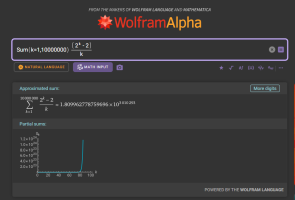
I’ve been investigating the sum:
S(n) = Σ_{k=1}^{n} (2^k - 2)/k for n > 3.
Conjecture (strong numerical evidence):
n^2 divides the numerator of S(n) ⇔ n is prime.
What’s proven / known:
- S(n) can be rewritten as:
S(n) = Σ 2^k/k - 2 Σ 1/k
- Using Wolstenholme’s theorem: for prime p>3,
H_{p-1} ≡ 0 mod p^2 ⇒ H_p ≡ 1/p mod p^2
- Partial symmetry ideas (k ↔ p-k) seem promising for the 2^k/k term, but no full proof yet.
My questions:
1. How to rigorously handle Σ 2^k/k modulo p^2 using p-adic or combinatorial methods?
2. How to prove the converse: that composites never give p^2 divisibility?
Numerical checks confirm the conjecture for many small primes and composites.
Any references, ideas, or techniques that could be applied here would be greatly appreciated!
Thank you!
I’ve been investigating the sum:
S(n) = Σ_{k=1}^{n} (2^k - 2)/k for n > 3.
Conjecture (strong numerical evidence):
n^2 divides the numerator of S(n) ⇔ n is prime.
What’s proven / known:
- S(n) can be rewritten as:
S(n) = Σ 2^k/k - 2 Σ 1/k
- Using Wolstenholme’s theorem: for prime p>3,
H_{p-1} ≡ 0 mod p^2 ⇒ H_p ≡ 1/p mod p^2
- Partial symmetry ideas (k ↔ p-k) seem promising for the 2^k/k term, but no full proof yet.
My questions:
1. How to rigorously handle Σ 2^k/k modulo p^2 using p-adic or combinatorial methods?
2. How to prove the converse: that composites never give p^2 divisibility?
Numerical checks confirm the conjecture for many small primes and composites.
Any references, ideas, or techniques that could be applied here would be greatly appreciated!
Thank you!