hi, I'm struggling with this decision tree question:
A part of an aircraft engine can be given a test before installation. The test has only a 75 % chance of revealing a defect if it is present, and the same chance of passing a sound (good) part. Whether or not the part has been tested it may undergo an expensive rework operation which is certain to produce a part free from defects. The cost of rework is £1000. If a defective part is installed in the engine the loss is £5000. Suppose 1 in 8 of parts are initially defective, and the cost of the test is £C.
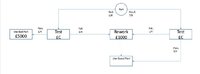
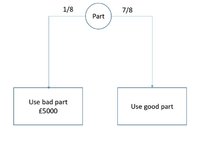
(a) Draw the decision tree, evaluate all probabilities and determine, in terms of C, all the optimal decisions.
(b) How much should the manager be willing to pay for the test?
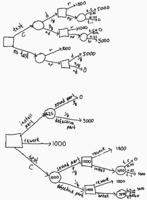
I know it's probably a simple question, and I understand the basics, but I'm having trouble processing the wording, and what I have so far doesn't feel like it's the right answer. I have attached what I have done so far(sorry it's messy, as it was rough work), if someone could give me some help as where I have gone wrong that would be great.
Thank you.
A part of an aircraft engine can be given a test before installation. The test has only a 75 % chance of revealing a defect if it is present, and the same chance of passing a sound (good) part. Whether or not the part has been tested it may undergo an expensive rework operation which is certain to produce a part free from defects. The cost of rework is £1000. If a defective part is installed in the engine the loss is £5000. Suppose 1 in 8 of parts are initially defective, and the cost of the test is £C.
(a) Draw the decision tree, evaluate all probabilities and determine, in terms of C, all the optimal decisions.
(b) How much should the manager be willing to pay for the test?
I know it's probably a simple question, and I understand the basics, but I'm having trouble processing the wording, and what I have so far doesn't feel like it's the right answer. I have attached what I have done so far(sorry it's messy, as it was rough work), if someone could give me some help as where I have gone wrong that would be great.
Thank you.