
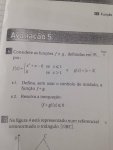
How do you do 6.1) ?????? (it's on the picture annexed to this!!!) They tell us to: define, without using the module, the function f+g . ???
\(\displaystyle \mbox{6. Consider the functions }\, f\, \mbox{ and }\, g,\, \mbox{ defined on }\, \mathbb{R},\, \mbox{ for:}\)
. . . . .\(\displaystyle f(x)\, =\, \begin{cases}x^2\, +\, x\, -\, 6,&\mbox{for }\, x\, \leq\, 1\\0,&\mbox{for }\, x\, >\, 1 \end{cases}\, \mbox{ and }\, g(x)\, =\, \bigg|\, x\, -\, 2\, \bigg|\)
\(\displaystyle \mbox{1. Define, without using the module (i.e., absolute-value) symbol, the function }\, f\, +\, g.\)
\(\displaystyle \mbox{2. Solve the inequality }\, \left(f\, +\, g\right)(x)\, \leq\, 0\)
\(\displaystyle \mbox{6. Consider the functions }\, f\, \mbox{ and }\, g,\, \mbox{ defined on }\, \mathbb{R},\, \mbox{ for:}\)
. . . . .\(\displaystyle f(x)\, =\, \begin{cases}x^2\, +\, x\, -\, 6,&\mbox{for }\, x\, \leq\, 1\\0,&\mbox{for }\, x\, >\, 1 \end{cases}\, \mbox{ and }\, g(x)\, =\, \bigg|\, x\, -\, 2\, \bigg|\)
\(\displaystyle \mbox{1. Define, without using the module (i.e., absolute-value) symbol, the function }\, f\, +\, g.\)
\(\displaystyle \mbox{2. Solve the inequality }\, \left(f\, +\, g\right)(x)\, \leq\, 0\)
Attachments
Last edited by a moderator: