
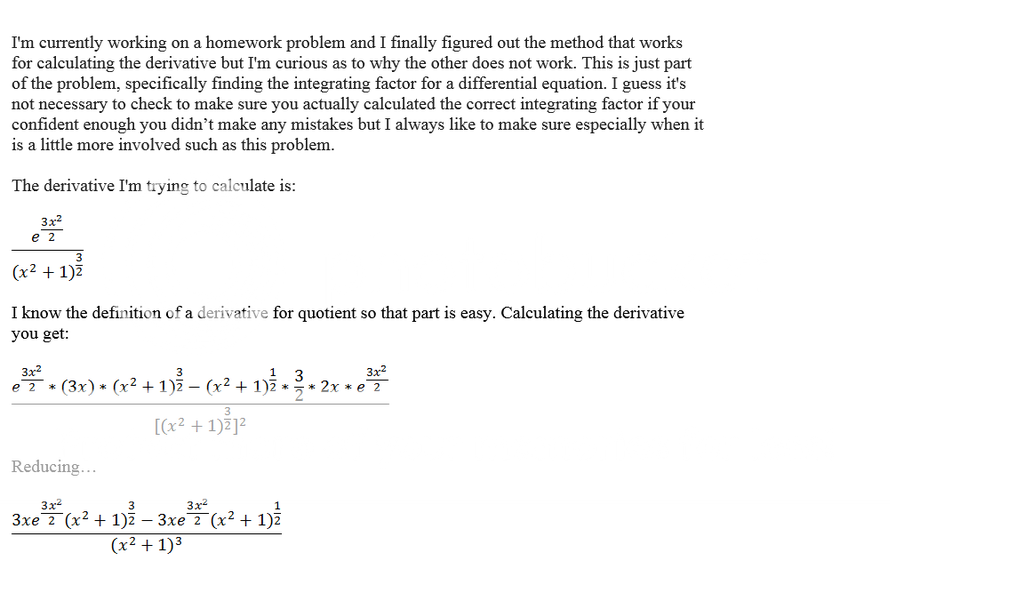
I'm currently working on a homework problem and I finally figured out the method that works for calculating the derivative but I'm curious as to why the other does not work. This is just part of the problem, specifically finding the integrating factor for a differential equation. I guess it's not necessary to check to make sure you actually calculated the correct integrating factor if your confident enough you didn’t make any mistakes but I always like to make sure especially when it is a little more involved such as this problem.
The derivative I'm trying to calculate is:
e^((3x^2)/2)/〖(x^2+1)〗^(3/2)
I know the definition of a derivative for quotient so that part is easy. Calculating the derivative you get:
(e^((3x^2)/2)*(3x)*〖(x^2+1)〗^(3/2)-〖(x^2+1)〗^(1/2)*3/2*2x*e^((3x^2)/2))/〖[〖(x^2+1)〗^(3/2)]〗^2
Reducing…
(3xe^((3x^2)/2) 〖(x^2+1)〗^(3/2)-3xe^((3x^2)/2) 〖(x^2+1)〗^(1/2))/〖(x^2+1)〗^3
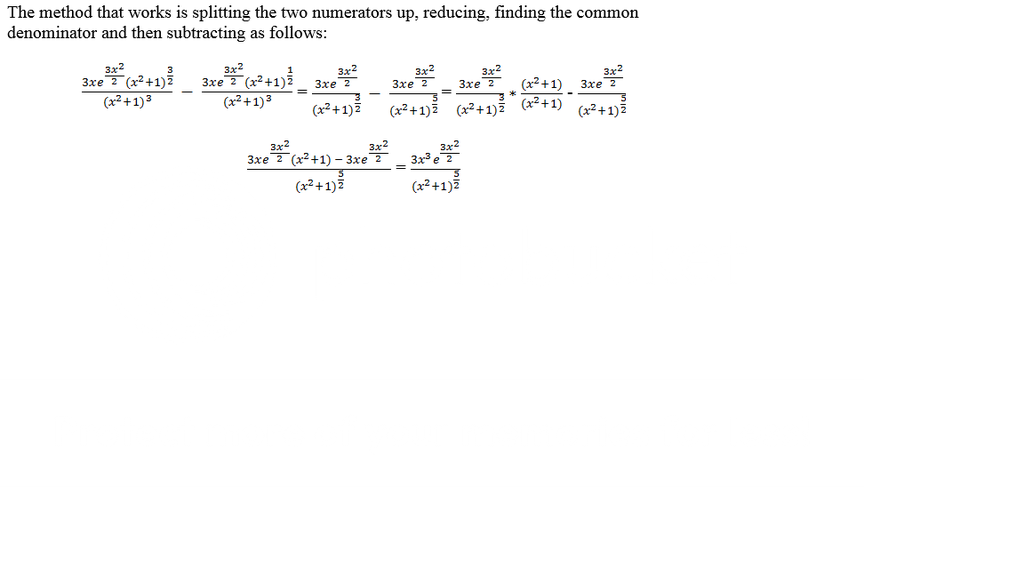
The method that works is splitting the two numerators up, reducing, finding the common denominator and then subtracting as follows:
(3xe^((3x^2)/2) 〖(x^2+1)〗^(3/2))/〖(x^2+1)〗^3 - (3xe^((3x^2)/2) 〖(x^2+1)〗^(1/2))/〖(x^2+1)〗^3 = (3xe^((3x^2)/2))/〖(x^2+1)〗^(3/2) - (3xe^((3x^2)/2))/〖(x^2+1)〗^(5/2) = (3xe^((3x^2)/2))/〖(x^2+1)〗^(3/2) *((x^2+1))/((x^2+1)) - (3xe^((3x^2)/2))/〖(x^2+1)〗^(5/2)
(3xe^((3x^2)/2) (x^2+1) - 3xe^((3x^2)/2) )/〖(x^2+1)〗^(5/2) = (3x^3 e^((3x^2)/2))/〖(x^2+1)〗^(5/2)
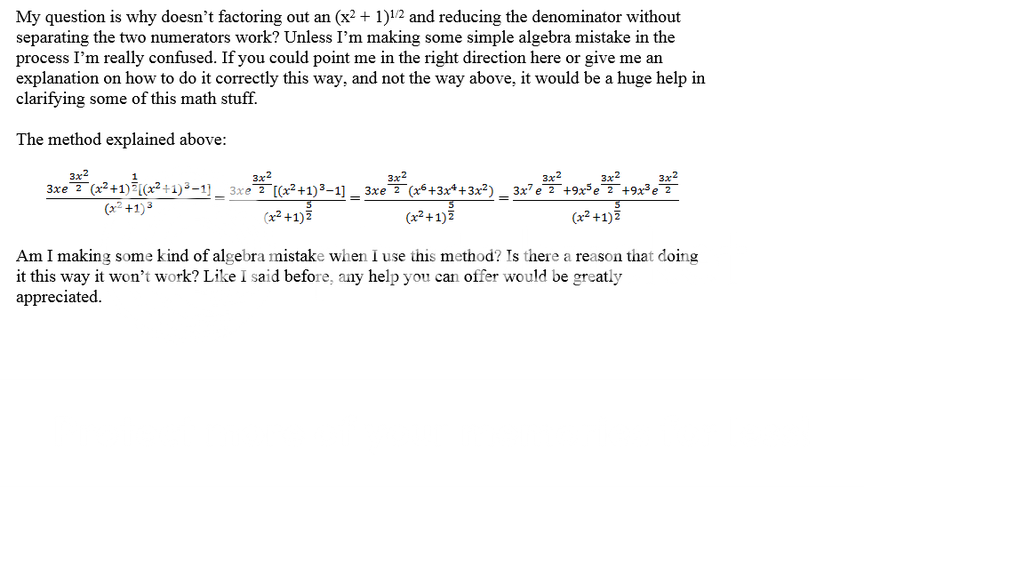
My question is why doesn’t factoring out an (x2 + 1)1/2 and reducing the denominator without separating the two numerators work? Unless I’m making some simple algebra mistake in the process I’m really confused. If you could point me in the right direction here or give me an explanation on how to do it correctly this way, and not the way above, it would be a huge help in clarifying some of this math stuff.
The method explained above:
(3xe^((3x^2)/2) 〖(x^2+1)〗^(1/2) [〖(x^2+1)〗^3-1])/〖(x^2+1)〗^3 = (3xe^((3x^2)/2) [〖(x^2+1)〗^3-1])/〖(x^2+1)〗^(5/2) = (3xe^((3x^2)/2) (x^6+〖3x〗^4+〖3x〗^2))/〖(x^2+1)〗^(5/2) = (3x^7 e^((3x^2)/2)+9x^5 e^((3x^2)/2)+9x^3 e^((3x^2)/2))/〖(x^2+1)〗^(5/2)
Am I making some kind of algebra mistake when I use this method? Is there a reason that doing it this way it won’t work? Like I said before, any help you can offer would be greatly appreciated.
*I tried pasting directly from word but the equations wouldn't transfer over, I'll try to attach a screen shot/clipping. It will definitely make this problem easier to see.
Part 1:
Part 2:
Part 3:
The derivative I'm trying to calculate is:
e^((3x^2)/2)/〖(x^2+1)〗^(3/2)
I know the definition of a derivative for quotient so that part is easy. Calculating the derivative you get:
(e^((3x^2)/2)*(3x)*〖(x^2+1)〗^(3/2)-〖(x^2+1)〗^(1/2)*3/2*2x*e^((3x^2)/2))/〖[〖(x^2+1)〗^(3/2)]〗^2
Reducing…
(3xe^((3x^2)/2) 〖(x^2+1)〗^(3/2)-3xe^((3x^2)/2) 〖(x^2+1)〗^(1/2))/〖(x^2+1)〗^3
The method that works is splitting the two numerators up, reducing, finding the common denominator and then subtracting as follows:
(3xe^((3x^2)/2) 〖(x^2+1)〗^(3/2))/〖(x^2+1)〗^3 - (3xe^((3x^2)/2) 〖(x^2+1)〗^(1/2))/〖(x^2+1)〗^3 = (3xe^((3x^2)/2))/〖(x^2+1)〗^(3/2) - (3xe^((3x^2)/2))/〖(x^2+1)〗^(5/2) = (3xe^((3x^2)/2))/〖(x^2+1)〗^(3/2) *((x^2+1))/((x^2+1)) - (3xe^((3x^2)/2))/〖(x^2+1)〗^(5/2)
(3xe^((3x^2)/2) (x^2+1) - 3xe^((3x^2)/2) )/〖(x^2+1)〗^(5/2) = (3x^3 e^((3x^2)/2))/〖(x^2+1)〗^(5/2)
My question is why doesn’t factoring out an (x2 + 1)1/2 and reducing the denominator without separating the two numerators work? Unless I’m making some simple algebra mistake in the process I’m really confused. If you could point me in the right direction here or give me an explanation on how to do it correctly this way, and not the way above, it would be a huge help in clarifying some of this math stuff.
The method explained above:
(3xe^((3x^2)/2) 〖(x^2+1)〗^(1/2) [〖(x^2+1)〗^3-1])/〖(x^2+1)〗^3 = (3xe^((3x^2)/2) [〖(x^2+1)〗^3-1])/〖(x^2+1)〗^(5/2) = (3xe^((3x^2)/2) (x^6+〖3x〗^4+〖3x〗^2))/〖(x^2+1)〗^(5/2) = (3x^7 e^((3x^2)/2)+9x^5 e^((3x^2)/2)+9x^3 e^((3x^2)/2))/〖(x^2+1)〗^(5/2)
Am I making some kind of algebra mistake when I use this method? Is there a reason that doing it this way it won’t work? Like I said before, any help you can offer would be greatly appreciated.
*I tried pasting directly from word but the equations wouldn't transfer over, I'll try to attach a screen shot/clipping. It will definitely make this problem easier to see.
Part 1:

Part 2:

Part 3:
