
Derivatives, refer to table to evaluate

dubb

New member
Joined
Oct 3, 2014
Messages
28
Hi,
I wanted to see if someone can verify the answer that I got, here is the question.

Refer to table to evaluate each expression.
here are the values for x=4
f(x) = 2
f ' (x) = 1
g(x) = 3
g ' (x) = 1

d/dx [ 2x^2+3/f(x)g(x) ] | x=4

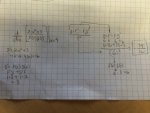
I got - 79/36, I attached a picture of my work (if you click on photo it gets larger so you can see). Thanks for your help!
 

Attachments

  • photo (1).jpg
    photo (1).jpg
    505.1 KB · Views: 3
Hi,
I wanted to see if someone can verify the answer that I got, here is the question.

Refer to table to evaluate each expression.
here are the values for x=4
f(x) = 2
f ' (x) = 1
g(x) = 3
g ' (x) = 1

d/dx [ 2x^2+3/{f(x)g(x)} ] | x=4

I got - 79/36, I attached a picture of my work (if you click on photo it gets larger so you can see). Thanks for your help!

\(\displaystyle \frac{d}{dx} \left[\dfrac{2x^2 + 3}{f(x)*g(x)}\right]\)

\(\displaystyle = \ \dfrac{\frac{d}{dx}(2x^2 + 3) \ \ * [f(x)*g(x)] \ - \ (2x^2 + 3) \ * \ \frac{d}{dx}[f(x)*g(x)]}{[f(x)*g(x)]^2}\)

Now continue.....
 
Last edited by a moderator:
Isn't the derivative of a quotient supposed to have a minus in the numerator?

[FONT=MathJax_Math-italic]d[/FONT][FONT=MathJax_Math-italic]d[/FONT][FONT=MathJax_Math-italic]x[/FONT][FONT=MathJax_Main]([/FONT][FONT=MathJax_Main]2[/FONT][FONT=MathJax_Math-italic]x[/FONT][FONT=MathJax_Main]2[/FONT][FONT=MathJax_Main]+[/FONT][FONT=MathJax_Main]3[/FONT][FONT=MathJax_Main])[/FONT][FONT=MathJax_Main] [/FONT][FONT=MathJax_Main] [/FONT][FONT=MathJax_Main]∗[/FONT][FONT=MathJax_Main][[/FONT][FONT=MathJax_Math-italic]f[/FONT][FONT=MathJax_Main]([/FONT][FONT=MathJax_Math-italic]x[/FONT][FONT=MathJax_Main])[/FONT][FONT=MathJax_Main]∗[/FONT][FONT=MathJax_Math-italic]g[/FONT][FONT=MathJax_Main]([/FONT][FONT=MathJax_Math-italic]x[/FONT][FONT=MathJax_Main])[/FONT][FONT=MathJax_Main]][/FONT][FONT=MathJax_Main] [/FONT][FONT=MathJax_Main]-[/FONT][FONT=MathJax_Main][/FONT][FONT=MathJax_Main] [/FONT][FONT=MathJax_Main]([/FONT][FONT=MathJax_Main]2[/FONT][FONT=MathJax_Math-italic]x[/FONT][FONT=MathJax_Main]2[/FONT][FONT=MathJax_Main]+[/FONT][FONT=MathJax_Main]3[/FONT][FONT=MathJax_Main])[/FONT][FONT=MathJax_Main] [/FONT][FONT=MathJax_Main]∗[/FONT][FONT=MathJax_Main] [/FONT][FONT=MathJax_Math-italic]d[/FONT][FONT=MathJax_Math-italic]d[/FONT][FONT=MathJax_Math-italic]x[/FONT][FONT=MathJax_Main][[/FONT][FONT=MathJax_Math-italic]f[/FONT][FONT=MathJax_Main]([/FONT][FONT=MathJax_Math-italic]x[/FONT][FONT=MathJax_Main])[/FONT][FONT=MathJax_Main]∗[/FONT][FONT=MathJax_Math-italic]g[/FONT][FONT=MathJax_Main]([/FONT][FONT=MathJax_Math-italic]x[/FONT][FONT=MathJax_Main])


So if I do the calculations from what you wrote I get 259/36[/FONT]
 
Top