
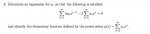
3. Determine an expression for \(\displaystyle a_n\) so that the following is satisfied:
. . . . .\(\displaystyle \displaystyle \sum_{n=1}^{\infty}\, \left(n\, a_n\, x^{n-1}\right)\, -\, 3\, \sum_{n=0}^{\infty}\, \left(a_n\, x^n\right)\, =\, 0\)
and identify the elementary function defined by the power series
. . . . .\(\displaystyle \displaystyle y(x)\, =\, \sum_{n=0}^{\infty}\, a_n\, x^n\)
I have figured out the expression for an should be:
a_n=(3^(n+1) a_0)/n!Xn
I also realize that ex= the power sum from 0 to infinity of X^n/n!
I am not sure how to write this a_n as the elementary function e^x
. . . . .\(\displaystyle \displaystyle \sum_{n=1}^{\infty}\, \left(n\, a_n\, x^{n-1}\right)\, -\, 3\, \sum_{n=0}^{\infty}\, \left(a_n\, x^n\right)\, =\, 0\)
and identify the elementary function defined by the power series
. . . . .\(\displaystyle \displaystyle y(x)\, =\, \sum_{n=0}^{\infty}\, a_n\, x^n\)
I have figured out the expression for an should be:
a_n=(3^(n+1) a_0)/n!Xn
I also realize that ex= the power sum from 0 to infinity of X^n/n!
I am not sure how to write this a_n as the elementary function e^x
Attachments
Last edited by a moderator: