

mrjust
New member
- Joined
- Dec 12, 2012
- Messages
- 24
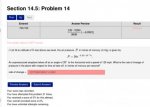
I saw a similar problem on here, but didn't quite understand it. I have tried to solve this using the method below using different approaches but I'm having trouble solving it. Can you tell me what I'm doing wrong? I'm about to give up on it.
I have tried the following,
first I found the partial derivative of P with respect to h
dp/dh = 30(-3.23*10^-5)e^(-3.23*10^-5h)
I set h=0 and this gave me :
grad P= 30(-3.23*10^-5)k
It is in the z direction because pressure only depends on height.
I should now find my directional derivative so this is what is got:
directional derivative = sqrt( {30(-3.23*10^-5)}^2)*cos(90+25)=-4.0952 (what are the units for this I'm unsure? Hg/ft?
I'm unsure of the value of theta. I think it should be that because grad P is pointing directly downward.
Now I converted my 120mph in to in/sec --> (120*5280*12)/3600 = 2112 in/sec
I think I'm getting lost at this step.
The quality of the picture is bad, here is a backup link..
http://bayimg.com/bAllPAaFH
I have tried the following,
first I found the partial derivative of P with respect to h
dp/dh = 30(-3.23*10^-5)e^(-3.23*10^-5h)
I set h=0 and this gave me :
grad P= 30(-3.23*10^-5)k
It is in the z direction because pressure only depends on height.
I should now find my directional derivative so this is what is got:
directional derivative = sqrt( {30(-3.23*10^-5)}^2)*cos(90+25)=-4.0952 (what are the units for this I'm unsure? Hg/ft?
I'm unsure of the value of theta. I think it should be that because grad P is pointing directly downward.
Now I converted my 120mph in to in/sec --> (120*5280*12)/3600 = 2112 in/sec
I think I'm getting lost at this step.
The quality of the picture is bad, here is a backup link..
http://bayimg.com/bAllPAaFH
Attachments
Last edited: