
Exponential and logarithmic functions and applications

Larry Moats

New member
Joined
May 20, 2014
Messages
10
How could the data in the attached table be used to generate a graph (preferably with the program geogabra if familiar) in the form y=ax^k from which the weight of a alligator can be surmised from it's length? Much appreciated in advance

Note- Length in inches, weight in poundsScreen Shot 2014-05-20 at 10.02.24 pm.png
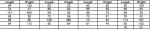
 
How could the data in the attached table be used to generate a graph (preferably with the program geogabra if familiar) in the form y=ax^k from which the weight of a alligator can be surmised from it's length? Much appreciated in advance

Note- Length in inches, weight in poundsView attachment 4128
One would probably do some sort of regression with the data. Consult the manual for the specifics of your software. ;)
 
Regression Models

So this regression, would it be exponential, how can it be arranged in the form y=ax^k to be graphed. I am not entirely sure but does it have something to do with a power relationship?
 
You are told it is to be of the form \(\displaystyle y= ae^{kx}\). I don't know what "software" you have available but you might take the logarithm of both sides to get \(\displaystyle ln(y)= kx+ ln(a)\) where ln(y) is linear in x. Surely your software must do a linear regression.
 
You are told it is to be of the form \(\displaystyle y= ae^{kx}\). I don't know what "software" you have available but you might take the logarithm of both sides to get \(\displaystyle ln(y)= kx+ ln(a)\) where ln(y) is linear in x. Surely your software must do a linear regression.

Thanks for the help, I now know how to graph it but not the theory behind it. Could you possibly outline taking the logarithm of both sides with the data in the attached table so as to find a way to calculate the alligators weight from it's height.
 
Last edited by a moderator:
Could you possibly outline taking the logarithm of both sides
You posted this to "Calculus". They should have taught you about logarithms back in algebra. Are you needing lesson instruction on this topic?
 
They should have taught you about logarithms back in algebra. Are you needing lesson instruction on this topic?

As this is an independent study with which we have no or limited mathematical foundation my knowledge on both calculus and algebra is sadly lacking. If anyone could help with the queries posted in the thread it would be most welcome.
 
So how would you go about finding the linear and exponential regression manually?
I don't think anybody does it "manually". Everybody uses "technology", like graphing calculators or spreadsheets.

Do the instructions actually specify that you have to complete this exercise "by hand"? :shock:
 
I don't think anybody does it "manually". Everybody uses "technology", like graphing calculators or spreadsheets.

Do the instructions actually specify that you have to complete this exercise "by hand"? :shock:

Unfortunately, the task requires manual working for justification & validation of the technologically produced equation.
 
Unfortunately, the task requires manual working for justification & validation of the technologically produced equation.

Google keywords least-squares regression method, for explanations/justifications of the equation of a 'best-fit' line, and how to determine it by hand. :cool:
 
So this regression, would it be exponential, how can it be arranged in the form y=ax^k to be graphed. I am not entirely sure but does it have something to do with a power relationship?

Y = ax^k is a power function -- NOT exponential. Various calculators and software programs will do a variety of regression analyses. You enter the data set, then you tell the software/calculator which regression type you'd like to use. It will do whatever you tell it to.

You can do a linear regression on this data, but that would likely be a poor choice. It would not be a good fit for the data -- but your calculator will go ahead and do it for you anyway.

What I suspect you will find when you do a power function regression analysis is that your k value will be somewhere around 3 -- meaning that your curve of best fit will be similar to a cubic equation.
 
Top