Exponential Modeling

ccertonio

New member
Joined
Feb 18, 2020
Messages
3
Hey I'm really stuck on this and don't really know how to go about it, hoping to find some help!
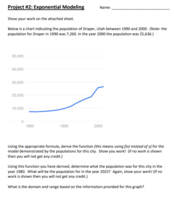
I decided that sharing the problem through a PDF would be best, since there is a graph involved. Also I understand that my domain is my x values but I don't understand how to put it into a function. Thanks in advance!
 

Attachments

  • Exponential Modeling PDF.pdf
    68 KB · Views: 5
Hey I'm really stuck on this and don't really know how to go about it, hoping to find some help!
I decided that sharing the problem through a PDF would be best, since there is a graph involved. Also I understand that my domain is my x values but I don't understand how to put it into a function. Thanks in advance!
Some of us will not open a pdf from an unknown source. May be you can take a high-res picture and paste that image.
 
Hey I'm really stuck on this and don't really know how to go about it, hoping to find some help!
I decided that sharing the problem through a PDF would be best, since there is a graph involved. Also I understand that my domain is my x values but I don't understand how to put it into a function. Thanks in advance!
1582073244728.png
 
Have you considered that a logarithm transformation will make your exponential problem into a linear problem?
 
They are not asking for the letter name for the domain! Not that it is a big deal, but I would have used t for the domain. What does the domain represent?
 
What is the general equation for an exponential function? This is what you should start with.
 
Here’s an example to help you understand how to proceed:
Image a scenario where you are trying to grow human skin cells in a laboratory.At the start of the year you have 250 skin cells in a jar. You have one skin cell in a Petri dish from which you plan to grow more skin cells. If a human skin cell divides in two once a day after how many days will the total number of skin cells (including those in the jar) equal 2298?

Think:

“1 cell produces 2 cells
each of those cells produces 2 cells
each of those cells produces 2 cells and so on”
So 1 becomes 2 becomes 4 becomes 8 and so on ........

Can you see a pattern ?

Day 0 1 = 2⁰

Day 1 2 = 2¹

Day 2 4 = 2²

Day 3 8 = 2³

After 3 days 8 skin cells will have been cultivated.

Total = 258 skin cells.

2298 - 250 = 2048 cells to be grown.

Let x = number of days this will take.
2ˣ= 2048
x = log₂2048
x = (log₁₀2048)/(log₁₀2)
x = 11
Check: 2¹¹ = 2048

If we let N = total number of skin cells we can write N as a function of x:
N(x) = 2ˣ+ 250
This is an example of an exponential function which has the general form
f(x) = aˣ+ c , where a > 0, a≠1, x is any real number.and c is a real constant.


Now let’s see if we can work backwards to find an exponential function rule given two pieces of information as in your question.

You know:
After 17 days N = 131322
After 34 days N = 17,179,869,184

General rule:
f(x) = aˣ+ c , where a > 0, a≠1, x = number of days and c i= 250 (number of skin cells (x) at the start when x = 0)

Replace f(x) with N(x) and substitute in your values to give two equations:

N(17) = 131322

131322 = a¹⁷ + c equation 1

N(32) = 17,179,869,184

17,179,869,434 = a³⁴ + c equation 2

Subtract equation 1 from 2 :

a³⁴ - a¹⁷ = 17,179,738,112

Let y = a¹⁷ and solve for y.

y² - y - 17,179,738,112 =0

By quadratic formula:

y = 131072 since y > 0

It follows:

a¹⁷ = 131072

logₐ131072 = 17

(log₁₀131072)/(log₁₀a) = 17

(log₁₀131072)/17 = log₁₀a

0.30102999566398 = log₁₀a

10 ^(0.30102999566398) = a

a = 2

Substituting a + 2 into equation 1 gives:
131322 = 131072 + c
c = 250

Rule becomes

N(x) = 2ˣ+ 250

 
N(t) = N0ekt, where N(t) represents the population t years from 1990, t is in years, k is some constant. You need to find N0 and k. You can solve for N0 and k with the two points you are given, namely (0, 7260) and (10, 25636).
Give this a try and see what you can do.
 
N(t) = N0ekt, where N(t) represents the population t years from 1990, t is in years, k is some constant. You need to find N0 and k. You can solve for N0 and k with the two points you are given, namely (0, 7260) and (10, 25636).
Give this a try and see what you can do.
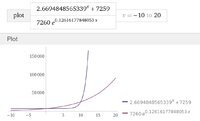
I agree with you Jomo - the use of e as the base produces a more accurate model for population growth. My approach gave a base of 2.6695 (rule P = 2.6695^t +7259). Even though it passed through the two given points after t = 10 the graph rose too steeply. (See both graphs below)
 
N(t) = N0ekt, where N(t) represents the population t years from 1990, t is in years, k is some constant. You need to find N0 and k. You can solve for N0 and k with the two points you are given, namely (0, 7260) and (10, 25636).
Give this a try and see what you can do.

The graph doesn't look to me like a pure exponential function. I'd guess it's more like P = a + be^(kt). This appears to be what @hoosie is thinking, too. Determining the three parameters, however, requires more than the two points explicitly given.
 
Top