find length of shortest road from highway to 2 towns

methodical

New member
Joined
Nov 14, 2008
Messages
5
I am in a calculus class and word problems when you have to come up with your own methods are my weakness.

Two towns A and B are 12 mi apart and are located 5 and 3 mi,respectively, from a long straight highway. A construction company has a contract to build the road from A to the highway and then to B. Determine the lenght(to the nearest mile) of the shortest road that meets the requirements.

This is what I have so far..

Length of the hypotoneuse of a right triangle whose other sides are 3 and T

+

Length of the hypotoneuse of a right triangle whose other sides are 5 and S-T

I know I am looking to minimize but how?
 
methodical said:
... word problems [for which] you [need] to come up with your own methods are my weakness.


Hello Methodical:

Did you draw a picture? I find that pictures help me to see a strategy.

I'm not sure what your symbols T and S represent because you did not define them.

You need to find a way to express the length of each segment of the road to be built in terms of the same variable.

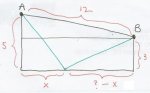
In my sloppy sketch below, these two segments are green. I chose the variable x.

Does this sketch help you to determine a function in terms of x that gives the sum of the lengths of the two segments of the road to be built?

[attachment=0:3bwc8987]junk677.JPG[/attachment:3bwc8987]

Cheers,

~ Mark :)


Attachments

  • junk677.JPG
    junk677.JPG
    13.6 KB · Views: 234
Very intriguing problem here, I think the thing to do is to go through the problem itself to find any key words that will make things simpler.

We know from the problem it is a "straight highway" which means we can assume the two hypotenuse we need to find are of right triangles.

Set up your formulas for them both in terms of a single variable, the original poster wrote T and S-T.

Hypotenuse 1) (3^2+(2T-12)^2)^1/2

Hypotenuse 2) (5^2+T^2)^1/2

Take those two and since you are looking to find the total distance simply add them and then take the derivative of that as your total. From there you solve for your critical number(s) and then plug it back in to find the value of your hypotenuses.

I believe that should give you a correct solution, if you find another way to solve it I would love to hear about it.
 
The resulting configuration is a right triangle where the dimensions of the legs are as follows:

L = horizontal dimension = shortest length of the road
2 miles = vertical dimension = (5 - 3) miles
D = distance between the towns = 12

Using the Pythagorean theorem,

D^2 = L^2 + (2)^2

12^2 = L^2 + 4

144 = L^2 + 4

L^2 = 144 - 4

L^2 = 140

L = 11.8 miles = 12 miles (rounded off to the nearest mile
 
incognito339 said:
... it is a "straight highway" which means we can assume the two hypotenuse we need to find are of right triangles ... Huh?

Hypotenuses only occur opposite right angles, so there is never any need to assume that they belong to right triangles.


... Hypotenuse 1) (3^2+(2T-12)^2)^1/2 ... Where is this side?

... if you find another way to solve it I would love to hear about it.


Hello Incognito:

I used the same method, but instead of 2T-12, I used 2*?35-T.

I obtained a different solution with this expression than I did using 2T-12.

Cheers,

~ Mark :)

 
methodical said:
... L = horizontal dimension = shortest length of the road ... The phrase in red is meaningless, to me.

... L^2 = 140 ... L = 2 * ?35


Hi Methodical:

As I see it, the value of L at which you arrived matches the value represented by the question mark in my sketch above.

I think that your answer is incorrect.

Do you really believe that you can answer this exercise without using calculus? (This is a rhetorical question.)

~ Howard I. Noe :?

 
Two towns A and B are 12 mi apart and are located 5 and 3 mi,respectively, from a long straight highway. A construction company has a contract to build the road from A to the highway and then to B. Determine the lenght(to the nearest mile) of the shortest road that meets the requirements.

Typically, the distance between the two towns is given parallel to the road.

Drop a line from B down across the road at point C to a point B', 3 miles on the other side of the road. Label the point where a line from A hits the roadway, perpendicular to the roadway, as point D.

Draw line AB' intersecting DC at E.
Reflect line B'E about DC so that B' is coincident with B.

AEB represents the shortest distance from A to E to B.

From the similar triangles created, AE = sqrt(5^2 + 7.5^2) and EB = sqrt(3^2 + 4.5^2) = 14.442.

If the distance between the towns is truly 12 miles, a few trig steps will get you the answer of 14.282 in the same way.
 
TchrWill said:
Typically, the distance between the two towns is given parallel to the road.


Gosh, I did not know this. I suppose that I jumped to a false conclusion because I was thinking that the posted problem is an exercise in calculus.

Are towns typically located on the same side of the road versus opposite sides of the road?

:?

 
Top