
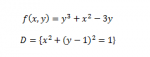
Find the absolute maximum and minimum values of f on the set D

mapabu

New member
Joined
May 2, 2013
Messages
4
I want to find the absolute maximum and minimum values of f on the set D, but i don't completely know where to start. I've tried using polar coordinates with r=2Sin(θ) with θ between 0 and 2pi for establishing the boundaries of D, after that i'm supposed to find the extreme values of f there, but i dont know to do it :confused:, if you know what's next or an easier way to follow I'd really appreciate it.
ex1.png
 
Is that really \(\displaystyle x^2+ (y- 1)^2\) equals 1 rather than \(\displaystyle x^2+ (y- 1)^2\le 1\)? Then D is just the one dimensional circle itself and parametic equations for a circle of radius 1 with center at (0, 1) are x= cos(t), y= 1+ sin(t). The "1+" shifts the center from (0, 0) to (0, 1). On that circle, the object function becomes \(\displaystyle x^2+ y^3- 3y= cos^2(t)+ 1+ 3sin(t)+ 3sin^2(t)+ sin^3(t)- 3- 3 sin(t)\). Take the derivative of that with respect to t and set it equal to 0.
 
Is that really \(\displaystyle x^2+ (y- 1)^2\) equals 1 rather than \(\displaystyle x^2+ (y- 1)^2\le 1\)? Then D is just the one dimensional circle itself and parametic equations for a circle of radius 1 with center at (0, 1) are x= cos(t), y= 1+ sin(t). The "1+" shifts the center from (0, 0) to (0, 1). On that circle, the object function becomes \(\displaystyle x^2+ y^3- 3y= cos^2(t)+ 1+ 3sin(t)+ 3sin^2(t)+ sin^3(t)- 3- 3 sin(t)\). Take the derivative of that with respect to t and set it equal to 0.

Sorry i was mistaken it's \(\displaystyle x^2+ (y- 1)^2\le 1\)
 
Well i solved it using another way, lagrange multipliers and making x^2=1-(1-y)^2
 
I would think "Laplace multipliers" is overkill. Take the partial derivatives and set them equal to 0. See if any of those zeros actually lie within the given circle. Then find critical values ON the bounding circle as I said before.
 
Top