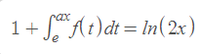
B BurlyUranus New member Joined Dec 10, 2019 Messages 1 Dec 10, 2019 #1 I'm confused at what should I do. I can't find a way to use the integral for the exercise, because the given function inside it is "f(t)dt".
I'm confused at what should I do. I can't find a way to use the integral for the exercise, because the given function inside it is "f(t)dt".
MarkFL Elite Member Joined Nov 24, 2012 Messages 2,966 Dec 10, 2019 #2 What do you get if you differentiate both sides of the equation with respect to \(x\)?
Steven G Elite Member Joined Dec 30, 2014 Messages 14,605 Dec 10, 2019 #3 BurlyUranus said: View attachment 15363 View attachment 15365 I'm confused at what should I do. I can't find a way to use the integral for the exercise, because the given function inside it is "f(t)dt". Click to expand... Bring the 1 to the other side. Look at the limits and think what f(x) should be to get ln(2x) - ln(e), oops I meant ln(2x)- 1 MarkFL gave you the standard way of doing these problems but I think that the answer is staring you in the face.
BurlyUranus said: View attachment 15363 View attachment 15365 I'm confused at what should I do. I can't find a way to use the integral for the exercise, because the given function inside it is "f(t)dt". Click to expand... Bring the 1 to the other side. Look at the limits and think what f(x) should be to get ln(2x) - ln(e), oops I meant ln(2x)- 1 MarkFL gave you the standard way of doing these problems but I think that the answer is staring you in the face.