
Finding equation of a fucntion curve

markraz

Full Member
Joined
Feb 19, 2014
Messages
338
Hi...
not sure if this is calculus or where to ask this.


I'm curious, If I drew random curve such as this: sigmoid.jpg on a piece of paper
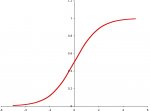
how would I calculate its exact function? I recall "curve sketching" from calc 1
but that would be the reverse process...

So what is the methodology used to do this?

Thanks in advance
 
Hi...
not sure if this is calculus or where to ask this.


I'm curious, If I drew random curve such as this: View attachment 4845 on a piece of paper
how would I calculate its exact function? I recall "curve sketching" from calc 1
but that would be the reverse process...

So what is the methodology used to do this?

Thanks in advance
This *looks* like the graph of an arctan x graph. Go from there?
 
Jomo has given you an idea of where to start for this particular case but actually this is a whole section of mathematics. Fitting curves (actually sets of data points) is important in many fields of practice and there are special techniques used depending on the fits, for commercial applications see
http://www.mathworks.com/products/curvefitting/
for example.

Generally, as an introduction to the subject one starts with two dimensional space, y=f(x) sort of thing, and fits a straight line to the data points. From there you go on to more complicated type of curve fitting including those in multiple dimensions, i.e. z=f(x,y) for three dimensional surfaces and even higher dimensional techniques. Possibly the Wikipedia article would be of interest
http://en.wikipedia.org/wiki/Curve_fitting
 
Jomo has given you an idea of where to start for this particular case but actually this is a whole section of mathematics. Fitting curves (actually sets of data points) is important in many fields of practice and there are special techniques used depending on the fits, for commercial applications see
http://www.mathworks.com/products/curvefitting/
for example.

Generally, as an introduction to the subject one starts with two dimensional space, y=f(x) sort of thing, and fits a straight line to the data points. From there you go on to more complicated type of curve fitting including those in multiple dimensions, i.e. z=f(x,y) for three dimensional surfaces and even higher dimensional techniques. Possibly the Wikipedia article would be of interest
http://en.wikipedia.org/wiki/Curve_fitting

Thanks, this looks like what I need. I'm curious what math course should this be covered in?
also with digital sampling, do they use a similar process?

thanks
 
Thanks, this looks like what I need. I'm curious what math course should this be covered in?
also with digital sampling, do they use a similar process?

thanks
Digital sampling is sampling individual points from a (generally) continuous function typically so that one can reconstruct the function. Many applications are for the 'function' to be a signal of some sort, i.e. music, radio waves, blood flow, etc. so that there is quite a bit of general techniques and theory under signal processing.

Depending on just what kind of detail you want to get into, a mathematical background will certainly help and a good understanding through Calculus III and Differential Equations would be a big help for an understanding of the theory. Generally you don't get into things like Fourier Transforms until Differential Equations and the Fast Fourier Transform (FFT) plays a big part in general signal processing in the 'real world'.
 
Top