
Finding the maximum area

IBstudent

New member
Joined
Jan 27, 2012
Messages
36
Hello people...

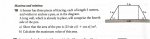
View attachment 2749I am having problems with the math problem attached. I can't answer b...

The only way I can solve this which I know is using a GDC or a software.. but this paper should be without calculator, can anyone show me a manual method that would be very much appreciated...

ThanksPhoto Apr 12, 1 20 48 PM.jpg
 
Last edited:
Hello people...

View attachment 2749I am having problems with the math problem attached. I can't answer both b...

The only way I can solve this which I know is using a GDC or a software.. but this paper should be without calculator, can anyone show me a manual method that would be very much appreciated...

ThanksView attachment 2750

I think I am confused. You can answer "a" but not "b"? Or can you not answer both "a" and "b"? You say you can't answer both "b" which does not make sense.
 
I think I am confused. You can answer "a" but not "b"? Or can you not answer both "a" and "b"? You say you can't answer both "b" which does not make sense.

Sorry... I meant I can't solve part b. Please help me out man I'm really confused :S
 
Sure. What have you tried so far on "b"?

Ok so usually I would draw a graph on my gdc and try to zoom in and find the maximum value..

But I guess in this case I should find the the derivative so find the maximum right?

I'll assume that is the case so....25sin(x+xcosx)
so the derivative should be...
25cos(x+xcosx)*-sin
= -25sin(x)cos(+xcosx)

Ooookay I have a feeling that I did some mistakes already. Plus I'm stuck again... Please help me out by showing me and methodology and I will really appreciate it...
 
Did you do part a?

The answer is NOT

area = 25sin[x{1+cos(x)}] ............ this is the function you were trying to differentiate above.

Do part (a) properly - the function for area is much simpler than 25sin[x{1+cos(x)}]!!
 
Did you do part a?

The answer is NOT

area = 25sin[x{1+cos(x)}] ............ this is the function you were trying to differentiate above.

Do part (a) properly - the function for area is much simpler than 25sin[x{1+cos(x)}]!!
That is the area (it is given in the question part 2 is basically proving rather than doing anything else.. I did find that the area of the trazium is two of the area of the triangle times the area of the rectangle....

So just find the length and width in terms of sin x and cos x then just come up with the formula for the area (after simplification).. besides, that answer is given, what I am asking you is how to find the maximum... that is the part I am stuck at...

Thanks
 
That is the area (it is given in the question part 2 is basically proving rather than doing anything else.. I did find that the area of the trazium is two of the area of the triangle times the area of the rectangle....

So just find the length and width in terms of sin x and cos x then just come up with the formula for the area (after simplification).. besides, that answer is given, what I am asking you is how to find the maximum... that is the part I am stuck at...

Thanks

You are stuck because you are INTERPRETING the given equation wrong!!

Prove the "formula" for the area (part a) - you'll see the difference.
 
That is the area (it is given in the question part 2 is basically proving rather than doing anything else.. I did find that the area of the trazium is two of the area of the triangle times the area of the rectangle....

So just find the length and width in terms of sin x and cos x then just come up with the formula for the area (after simplification).. besides, that answer is given, what I am asking you is how to find the maximum... that is the part I am stuck at...

Thanks
What Khan was referring to was that you wrote the area incorrectly. 25sin(x+xcosx) is not the same as 25sinx(1+cosx). That being said, your derivative is incorrect.

Use the product rule on 25sinx(1+cosx) and let us know what you get.
 
What Khan was referring to was that you wrote the area incorrectly. 25sin(x+xcosx) is not the same as 25sinx(1+cosx). That being said, your derivative is incorrect.

Use the product rule on 25sinx(1+cosx) and let us know what you get.

Oh ok now I got it! (the derivative bit not the maximum)

So I used the product rule and I got:
25cos^2(x) + 25cos(x) - 25sin^2(x)

What now?
 
Last edited:
What Khan was referring to was that you wrote the area incorrectly. 25sin(x+xcosx) is not the same as 25sinx(1+cosx). That being said, your derivative is incorrect.

Use the product rule on 25sinx(1+cosx) and let us know what you get.

I did what you said but how can I find the maximum without the aid of a calculator? Please help I was stuck on this problem since yesterday..
 
Has your class not covered derivative rules at all yet? :(

They did but we have the worst teacher ever who is so apathetic and wouldn't even teach right!

Guys.... please.... I have been struggling since yesterday and all you are doing so far is giving me vague statements and going off topic despite my frequent efforts to try to understand....

If you know how to please tell me....

I know that if the derivative is zero its either a maximum or a minimum. But how to I find the value of x?

Please take of few minutes of your time to help me cuz I really really need it.
 
They did but we have the worst teacher ever who is so apathetic and wouldn't even teach right!
This is unfortunate, because we cannot here provide the hours of classroom instruction which you profess not to have received.

You asked how to do this without a calculator; those hours of lectures, over a few weeks' time, would have explained how. The answers you've received would not have seemed "vague" if you'd been taught the material. Sorry. :-|
 
A = 25* sin(x) * {1 + cos(x)}

dA/dx = 25 * cos(x) + 25* cos ^2(x) - 25* sin^2(x) = 50 * cos^2(x) + 25 * cos(x) - 25

for maximum and/or minimum A → dA/dx = 0

so we have

2 * cos^2(x) + cos(x) - 1 = 0

This is a quadratic equation in cos(x). Solve for cos(x). Then solve for 'x'. Can be done easily without calculator.

If you need more help, show us your work and tell us where you are stuck again....
 
A = 25* sin(x) * {1 + cos(x)}

dA/dx = 25 * cos(x) + 25* cos ^2(x) - 25* sin^2(x) = 50 * cos^2(x) + 25 * cos(x) - 25

for maximum and/or minimum A → dA/dx = 0

so we have

2 * cos^2(x) + cos(x) - 1 = 0

This is a quadratic equation in cos(x). Solve for cos(x). Then solve for 'x'. Can be done easily without calculator.

If you need more help, show us your work and tell us where you are stuck again....
You... my friend... are a GENUIS!!!

I finally understand it!

Thanks man that helped a whole lot!
 
IBstudent, please stay with the method that Subhotosh Khan gave in post # 17 and continue to work out the problem that way. But, as an aside, think about your problem from a geometric standpoint. With your three congruent sides, you have half of an equilateral hexagon. The wall can represent a long diagonal of the whole hexagon. This hexagon must be regular (equilateral and equiangular) for its area to be a maximum. As a consequence of that, the area of the half-hexagon will also be a maximum. Then, going with that, that means the shape (of your intended area) can be subdivided into three congruent equilateral/equiangular triangles. The number of degrees in angle x would then be equal to 60 degrees, because a 5 meter length side would have to make that angle with the wall in order for the shape to achieve a maximum area. (An equilateral triangle has each of its interior angles equal to 60 degrees.) Then, one of the ways you can figure out the intended area is note that 5 meters is the length of the sides of all of those three triangles. Use 3*(area of one equilateral triangle) = \(\displaystyle 3\bigg(\dfrac{s^2\sqrt{3}}{4}\bigg), \ \) with s = side length of 5 meters, to get the total of the area of your shape expressed in square meters.
 
Top