Fractions/ percentages average

yekg01

New member
Joined
Apr 11, 2020
Messages
3
Hello,

I'm confused by the following,

lets say
11/16 like apples = 0.6875= 68.75%
and
4/5 like oranges = 0.8 = 80%

if we say the people who like both oranges and apples is 15/21= 71.42%
why does the average of (68.75% + 80%)/2 = 74.375%

An explanation would be helpful,
Thank you very much
 
Hello,

I'm confused by the following,

lets say
11/16 like apples = 0.6875= 68.75%
and
4/5 like oranges = 0.8 = 80%

if we say the people who like both oranges and apples is 15/21= 71.42%
why does the average of (68.75% + 80%)/2 = 74.375%

An explanation would be helpful,
Thank you very much
How did average come in here? What do you mean by average here? Average of what?

Please post the COMPLETE problem as it was presented to you - then we can help you intelligently!
 
Hi thank you for your reply,
this is the complete problem,
I dont understand why you can divide 15/21 and get the percentage as 71.42
and not get the same answer by working out the percentages separetly and getting the average of both percentages
thank you
 
Hi thank you for your reply,
this is the complete problem,
I dont understand why you can divide 15/21 and get the percentage as 71.42
and not get the same answer by working out the percentages separetly and getting the average of both percentages
thank you
this is the complete problem,

Where is the ORIGINAL problem statement?

Where and how did you get those numbers (11, 16, 4, 5, 15, 20)?
 
I am the quiz master,
the ORIGINAL question which I have made is,
why doesn't 15/21 as a percentage equal (11/16 + 4/5 ) /2 as a percentage
thank you,
 
lets say
11/16 like apples = 0.6875= 68.75%
and
4/5 like oranges = 0.8 = 80%

if we say the people who like both oranges and apples is 15/21= 71.42%
why does the average of (68.75% + 80%)/2 = 74.375%
The first problem we have here is that if 68.75% of a group of people like apples, and 80% of the same group like oranges, then it is impossible for 71.42% of that group to like both apples and oranges!

Those who like both will be a subset of those who like only one; so the percentage who like both (which you claim is 71.42%) has to be less than the percentage who like apples (which you claim is only 68%).

So your calculations of the percentages are wrong in the first place.

Why did you think you can add (11+4)/(16+5) to get the percent that like both? This makes no sense.

It also makes no sense to average two percentages to find the intersection of the sets.

And that's why we need to know the specific situation in which you are doing the calculation. Where do your fractions 11/16 and 4/5 come from?
 
Suppose I practice basketball a lot and I keep a running count. In my last 5,000,000 shots 4,000,000 went in. So my average is 4/5 or 80%. Now today having misplaced my tally I count today separate from all the other days. Today I made 5 out of 10 shots or 50%. Do you think that my overall average should be the direct average of 80% and 50%? Shouldn't the 80% have more value in computing the average than the 50%, why??
 
lets say
11/16 like apples and 4/5 like oranges
An explanation would be helpful,
I freely admit that I am really puzzled by this post. So here.
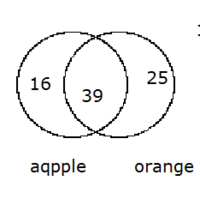
\(LCM(5,16)=80\) Thus \(\dfrac{55}{80}\) like apples and \(\dfrac{64}{80}\) like oranges.
Here is a Venn diagram.
A_P.gif
Now does that help?
 
Top