Function notation

jpanknin

Junior Member
Joined
Jan 8, 2020
Messages
140
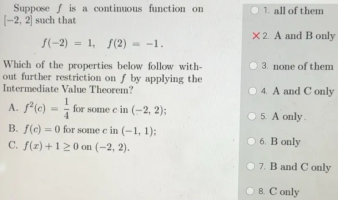
Can someone please explain the [imath]f^2(c)[/imath] notation in the screenshot below? I've not seen this notation and according to Google searches it could be either a function iterate or squaring the output. The context is the continuity of a function, but I'm only asking about the notation.

1769715788668.png
 
It normally means [imath] f^2(c)=f(f(c)). [/imath] I would write [imath] (f(c))^2=f(c)^2, [/imath] but this may depend on the author, where he puts the square. E.g., if [imath] f(x)=\sin(x) [/imath] then everybody reads [imath] \sin^2(x) [/imath] as [imath] (\sin(x))^2 [/imath] and not as applying the sine function twice. This is true for all standard functions. If we only have a general [imath] f [/imath] then positioning the square without additional parentheses is ambiguous. You can normally see it from context.
 
It normally means [imath] f^2(c)=f(f(c)). [/imath] I would write [imath] (f(c))^2=f(c)^2, [/imath] but this may depend on the author, where he puts the square. E.g., if [imath] f(x)=\sin(x) [/imath] then everybody reads [imath] \sin^2(x) [/imath] as [imath] (\sin(x))^2 [/imath] and not as applying the sine function twice. This is true for all standard functions. If we only have a general [imath] f [/imath] then positioning the square without additional parentheses is ambiguous. You can normally see it from context.
Yes, I normally see the square written as [imath](f(x))^2[/imath] or similar. I've gone through the book and don't see any similar notation. This question is on a separately developed homework though, so likely a different author.
 
It depends a bit on whether [imath] f^2(c)=(f\circ f)(c)=f(f(c)) [/imath] is an option at all. The specific line looks more as if [imath] f^2(c)=f(c)^2 [/imath] was meant. Applying a sine on a sine usually doesn't make sense. It is more problematic if you deal with complexity theory, where time and space of algorithms are calculated. They have a lot of [imath] \log(\log(n)) [/imath] expressions. But I think they are normally written out and [imath] \log^2(n) [/imath] means indeed [imath] (\log(n))^2 .[/imath]

[imath] f^2(c)= (f\circ f)(c)=f(f(c))[/imath] is rare. It occurs when you investigate function spaces (algebras) or sometimes in functional identities. If I were to bet, I would put my money on [imath] f^2(c)=1/4=(f(c))^2, [/imath] but it is not ultimately clear.
 
It depends a bit on whether [imath] f^2(c)=(f\circ f)(c)=f(f(c)) [/imath] is an option at all. The specific line looks more as if [imath] f^2(c)=f(c)^2 [/imath] was meant. Applying a sine on a sine usually doesn't make sense. It is more problematic if you deal with complexity theory, where time and space of algorithms are calculated. They have a lot of [imath] \log(\log(n)) [/imath] expressions. But I think they are normally written out and [imath] \log^2(n) [/imath] means indeed [imath] (\log(n))^2 .[/imath]

[imath] f^2(c)= (f\circ f)(c)=f(f(c))[/imath] is rare. It occurs when you investigate function spaces (algebras) or sometimes in functional identities. If I were to bet, I would put my money on [imath] f^2(c)=1/4=(f(c))^2, [/imath] but it is not ultimately clear.
Ok, appreciate the replies and help.
 
Can someone please explain the [imath]f^2(c)[/imath] notation in the screenshot below? I've not seen this notation and according to Google searches it could be either a function iterate or squaring the output. The context is the continuity of a function, but I'm only asking about the notation.

View attachment 39939
Please show the actual context! Since the meaning of the notation depends on that, we really can't give a definite answer without that. So far it's just a guess.

So, what instructions are given for this problem or group of problems? What do the other problems look like? Actually, what does the rest of this problem say??

I did a search to see if the whole problem happened to be available, and I found it:

1769722287515.png
It is still not entirely obvious which meaning is appropriate, except that we don't know enough to know what [imath]f(f(-2))[/imath] is, so it appears to mean [imath](f(x))^2[/imath]. (And whoever gave the answer I found does take it that way.)

But I can't imagine why anyone would write this problem in either case, especially without ever having used the notation in the context!

 
Please show the actual context! Since the meaning of the notation depends on that, we really can't give a definite answer without that. So far it's just a guess.

So, what instructions are given for this problem or group of problems? What do the other problems look like? Actually, what does the rest of this problem say??

I did a search to see if the whole problem happened to be available, and I found it:

View attachment 39940
It is still not entirely obvious which meaning is appropriate, except that we don't know enough to know what [imath]f(f(-2))[/imath] is, so it appears to mean [imath](f(x))^2[/imath]. (And whoever gave the answer I found does take it that way.)

But I can't imagine why anyone would write this problem in either case, especially without ever having used the notation in the context!

This is a homework problem, so I hesitated to put the whole thing up. But yes, that's the question (slightly different answer choices, but very similar). I answered under the assumption that it meant [imath](f(x))^2[/imath] and it was correct. Glad I'm not the only one who was confused! Thanks very much for the responses.
 
Top