
You are using an out of date browser. It may not display this or other websites correctly.
You should upgrade or use an alternative browser.
You should upgrade or use an alternative browser.
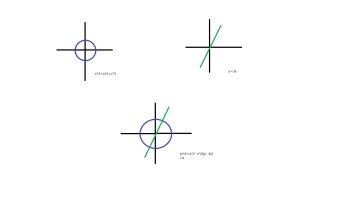
Fusing relationships
- Thread starter fixit86
- Start date
What is the question?
What do you need to find?
JoshuaSass
New member
- Joined
- Apr 9, 2026
- Messages
- 9
I've also found an issue within your equations, x^2+y^2=r^2 does not make a circle, it will create an oval. When r=1, x^2+y^2=1. This creates an oval, not a circle...
If you plot:I've also found an issue within your equations, x^2+y^2=r^2 does not make a circle, it will create an oval. When r=1, x^2+y^2=1. This creates an oval, not a circle...
x^2 + y^2 = 1 (1^2) on a plane graph paper, it will describe a circle with radius 1.
Can you explain the difference between an oval and a circle?

Dr.Peterson
Elite Member
- Joined
- Nov 12, 2017
- Messages
- 16,955
Here is the graph of [imath]\left(x^{2}+y^{2}-1\right)\left(y-2x\right)=0[/imath] in Desmos:I've also found an issue within your equations, x^2+y^2=r^2 does not make a circle, it will create an oval. When r=1, x^2+y^2=1. This creates an oval, not a circle...
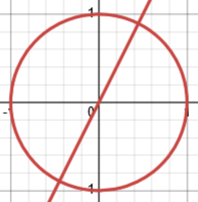
Looks like a circle to me. @fixit86 has exactly the right idea.
If what you mean by "oval" is "ellipse", then the general form (with center at the origin) is [imath]\frac{x^2}{a^2}+\frac{y^2}{b^2}=1[/imath]; a circle is a special case, with [imath]a=b=r[/imath]. So a circle is an oval, in this sense. If an "oval" has to have [imath]a\ne b[/imath], then the equation is for a circle, not an oval.
JoshuaSass
New member
- Joined
- Apr 9, 2026
- Messages
- 9
Ah, I was imputing it incorrectly, that is my fault. But I'm still confused upon what the OP is asking here?
Dr.Peterson
Elite Member
- Joined
- Nov 12, 2017
- Messages
- 16,955
There is no explicit question. He may have been asking for confirmation that you can obtain the union of two graphs ("fusing" them) by multiplying the equations (equated to zero), as in his [imath]\left(x^{2}+y^{2}-1\right)\left(y-2x\right)=0[/imath]. I did so by showing the graph.