
You are using an out of date browser. It may not display this or other websites correctly.
You should upgrade or use an alternative browser.
You should upgrade or use an alternative browser.
General formula for nth difference of a set
- Thread starter bforest
- Start date

stapel
Elite Member
- Joined
- Feb 4, 2004
- Messages
- 16,543
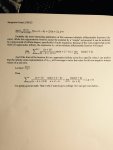
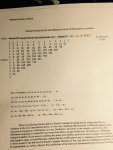
For those who can't see the text in the small images of the long article, here is what I'm seeing for the first page:
General formula for the n-th difference in a set of terms and its corallaries
In(59) = PascalTriangleForm[Table[Binomial[n, Range[0, n]], {n, 0, 12}]]
Out(59) = \(\displaystyle \begin{array}{rrrrrrrrrrrrr}1&1&1&1&1&1&1&1&1&1&1&1&1 \\ 1&2&3&4&5&6&7&8&9&10&11&12&\, \\ 1&3&6&10&15&21&28&36&45&55&66&\,&\, \\ 1&4&10&20&35&56&84&120&165&220&\,&\,&\, \\ 1&5&15&35&70&126&210&330&495&\,&\,&\,&\, \\ 1&6&21&56&126&252&462&792&\,&\,&\,&\,&\, \\ 1&7&28&84&210&462&924&\,&\,&\,&\,&\,&\, \\ 1&8&36&120&330&792&\,&\,&\,&\,&\,&\, \\ 1&9&45&165&495&\,&\,&\,&\,&\,&\,&\, \\ 1&10&55&220&\,&\,&\,&\,&\,&\,&\,&\, \\ 1&11&66&\,&\,&\,&\,&\,&\,&\,&\,&\, \\ 1&12&\,&\,&\,&\,&\,&\,&\,&\,&\,&\, \\ 1&\,&\,&\,&\,&\,&\,&\,&\,&\,&\,&\, \end{array}\)
Set of numbers: \(\displaystyle \, \left(a_1,\, a_2,\, a_3,\, a_4,\, a_5,\, a_6,\, a_7,\, a_8,\, ...,\, a_c\right)\)
\(\displaystyle \Delta_0\, =\, a_1,\, a_2,\, a_3,\, a_4,\, a_5,\, a_6,\, a_7,\, a_8,\, ...,\, a_c\)
\(\displaystyle \Delta_1\, =\, a_2\, -\, a_1,\, a_3\, -\, a_2,\, a_4\, -\, a_3,\, a_5\, -\, a_4,\, a_6\, -\, a_5,\, a_7\, -\, a_6,\, ...,\, a_c\, -\, a_{c-1}\)
\(\displaystyle \Delta_2\, =\, a_3\, -\, 2a_2\, -\, a_1,\, a_4\, -\, 2a_3\, -\, a_2,\, a_5\, -\, 2a_4\, -\, a_3,\, ..., a_c\, -\, 2a_{c-1}\, -\, a_{c-2}\)
\(\displaystyle \Delta_3\, =\, a_4\, -\, 3a_3\, -\, 3a_2\, -\, a_1,\, a_5\, -\, 3a_4\, -\, 3a_3\, -\, a_2,\, ..., a_c\, -\, 3a_{c-1}\, -\, 3a_{c-2}\, -\, a_{c-3}\)
When considering that the digits in Pascal's triangle are generated by adding the first two numbers in the row immediately above, it's not very surprising that binomial coefficients appear in the successive sequences of differences in a set. Similarly to the terms in the triangle, each term in the difference sequence is created by two terms from above, except in this case, two terms are subtracted instead of added. If you were to continue to series even further, and if you were to neglect the positive and negative signs, it would become evident that the coefficients in any \(\displaystyle \, \Delta_n\, \) sequence correspond perfectly to those found on the n-th level of Pascal's triangle. Because of this, any term in a difference sequence, can be represented as a series, wherein the coefficients of the terms are determined by the binomial formula.
. . . . .\(\displaystyle \Delta_n\, \neq\, \sum_{k=0}^n\, (nCk)\, a_{n-k}\)
The first term in the second sequence begins with \(\displaystyle \,a_3,\,\) and the first term in the third sequence begins with \(\displaystyle \, a_4.\,\) In general, each of the first terms in the n-th difference sequence will begin with begin an[sic] \(\displaystyle \, a_{n+1}\,\) term, so naturally the equation must be changed to reflect that. It becomes:
. . . . .\(\displaystyle \Delta_n\, \neq\, \sum_{k=0}^n\, (nCk)\, a_{n+1-k}\)
The "not equal to" signs are indeed in the original.
General formula for the n-th difference in a set of terms and its corallaries
In(59) = PascalTriangleForm[Table[Binomial[n, Range[0, n]], {n, 0, 12}]]
Out(59) = \(\displaystyle \begin{array}{rrrrrrrrrrrrr}1&1&1&1&1&1&1&1&1&1&1&1&1 \\ 1&2&3&4&5&6&7&8&9&10&11&12&\, \\ 1&3&6&10&15&21&28&36&45&55&66&\,&\, \\ 1&4&10&20&35&56&84&120&165&220&\,&\,&\, \\ 1&5&15&35&70&126&210&330&495&\,&\,&\,&\, \\ 1&6&21&56&126&252&462&792&\,&\,&\,&\,&\, \\ 1&7&28&84&210&462&924&\,&\,&\,&\,&\,&\, \\ 1&8&36&120&330&792&\,&\,&\,&\,&\,&\, \\ 1&9&45&165&495&\,&\,&\,&\,&\,&\,&\, \\ 1&10&55&220&\,&\,&\,&\,&\,&\,&\,&\, \\ 1&11&66&\,&\,&\,&\,&\,&\,&\,&\,&\, \\ 1&12&\,&\,&\,&\,&\,&\,&\,&\,&\,&\, \\ 1&\,&\,&\,&\,&\,&\,&\,&\,&\,&\,&\, \end{array}\)
Set of numbers: \(\displaystyle \, \left(a_1,\, a_2,\, a_3,\, a_4,\, a_5,\, a_6,\, a_7,\, a_8,\, ...,\, a_c\right)\)
\(\displaystyle \Delta_0\, =\, a_1,\, a_2,\, a_3,\, a_4,\, a_5,\, a_6,\, a_7,\, a_8,\, ...,\, a_c\)
\(\displaystyle \Delta_1\, =\, a_2\, -\, a_1,\, a_3\, -\, a_2,\, a_4\, -\, a_3,\, a_5\, -\, a_4,\, a_6\, -\, a_5,\, a_7\, -\, a_6,\, ...,\, a_c\, -\, a_{c-1}\)
\(\displaystyle \Delta_2\, =\, a_3\, -\, 2a_2\, -\, a_1,\, a_4\, -\, 2a_3\, -\, a_2,\, a_5\, -\, 2a_4\, -\, a_3,\, ..., a_c\, -\, 2a_{c-1}\, -\, a_{c-2}\)
\(\displaystyle \Delta_3\, =\, a_4\, -\, 3a_3\, -\, 3a_2\, -\, a_1,\, a_5\, -\, 3a_4\, -\, 3a_3\, -\, a_2,\, ..., a_c\, -\, 3a_{c-1}\, -\, 3a_{c-2}\, -\, a_{c-3}\)
When considering that the digits in Pascal's triangle are generated by adding the first two numbers in the row immediately above, it's not very surprising that binomial coefficients appear in the successive sequences of differences in a set. Similarly to the terms in the triangle, each term in the difference sequence is created by two terms from above, except in this case, two terms are subtracted instead of added. If you were to continue to series even further, and if you were to neglect the positive and negative signs, it would become evident that the coefficients in any \(\displaystyle \, \Delta_n\, \) sequence correspond perfectly to those found on the n-th level of Pascal's triangle. Because of this, any term in a difference sequence, can be represented as a series, wherein the coefficients of the terms are determined by the binomial formula.
. . . . .\(\displaystyle \Delta_n\, \neq\, \sum_{k=0}^n\, (nCk)\, a_{n-k}\)
The first term in the second sequence begins with \(\displaystyle \,a_3,\,\) and the first term in the third sequence begins with \(\displaystyle \, a_4.\,\) In general, each of the first terms in the n-th difference sequence will begin with begin an[sic] \(\displaystyle \, a_{n+1}\,\) term, so naturally the equation must be changed to reflect that. It becomes:
. . . . .\(\displaystyle \Delta_n\, \neq\, \sum_{k=0}^n\, (nCk)\, a_{n+1-k}\)
The "not equal to" signs are indeed in the original.
stapel
Elite Member
- Joined
- Feb 4, 2004
- Messages
- 16,543
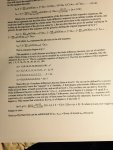
Page two:
However, this still leaves the problem of the signs, ever[sic] term — except for the first — in the series is negative. Actually, despite how simple it might seem to make all but one term negative, this was the most difficult problem for me to solve throughout this process. The first obvious step to take would be to simply add a negative sign to the entire summation, but then there'd still be positive term unaccounted for. Moreover, the previously positive sign would now be negative. In order to get rid of the unwanted leading now-negative term, you'd need to add a positive an+1 to the sum. Once I came to that conclusion the solution to the problem became painfully obvious: not just one an+1's[sic] needed to be added, but two. The first will cancel out the negative and the second will replace the previously displaced positive leading term. So the equation becomes:
. . . . .\(\displaystyle \Delta_n\, \neq\, \left[\,-\sum_{k=0}^n\, (nCk)\, a_{n+1-k}\, \right]\, +\, 2a_{n+1}\, =\, (_nC_0)\, a_n,\, -(_nC_1)\, a_{n},\, -(_nC_2)\, a_{n-1},\, -(_nC_3)\, a_{n-2},\, ...,\, -(_nC_n)\, a_1\)
. . . . .\(\displaystyle \Delta_n\, \neq\, \left[\, -\sum_{k=0}^{n+1}\, \dfrac{(n\, +\, 1)!}{(n\, -\, 1\, +\, k)!\, k!}\, a(sub)n_{+2-k}\right]\, +\, 2a_{n+2},\,\). . .\(\displaystyle \dfrac{(n\, +\, 1)!}{(n\, -\, 1\, +\, k)!\, k!}\, =\, (n\, +\, 1Ck)\)
While now a correct series representation of the first terms in their respective sequences, the series above represents only the first terms. Each difference sequence has an infinite number of terms, and each term itself is represented by a finite series. The second series-term in the sequence is given by scaling up the argument of the previous series by 1, the one after that also given by another scaling up. In general, the p-th term in this sequence will be given by shifting the original argument up by \(\displaystyle \, p\, -\, 1.\)
. . . . .\(\displaystyle \Delta_n\, =\, \left[\,-\sum_{k=0}^n\, (nCk)\, a_{n+1-k}\,\right]\, +\, 2a_{n+1},\,\)
. . . . . . . . . . . . .\(\displaystyle \left[\,-\sum_{k=0}^n\, (nCk)\, a_{n+2-k}\,\right]\, +\, 2a_{n+2},\)
. . . . . . . . . . . . . . . .\(\displaystyle \left[\,-\sum_{k=0}^n\, (nCk)\, a_{n+3-k}\,\right]\, +\, 2a_{n+3},\, ...,\, \)
. . . . . . . . . . . . . . . . . . .\(\displaystyle \left[\,-\sum_{k=0}^n\, (nCk)\, a_{n+p-k}\,\right]\, +\, 2a_{n+p}\)
And where \(\displaystyle \, \Delta_{n,p}\,\) represents the p-th term in the n-th sequence,
. . . . .\(\displaystyle \Delta_{n,p}\, =\, \left[\,-\sum_{k=0}^n\, (nCk)\, a_{n+p-k}\,\right]\, +\, 2a_{n+p}\)
. . . . .The \(\displaystyle \, \Delta_n\, \) sequence begins at p = 1
This equation is useful because according to the finite differences theorem, any set of numbers with a finite change at level n \(\displaystyle \, (\Delta_n),\,\) can be modeled by a polynomial of degree n. For example, take the sequence f(c) = ac = c2. This is a quadratic equation of degree n = 2. The first ten numbers of this sequence are,[sic] 1, 4, 9, 16, 25, 36, 49, 64, 81, 100.
. . . . .\(\displaystyle \Delta_0\, =\, 1,\, 4,\, 9,\, 16,\, 25\, 36,\, 49\, 64,\, 81\, 100,\, ...,\, c^2\)
. . . . .\(\displaystyle \Delta_1\, =\, 3,\, 5,\, 7,\, 9,\, 11,\, 13,\, 15,\, 17\, 19,\, ...,\, c^2\, -\, (c,\, -\, 1)^2\)
. . . . .\(\displaystyle \Delta_2\, =\, 2,\, 2,\,2,\,2,\,2,\,2,\,2,\,2,\,2,\,2,\,2,\,2,\,...,\, 2\, =\, \Delta n\)
. . . . .\(\displaystyle \Delta_3\, =\, 0,\, 0,\, 0,\, 0,\, 0,\, 0,\, 0,\, 0,\, 0,\, 0,\, 0,\, =\, \Delta n+1\)
Since this set of numbers[sic] differences become finite at level 2.[sic] The set can be defined by a second degree polynomial, hence the "squared" in n2. Similarly, A[sic] third degree polynomials[sic] differences becomes finite at level three, a fourth at level four, and an n-th at level n. The corollary one can derive from the finite differences theorem is that at level n+1 \(\displaystyle \, (\Delta_{n+1}),\, \) a polynomial of degree n's change will equal 0: a constant minus the same constant equals nothing. Furthermore, since all terms of the \(\displaystyle \, (\Delta_{n+1}),\, \) sequence will equal zero, it is acceptable to use one any[sic] of these terms for evaluating the statement: function f(c) is of degree n. This means that a function, f(c)[/I][/I] = ac, is of degree n, if and only if
. . . . .\(\displaystyle \Delta n+1,p\, =\, \left[\, -\sum_{k=0}^{n+1}\, \dfrac{(n\, +\, 1)!}{(n\, -\, 1\, +\, k)!\, k!}\, f(n\, +\, p\, +\, 2\, -\, k)\, \right]\, +\, 2f(n\, +\, p\, +\, 2)\, =\, 0\)
. . . . .\(\displaystyle \mbox{where }\, p\, \mbox{ is any non-negative integer or zero}\)
Since ac = f(c) then f(n) can be substituted for an: an+2-k = f(n + p + 2 - k) and an+2 = f(n + p + 2).
The conversion of the first summation to a list (on the right-hand side of the "equals" sign) is in the original. The "sub" in the second summation is probably a typo, as are some of what are probably meant to be subscripts after the comma in that line. The first two summations are "not equal to"; the third is where the "equals" starts coming into play. The twelve "2" terms before the ellipsis in the expansion of \(\displaystyle \, \Delta_2\, \) are in the original, as are the eleven "0" terms and the hanging comma in the expansion of \(\displaystyle \, \Delta_3.\,\) The characters after the "delta" in the final indented equation are probably supposed to be subscripted. Any other errors are probably mine.
I gotta go to bed. I'll do page 3 in the morning. :wink:
However, this still leaves the problem of the signs, ever[sic] term — except for the first — in the series is negative. Actually, despite how simple it might seem to make all but one term negative, this was the most difficult problem for me to solve throughout this process. The first obvious step to take would be to simply add a negative sign to the entire summation, but then there'd still be positive term unaccounted for. Moreover, the previously positive sign would now be negative. In order to get rid of the unwanted leading now-negative term, you'd need to add a positive an+1 to the sum. Once I came to that conclusion the solution to the problem became painfully obvious: not just one an+1's[sic] needed to be added, but two. The first will cancel out the negative and the second will replace the previously displaced positive leading term. So the equation becomes:
. . . . .\(\displaystyle \Delta_n\, \neq\, \left[\,-\sum_{k=0}^n\, (nCk)\, a_{n+1-k}\, \right]\, +\, 2a_{n+1}\, =\, (_nC_0)\, a_n,\, -(_nC_1)\, a_{n},\, -(_nC_2)\, a_{n-1},\, -(_nC_3)\, a_{n-2},\, ...,\, -(_nC_n)\, a_1\)
. . . . .\(\displaystyle \Delta_n\, \neq\, \left[\, -\sum_{k=0}^{n+1}\, \dfrac{(n\, +\, 1)!}{(n\, -\, 1\, +\, k)!\, k!}\, a(sub)n_{+2-k}\right]\, +\, 2a_{n+2},\,\). . .\(\displaystyle \dfrac{(n\, +\, 1)!}{(n\, -\, 1\, +\, k)!\, k!}\, =\, (n\, +\, 1Ck)\)
While now a correct series representation of the first terms in their respective sequences, the series above represents only the first terms. Each difference sequence has an infinite number of terms, and each term itself is represented by a finite series. The second series-term in the sequence is given by scaling up the argument of the previous series by 1, the one after that also given by another scaling up. In general, the p-th term in this sequence will be given by shifting the original argument up by \(\displaystyle \, p\, -\, 1.\)
. . . . .\(\displaystyle \Delta_n\, =\, \left[\,-\sum_{k=0}^n\, (nCk)\, a_{n+1-k}\,\right]\, +\, 2a_{n+1},\,\)
. . . . . . . . . . . . .\(\displaystyle \left[\,-\sum_{k=0}^n\, (nCk)\, a_{n+2-k}\,\right]\, +\, 2a_{n+2},\)
. . . . . . . . . . . . . . . .\(\displaystyle \left[\,-\sum_{k=0}^n\, (nCk)\, a_{n+3-k}\,\right]\, +\, 2a_{n+3},\, ...,\, \)
. . . . . . . . . . . . . . . . . . .\(\displaystyle \left[\,-\sum_{k=0}^n\, (nCk)\, a_{n+p-k}\,\right]\, +\, 2a_{n+p}\)
And where \(\displaystyle \, \Delta_{n,p}\,\) represents the p-th term in the n-th sequence,
. . . . .\(\displaystyle \Delta_{n,p}\, =\, \left[\,-\sum_{k=0}^n\, (nCk)\, a_{n+p-k}\,\right]\, +\, 2a_{n+p}\)
. . . . .The \(\displaystyle \, \Delta_n\, \) sequence begins at p = 1
This equation is useful because according to the finite differences theorem, any set of numbers with a finite change at level n \(\displaystyle \, (\Delta_n),\,\) can be modeled by a polynomial of degree n. For example, take the sequence f(c) = ac = c2. This is a quadratic equation of degree n = 2. The first ten numbers of this sequence are,[sic] 1, 4, 9, 16, 25, 36, 49, 64, 81, 100.
. . . . .\(\displaystyle \Delta_0\, =\, 1,\, 4,\, 9,\, 16,\, 25\, 36,\, 49\, 64,\, 81\, 100,\, ...,\, c^2\)
. . . . .\(\displaystyle \Delta_1\, =\, 3,\, 5,\, 7,\, 9,\, 11,\, 13,\, 15,\, 17\, 19,\, ...,\, c^2\, -\, (c,\, -\, 1)^2\)
. . . . .\(\displaystyle \Delta_2\, =\, 2,\, 2,\,2,\,2,\,2,\,2,\,2,\,2,\,2,\,2,\,2,\,2,\,...,\, 2\, =\, \Delta n\)
. . . . .\(\displaystyle \Delta_3\, =\, 0,\, 0,\, 0,\, 0,\, 0,\, 0,\, 0,\, 0,\, 0,\, 0,\, 0,\, =\, \Delta n+1\)
Since this set of numbers[sic] differences become finite at level 2.[sic] The set can be defined by a second degree polynomial, hence the "squared" in n2. Similarly, A[sic] third degree polynomials[sic] differences becomes finite at level three, a fourth at level four, and an n-th at level n. The corollary one can derive from the finite differences theorem is that at level n+1 \(\displaystyle \, (\Delta_{n+1}),\, \) a polynomial of degree n's change will equal 0: a constant minus the same constant equals nothing. Furthermore, since all terms of the \(\displaystyle \, (\Delta_{n+1}),\, \) sequence will equal zero, it is acceptable to use one any[sic] of these terms for evaluating the statement: function f(c) is of degree n. This means that a function, f(c)[/I][/I] = ac, is of degree n, if and only if
. . . . .\(\displaystyle \Delta n+1,p\, =\, \left[\, -\sum_{k=0}^{n+1}\, \dfrac{(n\, +\, 1)!}{(n\, -\, 1\, +\, k)!\, k!}\, f(n\, +\, p\, +\, 2\, -\, k)\, \right]\, +\, 2f(n\, +\, p\, +\, 2)\, =\, 0\)
. . . . .\(\displaystyle \mbox{where }\, p\, \mbox{ is any non-negative integer or zero}\)
Since ac = f(c) then f(n) can be substituted for an: an+2-k = f(n + p + 2 - k) and an+2 = f(n + p + 2).
The conversion of the first summation to a list (on the right-hand side of the "equals" sign) is in the original. The "sub" in the second summation is probably a typo, as are some of what are probably meant to be subscripts after the comma in that line. The first two summations are "not equal to"; the third is where the "equals" starts coming into play. The twelve "2" terms before the ellipsis in the expansion of \(\displaystyle \, \Delta_2\, \) are in the original, as are the eleven "0" terms and the hanging comma in the expansion of \(\displaystyle \, \Delta_3.\,\) The characters after the "delta" in the final indented equation are probably supposed to be subscripted. Any other errors are probably mine.
I gotta go to bed. I'll do page 3 in the morning. :wink:
Thanks for the help. The conversion of the first summation to a list was an accident.The commas should be not be there . The "sub" wasn't a typo. Microsoft word wouldn't let me convert to a subscript for some reason and I didn't feel like rewriting the entire equation. The first two summations are "not equal to" because they aren't equal, and I dint know what else to put. The "twelve" 2's and zero's are suppose to be like that. The hanging comma was, again, an accident. And the n+1 in delta n+1, p was, as u assumed, supposed to be subscripted. I look forward to reading the rest of your comments...
stapel
Elite Member
- Joined
- Feb 4, 2004
- Messages
- 16,543
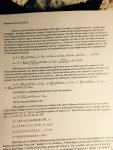
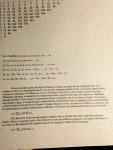
Page 3:
. . . . .\(\displaystyle \sum_{k=0}^{n+1}\, \dfrac{(n\, +\, 1)!}{(n\, -\, k\, +\, 1)!\, k!}\, f(n\, +\, 2\, -\, k)\, =\, 2f(n\, +\, 2),\, p\, =\, 0\)
Probably the most interesting application of this concerns infinitely differentiable functions like sin(c). While this trigonometric function cannot be modeled by a "simple" polynomial, it can be modeled by a polynomial of infinite degree, specifically a Taylor expansion. Because of this I can conjecture that as the limit of n approaches infinity, the expression \(\displaystyle \, \Delta_{n+1}\, \) of an infinitely differentiable function will equal:
. . . . .\(\displaystyle \displaystyle{ \lim_{n\, \rightarrow\, \infty}\, }\) \(\displaystyle \displaystyle{ \sum_{k\, =\, 0}^{n\, +\, 1} \,}\) \(\displaystyle \dfrac{(n\, +\, 1)!}{(n\, -\, k\, +\, 1)!\, k!}\, \sin(n\, +\, 2\, -\, k)\, =\, \lim_{n\, \rightarrow\, \infty}\, 2\sin(n\, +\, 2)\)
And if the limit of the function f(x) as c approaches infinity exists for a specific value, I can predict that the infinite series representation of \(\displaystyle \, \Delta_{n+1,p}\, \) will converge to twice that value for all non-negative integer values of p and zero.
Let \(\displaystyle \, f(c)\, =\, \dfrac{\sin(c)}{c}.\)
Then:
. . . . .\(\displaystyle \displaystyle{ \sum_{k\, =\, 0}^{n\, +\, 1} \,}\) \(\displaystyle \dfrac{(n\, +\, 1)!}{(n\, -\, k\, +\, 1)!\, k!}\, \dfrac{\sin(n\, +\, 2\, -\, k)}{n\, +\, 2\, -\, k}\, =\,\) \(\displaystyle \displaystyle{ \lim_{n\, \rightarrow\, \infty}\,}\) \(\displaystyle \dfrac{2\sin(n\, +\, 2)}{(n\, +\, 2)}\, =\, 2,\, p\, =\, 0\)
I'm pretty good at math. That's why I want to go to college. So I can get even better...
. . . . .\(\displaystyle \sum_{k=0}^{n+1}\, \dfrac{(n\, +\, 1)!}{(n\, -\, k\, +\, 1)!\, k!}\, f(n\, +\, 2\, -\, k)\, =\, 2f(n\, +\, 2),\, p\, =\, 0\)
Probably the most interesting application of this concerns infinitely differentiable functions like sin(c). While this trigonometric function cannot be modeled by a "simple" polynomial, it can be modeled by a polynomial of infinite degree, specifically a Taylor expansion. Because of this I can conjecture that as the limit of n approaches infinity, the expression \(\displaystyle \, \Delta_{n+1}\, \) of an infinitely differentiable function will equal:
. . . . .\(\displaystyle \displaystyle{ \lim_{n\, \rightarrow\, \infty}\, }\) \(\displaystyle \displaystyle{ \sum_{k\, =\, 0}^{n\, +\, 1} \,}\) \(\displaystyle \dfrac{(n\, +\, 1)!}{(n\, -\, k\, +\, 1)!\, k!}\, \sin(n\, +\, 2\, -\, k)\, =\, \lim_{n\, \rightarrow\, \infty}\, 2\sin(n\, +\, 2)\)
And if the limit of the function f(x) as c approaches infinity exists for a specific value, I can predict that the infinite series representation of \(\displaystyle \, \Delta_{n+1,p}\, \) will converge to twice that value for all non-negative integer values of p and zero.
Let \(\displaystyle \, f(c)\, =\, \dfrac{\sin(c)}{c}.\)
Then:
. . . . .\(\displaystyle \displaystyle{ \sum_{k\, =\, 0}^{n\, +\, 1} \,}\) \(\displaystyle \dfrac{(n\, +\, 1)!}{(n\, -\, k\, +\, 1)!\, k!}\, \dfrac{\sin(n\, +\, 2\, -\, k)}{n\, +\, 2\, -\, k}\, =\,\) \(\displaystyle \displaystyle{ \lim_{n\, \rightarrow\, \infty}\,}\) \(\displaystyle \dfrac{2\sin(n\, +\, 2)}{(n\, +\, 2)}\, =\, 2,\, p\, =\, 0\)
I'm pretty good at math. That's why I want to go to college. So I can get even better...