
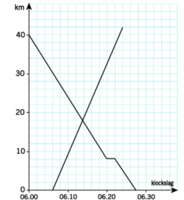
how a commuter train meets the high-speed train X2000. (Km/h)

Yeezboot

New member
Joined
Jan 15, 2021
Messages
6
Skärmbild 2021-01-15 231407.png


The graphs show how a commuter train meets the high-speed train X2000.
Shortly after the meeting, the commuter train does
a short stop at a station.

a) What velocity does the train "X2000" have and what velocity does the commuter train have when the trains meet? Answer in km / h.


b) How far apart are the trains 3.0 seconds in meetings?
 
a) I answered commuter train V= -95km/h and X200 V= 78 km/h

I'm not sure if I'm right but I tried my best.

question b) I'm generally confused and I don't understand the problem/question
 
a) I answered commuter train V= -95km/h and X200 V= 78 km/h

I'm not sure if I'm right but I tried my best.

question b) I'm generally confused and I don't understand the problem/question
Please post your solutions (and read posting guidelines).
For b) please post the exact question. Is it a translation? Could it be "3.0 seconds after they met"?
 
The vertical axis is labelled but not the horizontal axis! Is the horizontal in seconds.

My teachers were either amused or upset with me when on exams I stated that the problem can not be done.

BTW, why is this listed on under probability?
 
@Jomo

I am guessing, but, based on my knowledge of Germanic languages, "klockslag" looks like "clock position" to me ("lag" looking like the Germanic root behind "lie" and "lay" in English.)

The horizontal axis is definitely labeled, almost certainly in hours: minutes..
 
View attachment 24400
The graphs show how a commuter train meets the high-speed train X2000.
Shortly after the meeting, the commuter train does
a short stop at a station.

a) What velocity does the train "X2000" have and what velocity does the commuter train have when the trains meet? Answer in km / h.
b) How far apart are the trains 3.0 seconds in meetings?
First, I find that "klockslag" is Swedish for "hour" (or "time"). I should have known that, as a Peterson who has worked with Swedes in Sweden, but I had to look it up. I presume the times are in "hour.minute", though it could be decimal hours.

a) I answered commuter train V= -95km/h and X200 V= 78 km/h

I'm not sure if I'm right but I tried my best.

question b) I'm generally confused and I don't understand the problem/question

We'll want to see how you got your answers; I get approximately the same answer for the commuter train, but a greater speed for the X2000.

If the problem is in Swedish, pasting the original in here may let us find our own ways to check your translation. Since 3.0 seconds is a very short time, considering the likely inaccuracy of our reading of the graph, I am suspicious of everything about the second question! But the answer, if it means 3 seconds after the meeting, can be found using their relative speeds.
 
@Jomo

I am guessing, but, based on my knowledge of Germanic languages, "klockslag" looks like "clock position" to me ("lag" looking like the Germanic root behind "lie" and "lay" in English.)

The horizontal axis is definitely labeled, almost certainly in hours: minutes..
I have enough trouble with English, now I have to know German. I actually considered that klockslag was unit of time but went against that.
 
I have enough trouble with English, now I have to know German. I actually considered that klockslag was unit of time but went against that.
Well, it was a guess. The actual language is unknown to me: it could be Low German, Dutch, Friesian, Danish, Norwegian, Swedish, Icelandic, or something even less well known like Faroese. (It might possibly be German, but that is unlikely because the old German word for "clock" is "glocke.") In any case, I do not think it is technically a unit of time, but a measurement of time from which one can derive units. It's a clever presentation; it is less abstract than number of units and makes clear the importance of measuring devices in applications of math.
 
Well the actual language was Swedish :D "klockslag" means time or how much the clock ticks

 
Last edited:
Thanks for showing your work.

For the commuter train, you apparently used the points (0 min, 40 km) and (13.9 min, 18 km) and converted the time from 13.9 minutes to 13.9/60 hours, correctly obtaining -22/0.2316 = -94.96 km/h; I had used (0, 40) and (20, 8) to get -32/(20/60) = -96 km/h.

For the X2000, you used (0, 0) and (13.9, 18); but that line doesn't pass through the origin! You should have used (6, 0). I used (6, 0) and (24, 42). I generally look for points that are as close to grid points as possible for accuracy.
 
Top