
How do i solve this problem sum involving differentiation? Thank you guys!

qwert

New member
Joined
Jun 26, 2013
Messages
26
qn  math.jpg

Long question ahead..

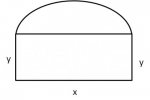
A new fountain is being designed for a large garden. The horizontal cross-section of the fountain occupies a rectangle x meters by y meters together with a semicircle of diameter x meters as shown in the diagram. A low wall will be built around the fountain. The time needed to build the wall will be 4 hours per meter for the straight parts and 10 hours per meter for the semicircular part. Given that the total time of 200 hours is taken to build the wall, find using differentiation, the maximum cross-sectional area.

(Answer according to my book is 75.5m^2)


Can anyone help me with it?

Heres my attempt at it:

straight ---> 4hours /meter
semi-circular ---> 10 hours/meter

Equation i got from the info above:

gif.latex
(4(area of straight wall) +10(area of semicircular wall)) = total time taken to build the entire wall

gif.latex
(simplified to this)

Since max value,
gif.latex


gif.latex


gif.latex


gif.latex


Thank you!
 
A low wall will be built around the fountain.

The time needed to build the wall will be 4 hours per meter for the straight parts and 10 hours per meter for the semicircular part.

Hi qwert:

You need to use perimeters, not areas. Note the red highlighting above. The time needed is stated per meter, not per meter squared.

Also, did they draw that diagram? I'm curious why it shows the diameter of the semicircle. They say that the wall is being built "around" the fountain, not through it. I would expect to see only the one line segment labeled x.

Cheers :)
 
Last edited:
Hi qwert:

You need to use perimeters, not areas. Note the red highlighting above. The time needed is stated per meter, not per meter squared.

Also, did they draw that diagram? I'm curious why it shows the diameter of the semicircle. They say that the wall is being built "around" the fountain, not through it. I would expect to see only the one line segment labeled x.

Cheers :)

Yep! I copied that diagram from the question. Only thing is that my scales are a bit off...the semicircle was supposed to be more of a semicircle..hah.

Anyway, i attempted the qn a few more times and this is what i got. I still got stuck though..

gif.latex
(I tried making an equation for the cross sectional area of the fountain)

gif.latex
( time taken to build straight wall + time taken to build semi-c wall = 200) (here i multiplied the no. of hours with the perimeters of the respective shapes)

gif.latex
(Simplified to this)

Subbing y=... into A=...

gif.latex


Since the qn wants the max area,
gif.latex


gif.latex
(By equating the derivative of A to 0)

....

resulting solutions (which are incorrect :<)

gif.latex


gif.latex


Am i heading in the right direction or am i completely off?

Thank you very much for the help!!:D:D
 
Last edited:
I copied that diagram from the question.

That diagram is misleading. There is no inner wall; only the outer perimeter of the shape is used.


Am i heading in the right direction

Yes!

Remove the top of the rectangle (which you counted twice, by the way), and your answer will match the book's.

In other words, use this equation.

4(x + 2y) + 10(1/2*Pi*x) = 200

See ya :)

PS: I verified the book's answer, by another method
 
Top