I have some integrals to solve for later...

pantentic

New member
Joined
Dec 25, 2015
Messages
1
I have some integrals to solve for later. But the thing is, my math knowledge is meager, so if you could help me out I would be grateful :)

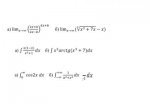
\(\displaystyle a)\, \lim_{x\, \rightarrow\, \infty}\, \left(\, \dfrac{2x\, +\, k}{2x\, -\, b}\, \right)^{kx + b}\)

\(\displaystyle b)\, \lim_{x\, \rightarrow\, \infty}\, \left(\, \sqrt[3]{\strut x^3\, +\, 7x\,}\, -\, x\, \right)\)

\(\displaystyle c)\, \int\, \dfrac{x\, (1\, -\, x)}{x^2\, +\, 1}\, dx\)

\(\displaystyle d)\, \int\, \left[\, x^2\, \arctan(x^3\, +\, 7)\, \right]\, dx\)

\(\displaystyle e)\, \int_0^{\infty}\, \cos(2x)\, dx\)

\(\displaystyle f)\, \int_{-\infty}^{+\infty}\, \dfrac{1}{a^2\, +\, x^2}\, dx\)
 

Attachments
  • Untitled.jpg
    Untitled.jpg
    8.3 KB · Views: 22
Last edited by a moderator:
But the thing is, my math knowledge is meager, so if you could help me out I would be grateful :)

\(\displaystyle a)\, \lim_{x\, \rightarrow\, \infty}\, \left(\, \dfrac{2x\, +\, k}{2x\, -\, b}\, \right)^{kx + b}\)

\(\displaystyle b)\, \lim_{x\, \rightarrow\, \infty}\, \left(\, \sqrt[3]{\strut x^3\, +\, 7x\,}\, -\, x\, \right)\)

\(\displaystyle c)\, \int\, \dfrac{x\, (1\, -\, x)}{x^2\, +\, 1}\, dx\)

\(\displaystyle d)\, \int\, \left[\, x^2\, \arctan(x^3\, +\, 7)\, \right]\, dx\)

\(\displaystyle e)\, \int_0^{\infty}\, \cos(2x)\, dx\)

\(\displaystyle f)\, \int_{-\infty}^{+\infty}\, \dfrac{1}{a^2\, +\, x^2}\, dx\)

What are your thoughts?

Please share your work with us ...even if you know it is wrong

If you are stuck at the beginning tell us and we'll start with the definitions.

You need to read the rules of this forum. Please read the post titled "
Read before Posting" at the following URL:

http://www.freemathhelp.com/forum/th...Before-Posting
 
Last edited by a moderator:
\(\displaystyle a)\, \lim_{x\, \rightarrow\, \infty}\, \left(\, \dfrac{2x\, +\, k}{2x\, -\, b}\, \right)^{kx + b}\)

\(\displaystyle b)\, \lim_{x\, \rightarrow\, \infty}\, \left(\, \sqrt[3]{\strut x^3\, +\, 7x\,}\, -\, x\, \right)\)

\(\displaystyle c)\, \int\, \dfrac{x\, (1\, -\, x)}{x^2\, +\, 1}\, dx\)

\(\displaystyle d)\, \int\, \left[\, x^2\, \arctan(x^3\, +\, 7)\, \right]\, dx\)

\(\displaystyle e)\, \int_0^{\infty}\, \cos(2x)\, dx\)

\(\displaystyle f)\, \int_{-\infty}^{+\infty}\, \dfrac{1}{a^2\, +\, x^2}\, dx\)

a) Writing it as \(\displaystyle \displaystyle \begin{align*} \mathrm{e}^{ \ln{ \left[ \left( \frac{2\,x + k}{2\,x - b} \right) ^{ k\,x + b } \right] } } \end{align*}\) and then applying some logarithm laws will help simplify it to a form where you can use L'Hospital's Rule.

b) I would try rationalising the numerator. The difference of two cubes rule will help.

c) Long divide.

d) \(\displaystyle \displaystyle \begin{align*} \int{ x^2\arctan{ \left( x^3 + 7 \right) } \,\mathrm{d}x } &= \frac{1}{3} \int{ 3\,x^2\arctan{ \left( x^3 + 7 \right) } \,\mathrm{d}x } \\ &= \frac{1}{3} \int{ \arctan{ \left( u \right) } \,\mathrm{d}u } \textrm{ after substituting } u = x^3 + 7 \implies \mathrm{d}u = 3\,x^2\,\mathrm{d}x \end{align*}\)

Do you know how to find the integral of the arctangent function?

e) Is it possible to evaluate the limit of a sine function at infinity?

f) What sort of an integral will this form be?
 
Last edited by a moderator:
a) Writing it as \(\displaystyle \displaystyle \begin{align*} \mathrm{e}^{ \ln{ \left[ \left( \frac{2\,x + k}{2\,x - b} \right) ^{ k\,x + b } \right] } } \end{align*}\) and then applying some logarithm laws will help simplify it to a form where you can use L'Hospital's Rule.

b) I would try rationalising the numerator. The difference of two cubes rule will help.

c) Long divide.

d) \(\displaystyle \displaystyle \begin{align*} \int{ x^2\arctan{ \left( x^3 + 7 \right) } \,\mathrm{d}x } &= \frac{1}{3} \int{ 3\,x^2\arctan{ \left( x^3 + 7 \right) } \,\mathrm{d}x } \\ &= \frac{1}{3} \int{ \arctan{ \left( u \right) } \,\mathrm{d}u } \textrm{ after substituting } u = x^3 + 7 \implies \mathrm{d}u = 3\,x^2\,\mathrm{d}x \end{align*}\)

Do you know how to find the integral of the arctangent function?

e) Is it possible to evaluate the limit of a sine function at infinity?

f) What sort of an integral will this form be?

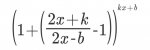
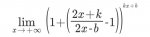
For a) I suggest not to waste time with De L'Hopital's rule. This exercise can be easily solved writing

\(\displaystyle \displaystyle \lim_{x\, \rightarrow\, +\infty}\, \)\(\displaystyle \bigg(\, 1\, +\, \left(\, \dfrac{2x\, +\, k}{2x\, -\, b}\, -\, 1\, \right)\, \bigg)^{kx\, +\, b}\)

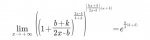
And then using e's limit:

\(\displaystyle \displaystyle \lim_{x\, \rightarrow\, +\infty}\, \)\(\displaystyle \bigg(\, \left(\, 1\, +\, \dfrac{b\, +\, k}{2x\, -\, b}\, \right)^{\frac{2x\, -\, b}{b\, +\, k}}\, \bigg)^{\left( \frac{kx + b}{2x - b} \right)\cdot(\kappa + b)}\, = \, e^{\frac{k}{2}(k + b)}\)
 

Attachments

  • image.jpg
    image.jpg
    13.2 KB · Views: 6
  • image.jpg
    image.jpg
    11.3 KB · Views: 7
  • image.jpg
    image.jpg
    10 KB · Views: 5
Last edited by a moderator:
It was here before so I didn't post anything. Seems gone now, so
\(\displaystyle \left(\, \frac{2x+k}{2x-b}\right)^{kx+b}\)
=\(\displaystyle \left(\, 1\, +\, ( \frac{2x+k}{2x-b}\, -\, 1)\right)^{kx+b}\)
=\(\displaystyle \left(\, 1\, +\, ( \frac{k+b}{2x-b})\right)^{kx+b}\)
=\(\displaystyle \left(\, 1\, +\, \frac{1}{\frac{2x-b}{k+b}}\right)^{kx+b}\)
=\(\displaystyle \left(\, 1\, +\, \frac{1}{\frac{2x-b}{k+b}}\right)^{kx}\) \(\displaystyle \left(\, 1\, +\, \frac{1}{\frac{2x-b}{k+b}}\right)^{b}\)
=\(\displaystyle \left(\, 1\, +\, \frac{1}{\frac{2x-b}{k+b}}\right)^{\frac{2x-b}{k+b}\, \frac{k(k+b}{2}}\) \(\displaystyle \left(\, 1\, +\, \frac{1}{\frac{2x-b}{k+b}}\right)^{\frac{b(2+k)}{2}}\)

Now let
t = \(\displaystyle \frac{2x-b}{k+b}\)
to get
\(\displaystyle \left(\, \frac{2x+k}{2x-b}\right)^{kx+b}\)
=\(\displaystyle \left(1\, +\, \frac{1}{t}\right)^{t\, \frac{k(k+b)}{2}}\) \(\displaystyle \left(\, 1\, +\, \frac{1}{t}\right)^{\frac{b(2+k)}{2}}\)
consider the various cases for k+b less than zero, greater than zero and equal to zero and use
\(\displaystyle \underset{x\, \to\, \infty}{lim}\, (1\, +\, \frac{1}{x})^x\, =\, e\)
 
It was here before so I didn't post anything. Seems gone now, so
\(\displaystyle \left(\, \frac{2x+k}{2x-b}\right)^{kx+b}\)
=\(\displaystyle \left(\, 1\, +\, ( \frac{2x+k}{2x-b}\, -\, 1)\right)^{kx+b}\)
=\(\displaystyle \left(\, 1\, +\, ( \frac{k+b}{2x-b})\right)^{kx+b}\)
=\(\displaystyle \left(\, 1\, +\, \frac{1}{\frac{2x-b}{k+b}}\right)^{kx+b}\)
=\(\displaystyle \left(\, 1\, +\, \frac{1}{\frac{2x-b}{k+b}}\right)^{kx}\) \(\displaystyle \left(\, 1\, +\, \frac{1}{\frac{2x-b}{k+b}}\right)^{b}\)
=\(\displaystyle \left(\, 1\, +\, \frac{1}{\frac{2x-b}{k+b}}\right)^{\frac{2x-b}{k+b}\, \frac{k(k+b}{2}}\) \(\displaystyle \left(\, 1\, +\, \frac{1}{\frac{2x-b}{k+b}}\right)^{\frac{b(2+k)}{2}}\)

Now let
t = \(\displaystyle \frac{2x-b}{k+b}\)
to get
\(\displaystyle \left(\, \frac{2x+k}{2x-b}\right)^{kx+b}\)
=\(\displaystyle \left(1\, +\, \frac{1}{t}\right)^{t\, \frac{k(k+b)}{2}}\) \(\displaystyle \left(\, 1\, +\, \frac{1}{t}\right)^{\frac{b(2+k)}{2}}\)
consider the various cases for k+b less than zero, greater than zero and equal to zero and use
\(\displaystyle \underset{x\, \to\, \infty}{lim}\, (1\, +\, \frac{1}{x})^x\, =\, e\)
Yeah, I don't know why but my answer kind of got deleted.
 
Top