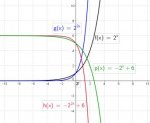
If given function of expotential curve, how do you determine its equation?

CX883

New member
Joined
Jan 29, 2014
Messages
2
I've been spending the past hour over the questions photographed in the link below, and I don't think I am going anywhere. This lovely textbook here does not provide any examples beforehand demonstrating how we students can crack this question.
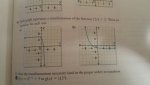
20140128_231515_resized.jpg
Now back on topic, the curves are here. Let's just focus on question 10a.) for now. I got y=-(1/2)^-x+6 as my answer for this question, but the answer page suggests something different. I have no problems finding the vertical transition, that's easy. But it is the stretch/compression factors as well as the reflections which I am having problems trying to find out when I'm only given a simple curve on a graph and am asked to find the equation.

Any math teachers here that can help? My test is on friday so the issue is pretty urgent, and I'd greatly appreciate a response. Thanks!
 
What's the "something different"? Thanks! ;)
 
The answer on the textbook is y=-2^2x+6

Now if you could tell me why that is, that'll be great. Thanks.

Grouping symbols are needed around the exponent:


y = -2^(2x) + 6 \(\displaystyle \ \ \ \) or


\(\displaystyle y \ = \ -2^{2x} + 6\)
 
Why.

I've been spending the past hour over the questions photographed in the link below, and I don't think I am going anywhere. This lovely textbook here does not provide any examples beforehand demonstrating how we students can crack this question.
View attachment 3748
Now back on topic, the curves are here. Let's just focus on question 10a.) for now. I got y=-(1/2)^-x+6 as my answer for this question, but the answer page suggests something different. I have no problems finding the vertical transition, that's easy. But it is the stretch/compression factors as well as the reflections which I am having problems trying to find out when I'm only given a simple curve on a graph and am asked to find the equation.

Any math teachers here that can help? My test is on friday so the issue is pretty urgent, and I'd greatly appreciate a response. Thanks!
exp1.jpg

Note that at y = 0, 2^(2x) + 6 is half the distance from origin as is 2^(x) + 6. That is because by doubling x you get places twice as fast so to speak. The ratio of respective difference of each curve from origin when y = 0 is one way to determine the coefficient to apply to x, i.e how much the function is being stretched or squished with respect to the x axis.

Try:

http://cims.nyu.edu/~kiryl/Precalcu...of Functions/Transformations of Functions.pdf

for illustrations and explanations of how to "move, stretch, squish, and flip graphs". Good luck with your exam.
 
Last edited:
Let's just focus on question 10a.) for now.

I got y = -(1/2)^(-x) + 6

Hi CX883:

The graph is a transformation of y = 2^x

There's no transformation that allows you to change the base from 2 to 1/2.


The answer on the textbook is y = -2^(2x) + 6

Now if you could tell me why that is, that'll be great.

The graph of 2^x needs to be reflected across the x-axis. Multiplying by -1 does that.

You already understand that adding 6 gives the vertical shift.

Multiplying x by a positive constant yields a horizontal expansion or compression (depending on the constant).

That's enough info to get this form:

y = -2^(kx) + 6

for some constant k

To find k, pick a point whose coordinates can be determined from the graph and substitute those values for y and x.

(2,-10) looks like a good choice

Solve for k. :cool:
 
Last edited:
Top